 Joyrise
The Definitive Guide to AI SEO Services (2026)
 By Alexi · · 17 min read

On this page
- Executive Summary: What AI SEO Services Actually Deliver in 2026
- Defining AI SEO: What It Is and What It Isn’t
- How AI SEO Services Work: The Core Components
- The AI SEO Services Landscape: Agency Retainers vs. Software Platforms
- How to Vet an AI SEO Service Without Falling for Repackaged SEO
- AI SEO Implementation: A Practical 5-Step Framework
- 6 Costly AI SEO Myths and Mistakes to Avoid
- The Future of AI SEO Services: Where We’re Headed
- Conclusion and Next Steps
- Key Takeaways
Guide to AI SEO services in 2026: how they work, agency vs. platform pricing, and a self-audit to earn citations in ChatGPT, AI Overviews, and Perplexity.
The Definitive Guide to AI SEO Services (2026)
Executive Summary: What AI SEO Services Actually Deliver in 2026
AI SEO services help your brand appear in AI-powered search results — Google AI Overviews, ChatGPT, Perplexity, and others — by optimizing for the way these models interpret, rank, and cite information. They’re not a replacement for traditional search engine optimization; they’re an expansion. In 2026, these services typically deliver a combination of entity optimization, structured data implementation, content designed for answer engines, and continuous monitoring of how your brand is surfaced in generative outputs.
The market now splits into two clear models: agency retainers that combine AI-focused strategy with human execution, and software platforms that automate much of the content and technical work. This guide gives you a vendor-neutral framework for deciding which model fits your business, how to audit your current AI visibility without spending a dollar, and a checklist to separate genuine AI expertise from repackaged traditional SEO.
Defining AI SEO: What It Is and What It Isn’t
AI SEO, often called generative engine optimization, AI search optimization, or SEO for AI search, is the practice of making your content discoverable and citable by large language models that now answer user queries directly. It’s not about tricking an algorithm with keyword density; it’s about ensuring that when a model constructs an answer, your brand’s information becomes the source — or at least a named recommendation.
What is AI SEO and why do I need it?
AI SEO is the discipline of optimizing your digital presence for retrieval-augmented generation systems — the infrastructure that lets tools like Google AI Mode, ChatGPT with browsing, and Perplexity pull from the web to compose answers. You need it because your customers are bypassing the ten blue links. Google’s own documentation now treats AI features as a core search interface, and Google’s guide to optimizing for generative AI features confirms that traditional SEO signals like structured data and crawlability remain fundamental, but with new relevance in a zero-click context. If you don’t appear when your audience asks a chat interface for a recommendation, you don’t exist for that query.
Is AI SEO different from traditional SEO?
Yes, in focus and measurement. Traditional SEO optimizes for crawling, indexing, and ranking in a list-based search engine results page. AI SEO optimizes for being sourced as an authoritative input in a generated answer. The technical underpinnings — crawlability, site architecture, entity disambiguation — overlap heavily, but execution diverges: you’re now optimizing for how an LLM weights and synthesizes your content, not just for a keyword-targeted page to rank first. The difference is less about silos than about layers; an informed strategy does both simultaneously.
Can AI SEO replace traditional SEO?
No. Traditional SEO builds the crawlable, indexable foundation that AI SEO relies on. If search engines can’t properly understand your site’s entities and content hierarchy, LLMs won’t cite you either. A November 11, 2026 article from Priority Marketing reiterates that SEO remains valuable alongside generative search, recommending a blended strategy. You can think of traditional SEO as the plumbing; AI SEO is the fixture upgrade that makes the water visible to new taps.
Generative Engine Optimization (GEO) vs. Traditional SEO: The Real Relationship
Generative engine optimization (GEO services) is a sub-discipline within AI SEO that specifically targets the algorithms behind generative AI search results. It’s what you practice when you format content for direct answers, build topic clusters that mirror user journeys an AI might follow, and emphasize factual precision and citations. Traditional SEO without a GEO layer still drives traffic from standard blue links, but increasingly those blue links sit below an AI-generated answer block. The two work together: strong traditional SEO earns the authority that lets GEO efforts convert into citations. For a deeper breakdown of their interplay, Is GEO Replacing SEO? No—But It’s Changing Search clarifies that the replacement narrative misunderstands the technical chain.
Commonly Confused Terms: AIO, AEO, GEO, and LLMO
- AIO (AI Optimization) – Broad term for any optimization targeting AI-driven interfaces, often used interchangeably with AI SEO.
- AEO (Answer Engine Optimization) – Older term; focuses on optimizing for featured snippets and voice answers. It’s now absorbed into GEO.
- GEO (Generative Engine Optimization) – Specific to optimizing for text generated by LLMs based on multiple sources. The most precise term for the work that matters in Google AI Overviews and ChatGPT.
- LLMO (Large Language Model Optimization) – Optimization for the behavior of the underlying LLM itself, including training data influence and prompt-based discovery. Often referred to as LLM optimization. Rarely a standalone service; usually part of advanced AI SEO.
What’s the difference between Traditional SEO and AI SEO?
Traditional SEO targets ranking positions for queries on a search engine results page. AI SEO targets whether your brand’s content is selected and correctly attributed when an AI assembles a response. In practice, traditional SEO asks “Where do I rank?” and AI SEO asks “Am I the source the model trusts?” Both require authority signals, but AI SEO adds a layer of content formatting, entity clarity, and monitoring that rankings alone don’t capture.
How AI SEO Services Work: The Core Components
What does the AI SEO or GEO process involve?
A complete AI SEO engagement typically cycles through these stages: auditing current AI visibility across major platforms, performing entity research to define the concepts your brand owns, implementing technical markup (especially schema that clarifies relationships), producing content optimized for answer breadth and citation-worthiness, building authority through consistent digital footprints, and continuously measuring referral traffic and brand mentions from AI-generated responses. The process is iterative because LLM training sources and model weights shift.
Technical Foundations: Structured Data, Entity Optimization, and Crawlability for LLMs
LLMs consume structured data to disambiguate entities and understand relational context. Implementing schema like Organization, WebSite, FAQ, Article, and sameAs links to authoritative knowledge bases (Wikipedia, Wikidata) helps search systems map your brand to a specific entity. Crawlability remains non-negotiable: if your JavaScript-rendered content isn’t accessible to a headless browser that an AI crawler might use, you’re invisible. A technical audit for AI SEO includes verifying that key pages render clean HTML, that entity identifiers are consistent across your site and off-platform mentions, and that you’re not blocking legitimate AI crawlers (e.g., GPTBot, Google-Extended) in robots.txt if you want to be cited.
Content Strategy for AI Search: Entities, Authority, and Answer-Driven Formats
Do keywords still matter, or is it all about entities?
Keywords don’t drive AI citations directly, but the topical authority they’ve historically built still matters. Entities have eclipsed exact-match keywords as the underlying language of search. Your content should be organized around the entities you want to be known for — your product category, your company, the problems you solve — and the language used should naturally include the terms real people ask questions with. LLMs map those terms to entities. A strong strategy covers both: entity-centered hubs that demonstrate deep topical coverage, which in turn shows the model your comprehensive authority. For practical guidance on building entity-based content, the Semrush Generative Engine Optimization guide outlines formats that match answer-engine consumption patterns.
What kind of content performs best in generative search?
Content that is structured for extraction: clear headings, direct answer paragraphs under those headings, supported by citations and original research or data. Formats like definitive guides, comparison tables, and FAQ sections that directly address a specific problem tend to be pulled into AI-generated answers. The content must demonstrate expertise and specificity — broad, generic blog posts rarely get cited because they don’t add unique value an LLM can’t generate from public-domain knowledge. At the operational level, this means investing in original research, case studies, or compiled statistics that no one else has, and presenting them in terse, attributable blocks. AI-generated content can scale this when used as a draft with human oversight, as many AI SEO platforms do, but without a distinct factual contribution, it won’t earn citations.
Monitoring and Measuring Success in a Zero-Click World: Beyond Rankings
How do I measure success in AI SEO if there are no rankings to track?
Track AI referral traffic. Most AI search interfaces now pass a referrer header that identifies the source — Google AI Overviews, ChatGPT (via browser), Perplexity. In Google Search Console, look at impressions from “AI Overview” and “AI Mode” filters where available. Use UTM parameters on key pages to segment traffic from known AI platforms. Beyond clicks, monitor brand mention volume in generative outputs using tools like semrush’s brand monitoring or custom scraping of Perplexity’s API. The metric that matters most: the number of times your brand appears as a cited source in answers that match your high-intent topics, because that correlates directly with referral traffic and downstream conversions.
What’s the difference between being cited and being recommended in AI search?
A citation means your content was used as a source but the user may not see your name unless the model attributes it. A recommendation means the model proactively names your brand as a solution — “You might consider Acme Analytics for that.” Recommendations drive significantly higher click-through, because the user is being directed to you. AI SEO services that prioritize entity clarity, authoritative off-site mentions, and consistent brand representation are more likely to earn recommendations than citations alone.
Will AI Overviews cause a drop in traffic for organic listings?
It depends on the query type. For informational queries where the AI Overview satisfies the need directly, click-through rates to organic listings below the overview have declined. However, for transactional or local intent queries, AI Overviews often include links to multiple providers, and being sourced can increase traffic. The impact is not uniform. An AI SEO service that monitors your category-specific query mix can help you model the traffic shift rather than panic.
The AI SEO Services Landscape: Agency Retainers vs. Software Platforms
Agency-Led AI SEO: What You’re Really Paying For — and When It’s Worth It
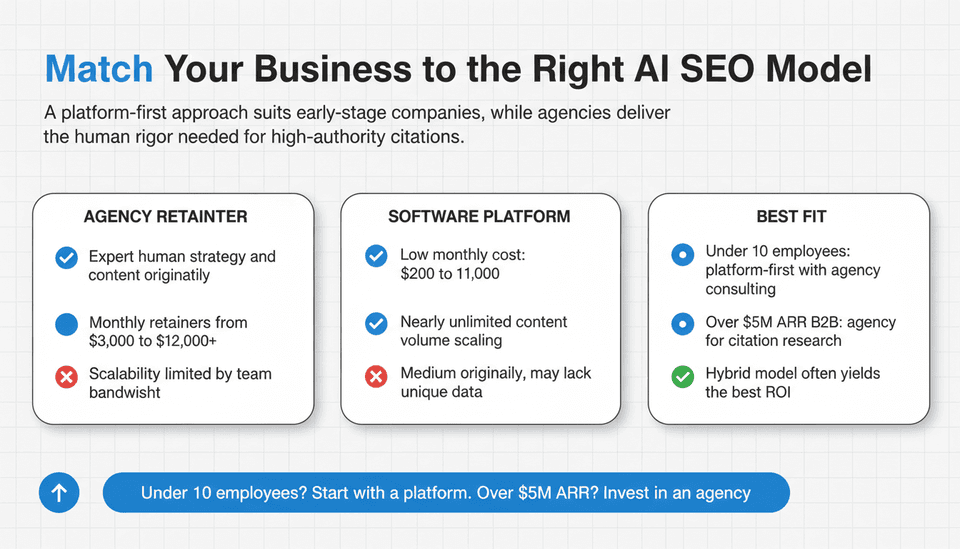
An AI SEO agency typically charges a monthly retainer that covers strategy, entity research, technical implementation, content creation, and ongoing monitoring. Retainers commonly start at $3,000/month for mid-market engagements, with top-tier firms billing $10,000+ per month. You’re paying for human expertise that adapts to model changes, relationships with data providers for entity mapping, and the editorial judgment to produce content that passes LLM quality thresholds. This model works when you have the budget, the in-house SEO team needs specialized augmentation, and your market relies heavily on high-stakes AI answers (legal, medical, complex B2B). The trade-off is speed: human-led content and technical changes take weeks, not hours.
Automated AI SEO Platforms: Speed, Cost, Control, and Realistic Trade-offs
Automated AI SEO platforms combine content generation, technical audits, and publishing workflows into a subscription. Pricing is typically $200–$1,000/month for hundreds of AI-generated, optimized articles. These platforms excel at scaling automated SEO content production, maintaining consistent entity-focused schema, and rapid iteration. The realistic trade-off is brand voice fidelity and true originality. While quality-assessment AI layers (like Joyrise’s second-pass quality judge) can improve output, fully automated content rarely produces the proprietary insights that earn top-tier citations. The model suits businesses that need to populate a large content footprint efficiently, especially in less competitive verticals or as a supplement to in-house strategic content. If your aim is to be cited as the leading authority in a dense knowledge space, a platform alone may not suffice without human editorial oversight.
How much does an AI SEO agency cost?
Agency retainers for AI SEO services typically range from $3,000 to $12,000 per month, depending on the scope of entity research, content volume, and technical integration required. Some boutique agencies offer project-based assessments starting around $5,000. The cost reflects the expertise needed to manually map entities, build authority through outreach, and continuously refine content as models change — tasks that are not yet fully automatable.
A Decision Framework: Choosing the Right Model for Your Business Stage and Resources
| Factor | Agency Model | Software Platform |
|---|---|---|
| Monthly cost | $3,000–$12,000+ | $200–$1,000 |
| Time to first results | 3–6 months for visible AI citations | 1–3 months for initial content indexing and monitoring |
| Content originality | High (human-written or heavily edited) | Medium (AI-generated, can lack unique data insight) |
| Technical precision | High (dedicated developer time) | Moderate (automated but may miss edge cases) |
| Scalability | Limited by team bandwidth | Nearly unlimited within subscription cap |
| Best fit | Complex B2B, high-authority sectors, large brands | Early-stage companies, content-hungry niches, Webflow users scaling blogging |
| Hidden cost | Coordination overhead, slower publishing | Quality degradation if unmonitored, potential duplication flags |
If you have fewer than 10 full-time employees and need to establish topical authority fast, a platform-first approach with occasional agency consulting on entity strategy often yields the best ROI. For example, an AI SEO platform like Joyrise can automate daily illustrated articles directly to a Webflow blog with built-in SEO compliance, while a separate agency audit ensures the entity map is accurate. Conversely, a $5M ARR B2B SaaS company in a technical niche should budget for an agency that can produce citation-worthy research and build editorial backlinks, using a platform only to support lower-tier content.
For more on the distinction between AI SEO companies, What Are the Best AI SEO Companies? Platforms vs. Agencies gives a side-by-side of pricing and deliverables.
How to Vet an AI SEO Service Without Falling for Repackaged SEO
How do I know if an AI SEO agency is just repackaging old content services?
Ask them to walk you through how they would improve your brand’s presence in a specific query on ChatGPT or Perplexity, not just Google rankings. A genuine AI SEO provider can show you concrete examples of entity optimization, schema they’d implement, and how they’d monitor AI referral traffic. If their answer revolves around “better content” and “more backlinks” without mentioning structured data for LLMs, retrieval mechanisms, or citation monitoring, they’re likely repackaging traditional SEO. Also check if they understand the difference between Google’s AI Overviews and AI Mode — many do not.
7 Questions to Ask Before You Sign a Contract or Subscription
Use this checklist in every vendor conversation:
- “Show me a current client’s AI referral traffic trend and attribution method.” If they can’t, they aren’t measuring what matters.
- “How do you handle entity disambiguation and which knowledge bases do you connect to?” Look for mentions of Wikidata, schema.org/Organization, and sameAs links.
- “What’s your process when Google or OpenAI changes its crawling or citation policy?” They should have a monitoring protocol, not just “we’ll adjust.”
- “How do you produce content that earns AI citations beyond what existing top-ranking pages provide?” They need a method for injecting original data, expert quotes, or unique frameworks.
- “Do you have a stance on blocking or allowing AI crawlers?” A thoughtful answer shows they understand the trade-off between training data use and citation opportunity.
- “Can you give me an example where a client’s AI visibility improved without a corresponding rank increase for a target keyword?” This separates GEO work from traditional SEO boats that rose.
- “What’s the one metric you use to judge your own AI SEO performance?” If they say “rankings,” walk away.
AI SEO Implementation: A Practical 5-Step Framework
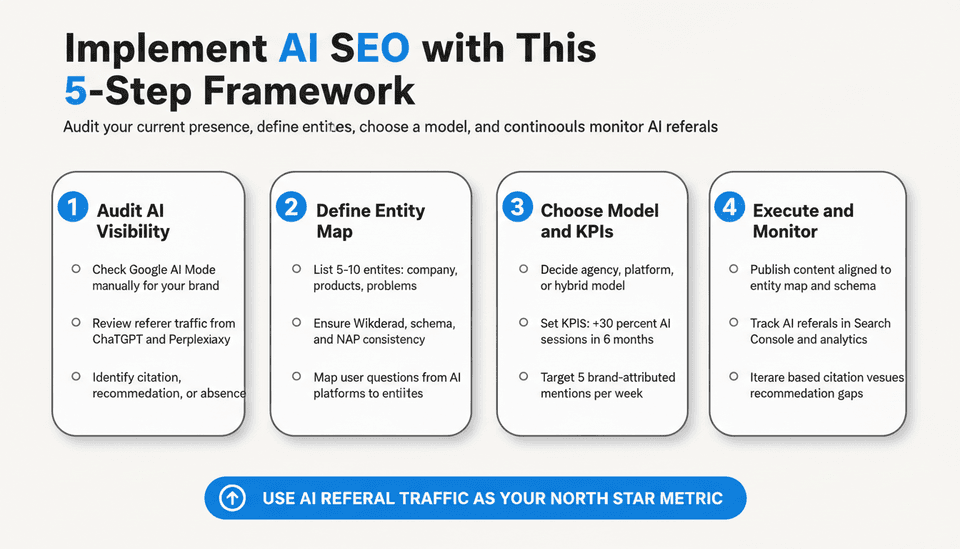
Step 1: Audit Your Current AI Visibility Before You Spend Anything
How do I access Google AI Mode?
Google AI Mode is accessible via Google Labs in the US as of late 2026 (availability may vary by region). You can enable it in Chrome’s experimental settings or visit labs.google.com to turn on AI features. Once enabled, search queries that trigger the mode will show an AI-generated summary. Use this to manually test your brand’s presence on your key queries: search for your product category, your brand, and competitor brands. Note whether you’re cited, recommended, or absent.
How do I know if my target market is using AI to find businesses?
Check your analytics for referrer traffic from chat.openai.com, perplexity.ai, and Google AI Overviews (look for a /ai-overview referrer). In Google Search Console, filter by search appearance “AI Overview.” If you see impressions from these sources, your audience is already using them. For B2B, session recordings and micro-surveys can reveal how prospects discover you, but the technical referrer data is the hardest signal.
Step 2: Define Your Entity Map and Content Gaps for Multi-Platform LLMs
List the 5–10 entities that define your business: your company, products, key people, locations, and the problems you solve. For each entity, identify whether a Wikipedia or Wikidata page exists, how consistent NAP (name, address, phone) is across structured citations, and whether your site’s schema unambiguously connects these nodes. Then map the questions each platform’s users ask about those entities. You can extract these from Perplexity’s “People also asked” equivalents, Google’s “AI Mode” queries, and ChatGPT’s prompt patterns. Gaps become your content briefs.
Step 3: Choose Your Service Model and Set Realistic KPIs
Based on the decision framework above, decide whether you’ll use an agency, a platform, or a hybrid. Define KPIs that reflect AI visibility: increase in AI referral sessions by 30% in 6 months, brand-attributed mentions up from 0 to 5 per week on target queries, and a 15% lift in non-branded organic traffic from content hubs (since better entity authority lifts traditional SEO too).
Step 4: Execute and Optimize — Continuously Improving for AI Overviews and Chatbots
If using a platform, configure it to produce content around your entity map, ensuring schema is auto-generated and internal linking surfaces your cornerstone content. If using an agency, they should produce a quarterly cycle of content, technical enhancements, and citation monitoring. For both, treat AI SEO as a continuous improvement loop: publish, monitor AI referral patterns, identify topics where you’re cited but not recommended, then refine the content to add more definitive, unique value.
Step 5: Build Your Feedback Loop Using Search Console and AI Referral Tracking
Set up a dashboard that combines:
- Google Search Console data for “AI Overview” impressions and clicks.
- Custom segment in Google Analytics for AI referrer traffic.
- Weekly spot checks on Perplexity and ChatGPT for your top 10 entity-related questions.
- A simple spreadsheet tracking each time your brand appears in an answer, with context. This loop lets you quantify ROI even when clicks are sparse: a recommendation that appears in 500 AI searches per month might only generate 50 clicks, but those 50 come with high purchase intent. The value is in the intent, not the volume.
6 Costly AI SEO Myths and Mistakes to Avoid
- Myth: You can just block AI crawlers and ignore AI SEO. That protects your content from being used to train models, but it also makes you invisible to any answer engine that relies on real-time retrieval. There’s a nuanced decision here — understand the trade-off.
- Myth: AI-generated content alone will earn AI citations. LLMs evaluate content authority based on signals that AI-generated articles lack unless human-curated, like external citations and unique datasets. Purely automated content often gets ignored.
- Myth: You need to be on every AI platform. Focus on where your audience is — Google AI Mode dominates general consumer queries, ChatGPT for developer and professional searches, Perplexity for research workflows.
- Mistake: Neglecting core Web Vitals because “AI doesn’t care about page speed.” Sluggish sites reduce crawl efficiency and user engagement, indirectly hurting the authority signals that contribute to AI rankings.
- Mistake: Treating AI SEO as a project with an end date. Model updates and shifting interfaces demand ongoing adaptation; a one-time audit loses relevance fast.
- Mistake: Measuring AI SEO solely by organic traffic changes. Attributing traffic shifts to AI SEO requires isolating AI referral sources; otherwise you’ll confuse correlation with causation when traditional SEO work also lifts rankings.
For a reality check on AI-generated content quality, How Good Is AI for SEO? A No-Hype 2026 Reality Check details what actually works.
The Future of AI SEO Services: Where We’re Headed
The SEO services market is now shaped by AI-powered results, as noted in Search Engine Land’s statistics report (November 12, 2026), and we’re seeing vertical-specific AI SEO services emerge. Just this month, Solutionarian Marketing expanded AI search services for contractors (The Courier-Journal, November 10, 2026) and Local Site Stack launched a done-for-you website and local SEO service for contractors nationwide (Yahoo Finance, November 12, 2026), signaling that local businesses can no longer ignore the AI channel. Expect the next 12 months to bring tighter integration between structured data and LLM training corpora, more nuanced AI referral attribution tools, and a shift from “rankings” to “share of model voice” as the primary competitive metric.
Conclusion and Next Steps
Is AI SEO worth it for smaller or earlier-stage B2B companies?
Yes, but start lean. A $200/month AI SEO platform can build foundational entity clarity and content volume that traditional SEO would cost 5x to achieve. The key is to focus on becoming the best answer for a narrow set of high-intent queries your prospects ask in AI interfaces. Even without an agency, you can manually monitor your presence on ChatGPT and Google AI Mode and iterate.
How long does it take to see results from AI SEO?
Initial entity mapping and content publication can produce measurable AI referrals within 2–3 months, but earning a recommendation over a citation often takes 6–12 months of consistent authority building. The timeline shortens if you have an existing strong traditional SEO foundation.
How do traditional SEO and AI SEO work together?
Think of them as a feedback loop: traditional SEO builds the authority and crawl infrastructure; AI SEO formats and monitors for generative surfaces. The content you optimize for AI also earns more organic rankings, and the backlinks you earn for traditional SEO increase the likelihood of being cited by LLMs. You don’t split budget — you sequence it.
Can AI SEO help with branded search?
Absolutely. When someone searches for your brand in a generative interface, AI SEO ensures the model accurately represents your offerings, locations, and latest achievements. Many AI SEO services handle brand SERP control as a baseline, pushing down inaccurate or outdated summaries.
Key Takeaways
- AI SEO is not a replacement for traditional SEO; it's a parallel discipline that requires both foundational crawlability and entity-focused content.
- Vet providers by asking for AI referral traffic data and a demonstration of entity disambiguation, not just content promises.
- The choice between an agency and a platform depends on your budget and authority needs — a $200/month platform can handle scale, but a $5k agency retainer delivers the human editorial rigor that wins recommendations.
- Start with a free self-audit of your brand’s presence in Google AI Mode and ChatGPT before paying anyone, and use AI referral traffic as your north star metric.
- Automated content works for quantity, but earning AI citations demands original data and human editorial judgment that platforms alone rarely supply.
If you’re ready to see how an automated AI SEO platform can publish daily, illustrated articles to your Webflow blog — complete with entity-aware schema and built-in AI visibility monitoring — try Joyrise by reading your first article before you pay.