 Joyrise
AI SEO Ranking: A Complete Guide to AI-Driven Search Success
 By Alexi · · 12 min read

On this page
- What is AI SEO ranking?
- The Core Components of an AI SEO System
- How AI SEO Tools Actually Improve Rankings
- Build vs. Buy: Tools, Services, or Automated Platforms?
- A Practical Implementation Framework
- 5 AI SEO Ranking Myths That Waste Budget
- AI SEO and the Future of Search Visibility
- Direct Answers to Common AI SEO Ranking Questions
- Conclusion: Your AI SEO Ranking Roadmap
- Key Takeaways
AI SEO ranking is the practice of building a measurable system that uses AI to research topics, produce and optimize content, publish it, and track visibility across Google and AI answer engines. Most guides stop at tool roundups. This one gives you a systems-level framework—including what changed in rank tracking this month and how to run AI content production without sacrificing quality.
If you take away three ideas, take these: AI SEO ranking is a workflow, not a single tool; rank tracking is now directional because of Google data issues; and AI visibility requires separate measurement from traditional rankings.
What is AI SEO ranking?
AI SEO ranking is the measurable outcome of an AI-supported workflow that improves where a page appears in traditional search results and in AI-generated answers. It spans automated keyword research, content generation, on-page optimization, technical monitoring, and AI visibility tracking. This guide focuses on content-led organic search, not paid search or local maps.
A few terms get confused. AI content optimization means adjusting a page for ranking signals such as headings, entities, and internal links. AI search visibility means showing up in AI answer engines such as Google AI Overviews, ChatGPT, or Perplexity. LLM visibility is narrower: whether a language model can retrieve and surface your brand. Automated SEO content is content produced and published through a repeatable machine-plus-human pipeline. For a deeper comparison of LLM and GEO, see What is the difference between LLM and GEO?.
AI SEO ranking is a workflow, not a single tool.
The Core Components of an AI SEO System
Every AI SEO system, whether built from point tools or run on a platform, has four components.
AI-Powered Keyword Research and Opportunity Analysis
AI tools can process Search Console queries, competitor sitemaps, and review sites to cluster keywords by intent, find gaps where your site has topical authority but no page, and grade opportunity. The useful output is not a 5,000-row export. It is a short list of clusters ranked by whether one article and one internal link can actually win the query. Keyword lists only create leverage when they are tied to a page you can actually rank for.
Automated Content Generation and Optimization
The content engine takes a brief and produces drafts with headings, meta descriptions, table of contents, and internal links. AI content optimization then aligns the draft with entity coverage and search intent. Brand voice controls matter here. A B2B finance firm might feed the model compliance language, audience pain points, and forbidden claims before generation. Without those constraints, the output is generic. Automation without a brand voice control produces interchangeable posts that rank nowhere for long.
Technical SEO Audits and Monitoring
AI scans for crawl issues, broken links, missing structured data, and slow pages. A recent example of why audits need fresh context: Search Engine Journal reported on November 7, 2026 that a Google Lighthouse update altered PageSpeed lab scores, meaning a page can now show a different lab score despite no site changes. Technical SEO reports are only as current as the last scan, and Google just moved the scoreboard.
Rank Tracking and AI Visibility Measurement
AI SEO ranking tools increasingly bundle keyword discovery, site audits, and AI visibility monitoring. Traditional rank tracking has become less precise. According to Search Engine Journal's November 7, 2026 report, Google rank data may now include one-word results and redirect URLs, which makes average position noisier. On the AI side, Mashable covered a lifetime SEOAgent subscription on November 9, 2026 that bundles Google rankings and AI visibility tracking for a single site, and PCMag reported on November 10, 2026 that the deal includes keyword discovery, website auditing, and AI-driven visibility monitoring for $69 one time. That is a signal the market now treats AI visibility as a core metric, not a side experiment.
Rank tracking is now a directional signal, not a precise scoreboard.
How AI SEO Tools Actually Improve Rankings
AI does not create authority out of nothing. It reduces the cost of consistency, speeds up research, and enforces structure. Ranking still follows quality signals.
From Keyword List to Ranked Article: The Data Flow
A standard automated SEO content flow looks like this: Search Console and competitor data feed an opportunity model; that model produces a brief; the brief becomes a draft; optimization adds entities, headings, and links; a quality pass catches errors; publishing triggers indexing; tracking feeds the next cycle. For example, a SaaS company targeting "accounts receivable aging report" might use AI to classify the query as informational, draft an article that answers the question in the first 80 words, add internal links to product and glossary pages, then publish directly to the CMS. The ranking gain comes from matching intent and shipping a complete page faster than a manual process, not from a hidden algorithm trick. For a deeper workflow guide, see How to Build Workflows With ChatGPT (2026 Guide).
The Role of Entity Understanding and Search Intent
Modern search is entity-based. AI tools can map products, people, locations, and concepts in a draft to the entities Google and LLMs associate with a query. Intent classification matters more than keyword density. An informational query should not lead to a product page, and a transactional query should not get a definition. As Google's guide to optimizing for generative AI features makes clear, content should be people-first and demonstrate experience, expertise, authoritativeness, and trustworthiness. If the page does not match the intent, no amount of AI optimization will save it.
Quality Signals: What Google Still Rewards
Google rewards usefulness, originality, and page experience, not whether a human typed every word. The Google AI content guidelines are explicit: content created primarily to manipulate search rankings violates spam policies regardless of how it was produced. The practical bar is whether a subject-matter expert would call the page correct and useful. AI can help meet that bar by ensuring complete coverage, but the final judgment remains editorial.
Google rewards usefulness, originality, and page experience—not whether a human typed every word.
Build vs. Buy: Tools, Services, or Automated Platforms?
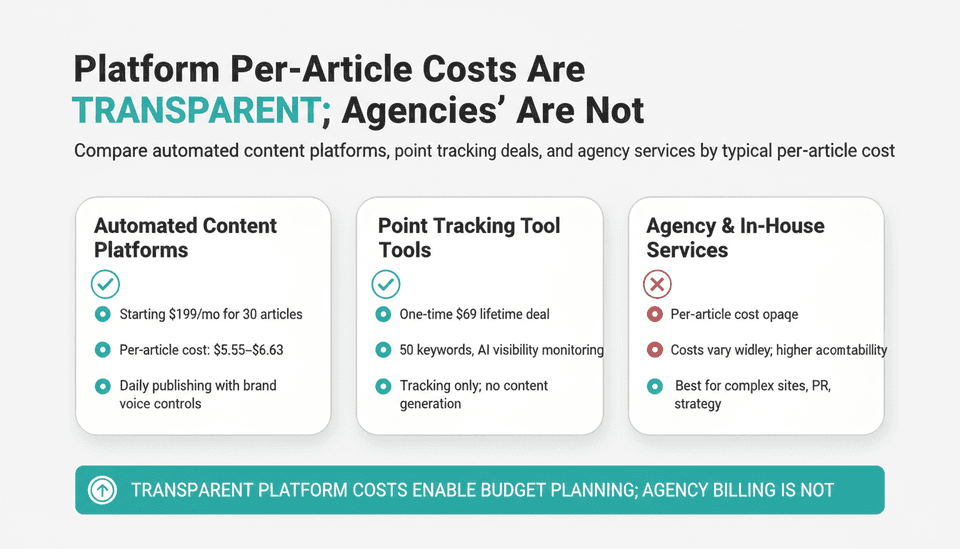
There are three real options for AI SEO implementation.
Point Solutions and Tool Stacks
Point solutions include Semrush or Ahrefs for research, Surfer for on-page optimization, and Writesonic or similar tools for drafting. The SEOAgent lifetime deal covered by Mashable and PCMag shows how point tracking can now be acquired cheaply, but content generation and publishing still require other tools. A point solution solves one step; a system is what ranks pages. Point stacks offer control and configurability, but someone has to maintain the integrations and quality checks.
Managed AI SEO Services
Managed services add human strategy and oversight on top of AI tooling. On November 6, 2026, Yahoo Finance reported that Myna Marketing launched AI SEO services in Hawaii to help local businesses adapt as consumers shift to AI-powered search platforms. The tradeoff is predictable: high touch, higher cost, slower turnaround, but more accountability. This option fits complex sites with regulatory risk or brand sensitivity.
End-to-End AI Content Platforms
End-to-end platforms plan, write, optimize, and publish content on a subscription basis. The typical unit is daily illustrated articles published directly to a Webflow blog, with Search Console integration and a second AI quality pass. The tradeoff is less custom control than an in-house stack, but the per-article cost drops sharply. End-to-end platforms win on unit cost and consistency; they lose on deep customization.
Cost Comparison: In-House, Agency, and AI Automaton
The table below uses public pricing from an automated content platform as a baseline. Other options vary widely.
| Option | Starting price | Typical output | Per-article cost | Best for |
|---|---|---|---|---|
| Automated content platform, Basic | $199/month | 30 articles/month | $6.63/article | Webflow teams testing scaled content |
| Automated content platform, Pro | $499/month | 80 articles/month | $6.24/article | Teams wanting research and quality review |
| Automated content platform, Max | $999/month | 180 articles/month | $5.55/article | Sites wanting near-daily publishing |
| SEOAgent lifetime tracking | $69 one-time | 50 keywords, 1 site, AI visibility monitoring | N/A | Solo operators watching rank and AI mentions |
| In-house SEO hire | Varies | Varies | Varies | Teams needing strategy across channels |
| Traditional SEO agency | Varies | Varies | Varies | Complex sites, PR, technical overhauls |
Platform per-article costs are transparent; agency unit costs are not.
A Practical Implementation Framework
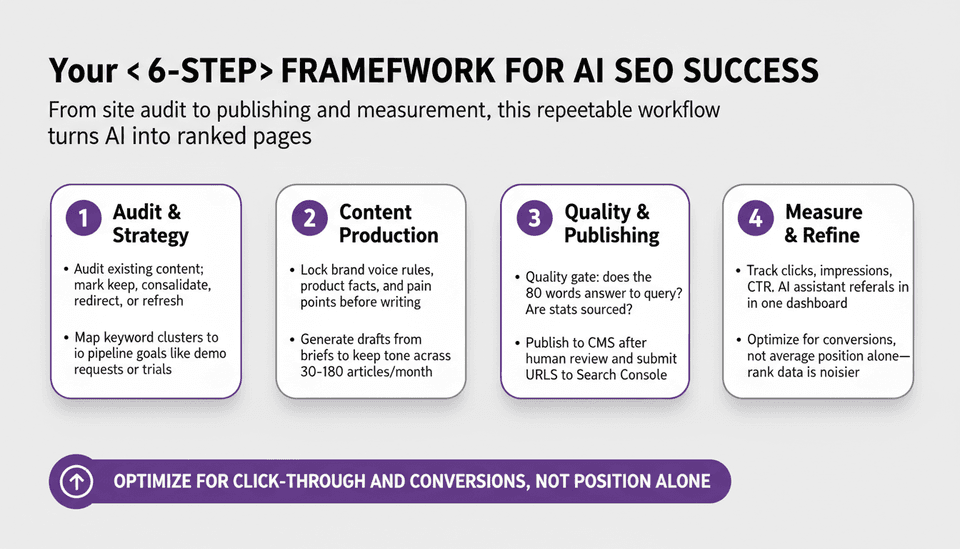
This is the operating system that turns AI SEO tools into ranked pages.
Step 1: Deep Site and Competitor Analysis
Run an AI-powered scan of your existing content, product pages, brand voice, and top competitors. The deliverable is a content inventory map plus 20 to 30 competitor URLs where you have a realistic gap. Example: feed your top 50 pages into an AI content quality audit and mark every page as keep, consolidate, redirect, or refresh.
Step 2: Keyword Strategy Anchored in Business Goals
Softer keyword volume is not a strategy. Map each cluster to a business outcome: demo request, trial signup, sales-qualified lead, or brand defensibility. The AI SEO strategy document should answer one question for every target: if this page ranks, what happens in the pipeline? Volume without commercial relevance is a vanity metric.
Step 3: AI Content Production with Brand Voice Controls
Before generating, lock these inputs:
- Brand voice rules in three to five plain-language sentences
- Product facts and claims that are approved
- Audience pain points the article must address
- Internal linking rules for at least two target pages
Then generate from the brief, not from a blank prompt. This keeps tone consistent across 30 or 180 articles per month.
Step 4: Quality Assurance and Human-in-the-Loop Editing
Use a quality gate before anything publishes. A practical checklist:
- Does the first 80 words answer the query?
- Is every statistic sourced or removed?
- Would a subject-matter expert say this is correct?
- Are there at least two natural internal links?
- Are headings specific and search-relevant?
- Are there any hallucinated product claims?
A second AI pass can catch style and structure issues. A human still reviews for brand risk and factual claims. If a draft could be published under any brand, it has failed the quality gate.
Step 5: Automated Publishing and Indexing
Publish directly to Webflow or hold drafts for approval. Automated publishing reduces the gap between research and indexation, but it should sit behind the quality gate. Submit new URLs in Google Search Console immediately after publishing.
Step 6: Ranking and Traffic Measurement Refinement
Track clicks, impressions, CTR, average position, and AI assistant referrals in one dashboard. Because rank data may include one-word results and redirect URLs, an average position can fall while real clicks rise. Review weekly, but judge on click-through and conversions. Optimize for click-through and conversions, not position alone.
5 AI SEO Ranking Myths That Waste Budget
Myth 1: AI Content Is Penalized by Google
Google does not penalize content simply because AI produced it. It penalizes spammy scaled content, low value, and manipulation. The Google AI content guidelines make that distinction. AI-generated content is not penalized; spammy scaled content is.
Myth 2: You Need a Different Tool for Every Task
Tool creep inflates AI SEO cost without improving output. Many point tools overlap on keyword research, audits, and tracking. The SEOAgent lifetime deal reported by Mashable and PCMag shows that tracking and AI visibility can be bundled in one cheap product. Most teams need three tools, not fifteen.
Myth 3: AI SEO Is Set-and-Forget
Search changes, competitors publish, and Google updates reframe measurements. A Lighthouse change in November 2026 altered PageSpeed lab scores without any site edit. Autopilot content decays. AI SEO strategy requires a weekly or monthly refinement loop.
Myth 4: More Content Always Means More Traffic
Scaling from 30 to 180 articles only works with a topical map and internal linking discipline. Without it, new pages cannibalize old pages and dilute authority. Publishing volume without a topical map just creates more pages to lose with.
Myth 5: AI Search Visibility Is Just a Buzzword
On November 11, 2026, Car Dealership Guy News reported that a BMW dealership general manager built a custom tool to rank all 349 U.S. BMW stores on AI visibility. That is a local operator, not a tech vendor, tracking whether AI engines surface specific store names. AI visibility is already measured by local operators—that makes it real.
AI SEO and the Future of Search Visibility
Optimizing for LLMs and AI Answer Engines
LLMs retrieve from the open web and cite sources. They favor clear structure, direct answers, and authoritative entities. Optimizing for them does not require abandoning SEO. It means tightening your pages, adding complete entity context, and giving LLMs a clean reason to cite you. For the strategic shift, see Is GEO Replacing SEO? No—But It’s Changing Search.
The Rise of LLMs.txt and Structured Data for AI
LLMs.txt is an emerging file that gives AI crawlers a plain-language guide to your site. For most sites, structured data, clear titles, and well-scoped headings matter more today. LLM visibility is still built on the same foundation as search visibility: discoverable, citable pages with clear answers.
Navigating Rank Data Unreliability and AI Training Opt-Outs
Search Engine Journal reported on November 7, 2026 that Google rank data may now include one-word results and redirect URLs, and that a shared AI training opt-out robots.txt control is under discussion. The rank data issue means average position is less reliable as a KPI. The training opt-out discussion means a single robots.txt choice may soon affect whether AI crawlers can train on your content and, potentially, how often you appear in AI answers. Do not choose an opt-out without understanding that tradeoff. Treat rank tracking as directional and add AI citation monitoring.
Direct Answers to Common AI SEO Ranking Questions
What is AI SEO ranking?
It is the measurable result of an AI-supported workflow that improves where pages appear in Google and whether they appear in AI-generated answers.
How can AI tools improve search rankings?
They reduce research time, enforce intent matching, scale content production, and catch technical issues faster, but ranking gains still depend on usefulness, authority, and relevance.
What are the best AI SEO content optimization tools?
In 2026 tool tests, Surfer, Semrush, Ahrefs, and Writesonic are frequently cited, but the best tool depends on whether you need research, on-page optimization, or full content production. The right question is which three tools form a system, not which one wins a listicle.
Can AI tools help with AI search results?
Yes. They can track AI visibility, structure content for citation, and monitor whether ChatGPT, Google AI Overviews, or Perplexity mention your brand. This is a separate measurement layer from traditional rank tracking.
Do I need an LLMs.txt file?
Not today for most sites. Structured data, clear headings, and direct answers matter more. LLMs.txt is worth testing if you control a large content library and want to guide AI crawlers explicitly.
How do I integrate AI SEO tools with Google Search Console?
Connect Search Console to your tracking dashboard, export query and page data into keyword research, submit new URLs after publishing, and monitor clicks, impressions, CTR, and AI assistant referrals in one place.
How much do AI SEO tools and services cost?
Automated content platforms start around $199 per month for 30 articles, with per-article costs between $5.55 and $6.63 in public pricing. Point tools like SEOAgent can cost $69 one time for tracking. Agencies and in-house hires vary widely.
Is AI-generated content safe for SEO?
Yes, if it is useful, accurate, and not produced to manipulate rankings. Google's spam policies target scaled abuse and low value, not the production method.
How do I choose between an AI tool and an SEO service?
Choose an AI tool or platform when you need consistent, low-cost content and own the subject matter. Choose a managed service when you need strategy across channels, high accountability, or help with high-risk editorial content.
What are the common mistakes with AI SEO?
Publishing AI drafts without human quality gates, treating rank tracking as precise, confusing output volume with traffic, ignoring AI visibility, and buying a different tool for every task. The system matters more than any single tool.
Conclusion: Your AI SEO Ranking Roadmap
Start with a deep site and competitor analysis. Anchor keywords to pipeline goals. Produce content with brand voice controls, run every draft through a quality gate, publish automatically, and measure clicks plus AI citations. Rank tracking is directional now, so build AI SEO implementation around what actually drives revenue: useful pages, clear intent match, and citable brand context.
Key Takeaways
- AI SEO ranking is a repeatable system, not a single tool, and it fails without brand voice controls and human quality gates.
- Google rank data is noisier now, so track clicks, conversions, and AI visibility alongside average position.
- Per-article costs for automated content platforms are transparent and dramatically lower than most agency retainers on a unit basis.
- AI-generated content is safe when it is useful and accurate; spammy scaled content is the actual risk.
- AI search visibility is real, measurable, and already being tracked by local operators, not just enterprise SEO teams.
Ready to replace manual blogging and fragmented point tools? Sign up for Joyrise and read your first article before you pay.