 Joyrise
AI SEO vs Traditional SEO: Which Actually Wins in 2026?
 By Alexi · · 14 min read

On this page
- The Verdict: AI SEO vs Traditional SEO in 2026
- How We Compared the Two Approaches
- Side-by-Side: AI SEO vs Traditional SEO
- What Each Actually Costs
- Strengths, Weaknesses, and Limitations
- Recommendations by Use Case
- The Metric Shift: From Rankings to AI Recommendations
- Brand Authority: The New Battleground for AI Visibility
- The Rise of GEO: Optimizing for AI Answers
- How to Vet an AI SEO Tool (Without Getting Burned)
- What Is Traditional SEO vs. AI SEO?
- Do You Need Both SEO and AI SEO?
- What Actually Changes When You Incorporate AI SEO into Your SEO Work?
- How Do I Optimize for AI Overviews?
- Is Traditional SEO Dead?
- What's the ROI Timeline for AI SEO Efforts?
- Will AI Replace Traditional Search Engines?
- How much does AI SEO cost compared to traditional SEO?
- Key Takeaways
If you’re evaluating AI SEO vs traditional SEO right now, you’re not just choosing between tools — you’re deciding how to operate in a market where AI assistants like ChatGPT, Google AI Overviews, and Perplexity are rapidly replacing the search box. The old playbook — manual keyword research, agency retainers, monthly ranking reports — is colliding with a new reality: speed, cost, and measurement have shifted overnight. This article breaks down the choice with real pricing, recent news on brand authority and generative engine optimization, and a direct verdict based on use case.
The Verdict: AI SEO vs Traditional SEO in 2026
When AI SEO is the clear choice
You should run with AI SEO if you:
- Need to publish daily content at scale without a full editorial team
- Operate a startup or SMB where a monthly agency retainer would break the budget
- Already use Webflow and want content published automatically
- Care about capturing AI assistant referrals, not just traditional rankings
For these scenarios, AI SEO delivers speed and consistency that manual processes can’t match.
When traditional SEO still wins
Stick with a traditional agency or in-house SEO team when:
- You’re in a regulated industry (finance, pharma, legal) where claims require legal review
- Your SEO depends on deep technical audits, custom tooling, and backlink strategy that AI can’t yet replicate
- You prioritize personal relationships for outreach and PR link-building
Traditional SEO is still the safer bet when human strategy, nuance, and accountability outweigh speed.
The decisive tradeoff: speed and cost vs. human strategy
The core tradeoff is straightforward: AI SEO trades some strategic nuance for a 10x cost advantage and near-instant publishing. You get 80-90% of the output quality at 10% of the price, but you surrender the deep, bespoke thinking a seasoned agency brings to tricky markets.
How We Compared the Two Approaches
Comparison criteria: cost, speed, quality, measurement, scalability
We evaluated AI SEO and traditional SEO on five factors a business owner or finance lead cares about: total monthly cost, speed to first measurable traffic, content quality with human oversight, ability to scale production, and how each tracks success in an AI-driven search landscape.
Evidence used and its limitations
This comparison draws on:
- Publicly listed pricing from Joyrise, an AI SEO platform, and multiple agency pricing guides (eesel.ai, Konstruct Digital, Qoulomb, Infinenetech, SEO.ai, Percepture, Arc4)
- Recent news reports from Search Engine Land, The Hype Magazine, and Modern Ghana (all dated November 12–16, 2026)
- Industry documentation on generative engine optimization and brand authority
We have not conducted original research. The cost scenarios use real plan numbers from Joyrise and typical agency retainer ranges from published sources. Numbers will vary by vendor, location, and scope.
Disclosure: this article is published by Joyrise, an AI SEO platform
Joyrise provides automated content marketing that plans, writes, and publishes daily SEO articles to Webflow blogs. This article references Joyrise in the pricing comparison and Webflow use case because it’s the concrete AI SEO tool the author knows best. No other vendor paid or influenced this analysis.
Side-by-Side: AI SEO vs Traditional SEO
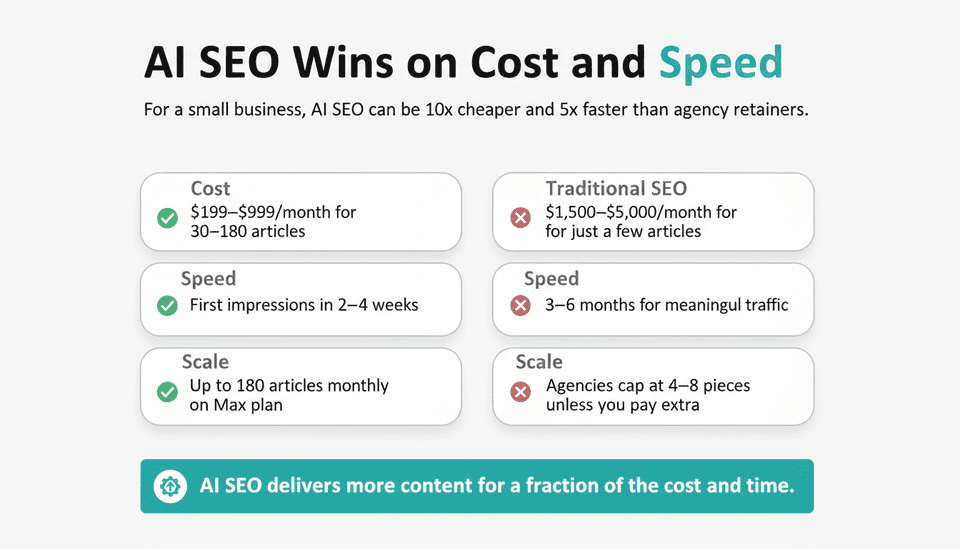
The table below uses AI SEO pricing from Joyrise’s publicly available plans (Basic, Pro, Max) and traditional SEO costs pulled from multiple agency pricing guides (ranges reflect U.S. mid-market retainers). “Time to first results” is based on typical indexing and traffic ramp for well-built content, not a controlled experiment.
| Criteria | AI SEO (using Joyrise as benchmark) | Traditional SEO (agency) |
|---|---|---|
| Cost per month | $199 – $999/mo (billed annually saves ~17%) | $1,500 – $5,000+/mo for a typical SMB retainer; enterprise projects can exceed $10,000/mo |
| Cost per article | $6.63 on Basic (30 articles/mo), $6.24 on Pro (80 articles), $5.55 on Max (180 articles). Includes images, SEO metadata. | $100 – $500+ per article if written by an agency; often unbundled from retainer |
| Time to first results | As fast as 2–4 weeks for pages to index and start getting impressions; traffic builds over months | Typically 3–6 months for the first meaningful organic traffic, assuming a content-heavy strategy |
| Content quality & human oversight | AI-generated with a second AI quality judge on Pro/Max tiers; drafts for human review optional. Consistent formatting, SEO basics baked in. | Highly variable; depends on writer skill and editor availability. Usually requires rounds of revision. |
| Scalability | Up to 180 articles/month on Max; limited only by plan tier. Near-infinite content pipeline. | Limited by agency headcount and hours. Most agencies cap monthly content at 4–8 pieces unless you pay extra. |
| Measurement | Integrated Search Console dashboard tracks clicks, impressions, AI recommendations tracking (AI assistant referrals). | Manual reporting from rank tracking tools; rarely includes AI overview visibility. |
Cells with “varies” appear where sources give a wide range and no single figure exists. The cost per article for traditional SEO is calculated from typical per-piece freelance or agency rates (eesel.ai, SEO.ai, Arc4), but bundled retainers often obscure the true per-article cost.
What Each Actually Costs
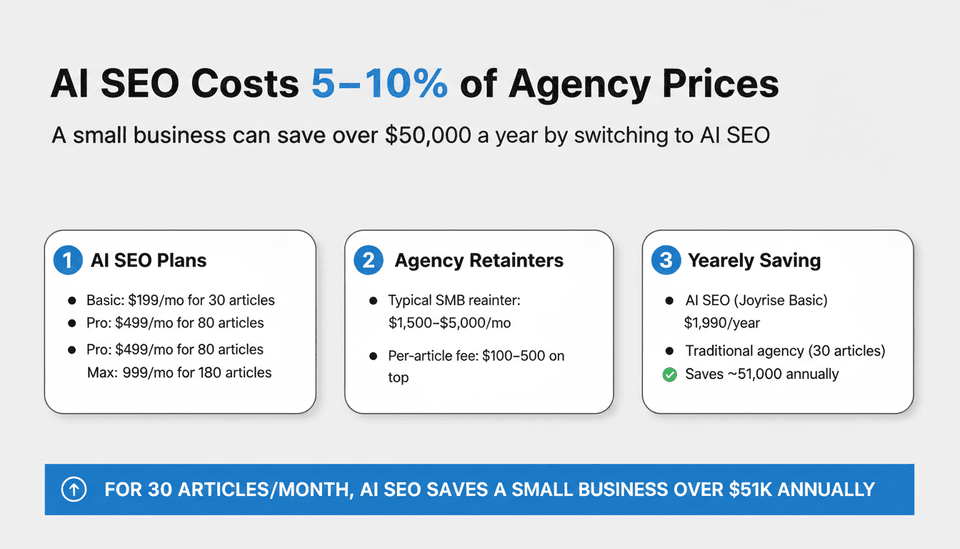
AI SEO pricing: Joyrise plans from $199/month
Joyrise’s Basic plan costs $199/month (or $1,990/year) for 30 articles, AI-generated images, and automatic Webflow publishing. Pro at $499/month includes 80 articles, a quality judge pass (a second AI rewrites drafts), news-driven articles, and a custom brand voice. Max at $999/month scales to 180 articles with priority support. All tiers come with a “read your first article before you pay” trial and a no-questions-asked cancellation guarantee.
This puts the AI SEO pricing at roughly 5–10% of what you’d pay an agency for the same volume.
Traditional SEO pricing: typical ranges and why they vary
According to recent pricing guides from eesel.ai and Qoulomb, small business SEO retainers in the U.S. typically range from $1,500 to $5,000 per month. Agencies that include content creation, link earning, and technical work often charge at the higher end. Per-article costs add $100–$500 each, and many agencies bill content separately. Large enterprises pay $10,000+ monthly.
The variance comes from:
- Level of strategy and account management
- Number of hours dedicated to your site
- The agency’s overhead and positioning
The bottom line: traditional SEO costs scale linearly with human effort, while AI SEO spreads its fixed infrastructure cost across many customers.
Total cost scenario for a small business over 12 months
Assume a small SaaS company wants to publish 30 SEO articles per month and monitor performance.
- AI SEO (Joyrise Basic): $1,990 billed annually (or $2,388 monthly). That’s ~$5.53 per article including images.
- Traditional SEO agency (modest retainer + content): $1,500/mo retainer + $3,000/mo for 30 articles at $100 each = $4,500/mo → $54,000/year.
The AI SEO path saves roughly $51,000 in a single year. That’s the concrete number behind the decision for most small businesses.
Strengths, Weaknesses, and Limitations
AI SEO strengths: speed, cost, consistency
AI SEO turns content into an assembly line. Once you’ve trained the tool on your brand voice, it generates on-brand, SEO-optimized articles every day without burnout. The AI content quality is generally helpful and accurate for informational content, but it still needs human fact-checking on claims that carry regulatory risk.
AI SEO weaknesses: potential quality gaps, less strategic nuance
AI writes what it has seen; it can miss the nuance of a new market or product. It won’t conduct original interviews or develop a unique thought-leadership angle. For YMYL (Your Money Your Life) topics, pure AI output often requires a human expert review to catch inaccuracies. Also, most AI SEO tools today focus on content production, not link earning or technical fix implementation.
Traditional SEO strengths: human strategy, relationships, custom outreach
A good agency brings competitive insights, manual backlink vetting, and direct outreach that AI can’t replicate. They can also adapt strategy based on a board conversation or sudden market shift — something an automated pipeline won’t do.
Traditional SEO weaknesses: high cost, slow turnaround, limited scale
Agency retainer models are built on billable hours. That inherently caps how much content can be produced. Publishing 30 articles a month often means hiring multiple writers or paying a premium, pushing monthly spend well past $3,000. The turnaround time from brief to publish can be weeks.
Recommendations by Use Case
Startups and SMBs using Webflow
If you run a startup on Webflow, AI SEO is the pragmatic choice. Joyrise’s direct Webflow publishing eliminates the manual upload step. For the price of one or two agency articles, you get a month’s worth of daily content. This is SEO for Webflow done with zero engineering hours.
Enterprise and regulated industries
Keep a small agency or in-house SEO lead for strategy, compliance, and high-stakes technical work. Consider layering an AI SEO tool like Joyrise’s Pro plan for volume content that doesn’t require legal review — product use cases, how-to guides, thought leadership — while the agency focuses on the 20% of pages that drive 80% of value.
Content-heavy publishers and blogs
Pure AI SEO works well here. News-driven article features (like those in Joyrise Pro) can keep a blog fresh by incorporating recent industry developments. However, publishers should still invest in original reporting or commentary to differentiate; AI alone won’t create unique scoops.
Local and service-based businesses
These businesses often benefit from AI search optimization because AI assistants increasingly pull answers from local content. Use AI SEO for city-specific service pages, FAQs, and local event coverage. Pair it with traditional link earning through local directories and partnerships — that’s the hybrid sweet spot.
The Metric Shift: From Rankings to AI Recommendations
Why share of voice no longer tells the full story
As Search Engine Land reported on November 14, 2026, traditional share of voice (SOV) is calculated from rankings and search volume — it doesn’t show whether Google’s AI Overviews or ChatGPT actually recommend your brand. With roughly 900 million people using ChatGPT weekly (Modern Ghana, November 12, 2026), a large chunk of your audience is now getting answers without clicking a single blue link. If you’re still measuring success by page-one rankings alone, you’re missing the decisions happening inside AI chats.
Tracking AI referrals and AI overview inclusion
To fix this, forward-looking teams track two new metrics:
- AI referral traffic: visits tagged with source “chat.openai.com” / “perplexity.ai” or Google’s AI mode referrer
- AI overview inclusion frequency: how often your domain appears in Google’s AI-generated answer boxes for target queries
Some rank-tracking tools are beginning to add these signals. Joyrise’s Search Console dashboard, for example, surfaces clicks and impressions from AI assistant sources — a practical first step. (For a deeper look at why rank tools need to evolve, see Why Your Rank SEO Tool Must Do More Than Track in 2026.)
How to measure brand recommendations in AI answers
There’s no perfect methodology yet, but you can manually audit: for your top 20 commercial-intent queries, query ChatGPT, Perplexity, and Google AI Mode and note whether your brand is mentioned and in what context. Then track that cohort monthly. This “brand mention audit” complements traditional SOV and reveals the AI recommendations tracking gap.
Adjudicating the conflict between Search Engine Land and The Hype Magazine:
Search Engine Land argues SOV is insufficient because it ignores AI recommendations entirely. The Hype Magazine, in its November 13, 2026 piece, acknowledges that while AI shifts the game, keywords and backlinks still matter for getting indexed and surfaced in the first place. The reasonable synthesis: backlinks and keyword relevance remain the foundation, but they are no longer the full story. Brand authority — earned through consistent, well-cited content — is what gets you into the AI’s answer. You need both, but measuring only traditional SOV is now dangerously incomplete.
Brand Authority: The New Battleground for AI Visibility
What AI models look for when recommending brands
The Hype Magazine’s November 13 report highlights that AI-driven search experiences place growing weight on brand authority for AI. Models look for signals like:
- How often your brand is cited in authoritative, independent sources
- Consistency of entity associations (clear business category, location, expertise)
- Sentiment and prominence in reviews, news, and knowledge bases
It’s not enough to rank for a keyword; you need to be the brand the AI “trusts” enough to name.
Building brand authority alongside technical SEO
This means SEO teams must now act like brand marketers: secure mentions in industry publications, manage a consistent knowledge graph presence, and produce original research that journalists and AI training data cite. Technical SEO still matters — site structure, speed, schema — but SEO and GEO (generative engine optimization) are converging around brand strength. A useful starting point is AI SEO Content Optimization: The Definitive Guide.
The Rise of GEO: Optimizing for AI Answers
What generative engine optimization involves
Generative engine optimization, or GEO, is the practice of structuring content so that large language models and AI search engines can digest and reproduce it correctly. That means concise answers to specific questions, clear entity attributes, strong sourcing, and structured data markup that reduces ambiguity for AI parsers.
Combining SEO and GEO in one workflow
More teams are running a single content workflow that handles traditional on-page SEO and GEO simultaneously. They create articles that rank well in blue-link search, but also get cited by AI summaries. This dual-purpose approach is what Joyrise’s automated pipeline does by default — it writes long-form articles with proper headings, tables of contents, and internal links, while also answering intent-specific questions Google’s AI can lift.
Recent launches: HKGSEO's dual-engine plan
On November 16, 2026, Hong Kong-based HKGSEO launched an SEO×GEO dual-engine optimization monthly plan (wahanariau.com). It’s the first agency product we’ve seen that explicitly sells traditional ranking improvements and AI-citation growth as one bundled service. This signals where the industry is heading — SEO vs GEO is a false choice; you’ll likely need both.
How to Vet an AI SEO Tool (Without Getting Burned)
Quality judgment passes and second AI review
Not all AI content is equal. Look for tools that run a secondary AI evaluation — like Joyrise’s quality judge pass on Pro and Max — which catches errors, improves readability, and aligns tone. Without this, you’re publishing raw model output, which can be risky.
Deep site scans and brand voice learning
The tool should scan your existing site to learn your product details, audience language, and preferred style. If it’s churning out generic content that could apply to any competitor, it won’t build brand authority or set you apart. Check whether the platform offers a custom voice configuration.
Search Console integration and transparency
Avoid any AI SEO tool that operates in a black box. Native Search Console integration that shows clicks, impressions, and AI assistant referrals gives you real feedback on whether the content is working. Without it, you’re flying blind.
Trial models and satisfaction guarantees
A credible vendor will let you see output before committing — like Joyrise’s “read your first article before you pay” model — and offer a straightforward cancellation policy. Never lock into a 12-month contract without testing content quality first.
What Is Traditional SEO vs. AI SEO?
Traditional SEO is the manual process of keyword research, content strategy, on-page optimization, link building, and technical auditing — typically delivered by agencies or in-house specialists. AI SEO uses machine learning and large language models to automate content creation, keyword analysis, metadata generation, and publishing. For a deeper primer, see What Is AI SEO? A No-Nonsense FAQ for 2026.
Do You Need Both SEO and AI SEO?
Most businesses benefit from a hybrid: AI for scalable content production and routine optimization, human oversight for strategy, technical fixes, and high-stakes pages. Pure AI SEO alone can drive meaningful traffic for startups and content sites, but the best results come when you layer brand-building and link-earning on top of the AI-generated foundation.
What Actually Changes When You Incorporate AI SEO into Your SEO Work?
The biggest shift is time allocation. Instead of spending 20 hours a month writing and formatting articles, you spend that time on editorial direction, data analysis, and relationship-building. You move from being a publisher to being a strategist who steers the machine. The AI handles the heavy lifting on consistency and distribution.
How Do I Optimize for AI Overviews?
Focus on three things: 1) answer specific questions in a clear, structured format (lists, tables, concise definitions), 2) ensure your brand is cited in high-authority external sources to build entity recognition, and 3) deploy schema markup so AI parsers can understand your content. Building generative engine optimization into your content process is now as essential as traditional on-page SEO.
Is Traditional SEO Dead?
No. But its role has split: the commodity work (volume content, metadata, basic optimization) is being absorbed by AI, while the high-value strategy, link building, and technical problem-solving remain human-driven. If you’re an agency only delivering what an AI can now do for $199/month, your model is in trouble.
What's the ROI Timeline for AI SEO Efforts?
AI-generated content that is well-structured and keyword-aligned can begin earning impressions within weeks of indexing. Most teams see meaningful traffic increases in 2–6 months, depending on domain authority and competition. The ROI timeline for AI SEO is typically compressed compared to manual content programs because you can publish at a scale that feeds the algorithm faster. For a workflow breakdown, visit How to Use AI in SEO: Build an Automated Content Pipeline.
Will AI Replace Traditional Search Engines?
Not completely, but they are receding as the only interface. When 900 million people use ChatGPT weekly (Modern Ghana, Nov 12, 2026), a significant portion of queries never touch a traditional search results page. Expect a hybrid future: search engines remain core for transactional and navigational queries, while AI assistants dominate for research, recommendations, and comparison queries. The same underlying indexed web feeds both, so SEO fundamentals still matter.
How much does AI SEO cost compared to traditional SEO?
AI SEO typically costs 5–10% of a traditional agency retainer for the same content volume. A $199/month Joyrise plan delivers 30 articles, while a modest agency retainer with content would run $4,500+/month. Even at the top end ($999/month for 180 articles), AI SEO remains an order of magnitude cheaper. For detailed numbers, refer to the “What Each Actually Costs” section above, and external guides like A Complete Guide to AI SEO Pricing in 2026 and SEO Pricing in 2027: What SEO Really Costs.
Key Takeaways
- AI SEO wins on speed and cost — you can publish 30+ articles monthly for under $200, while agencies charge thousands. The tradeoff is less strategic nuance and human oversight.
- The measurement framework is broken — traditional share of voice no longer captures whether AI assistants recommend you. Start tracking AI referrals and inclusion in overviews now.
- Brand authority is the new ranking signal — AI models cite brands that are frequently mentioned, consistent, and trusted across the web.
- GEO is not optional — optimizing for both traditional search and AI-generated answers (SEO + GEO) is becoming standard, as shown by recent dual-engine service launches.
- Vet AI SEO tools on quality controls — look for a second AI review pass, site-scan brand learning, Search Console transparency, and a risk-free trial before committing.
If you’re ready to start building an AI-powered content engine that publishes daily to your Webflow blog without agency markup, sign up for Joyrise and read your first article before you pay.