 Joyrise
AI SEO Generator: The Definitive Guide (2026)
 By Alexi · · 15 min read

On this page
- Executive Summary: What Is an AI SEO Generator?
- How AI SEO Generators Actually Work
- The Four Types of AI SEO Generators (and Which One You Need)
- Key Features to Look For in an AI SEO Generator
- How to Implement an AI SEO Generator in Your Workflow
- AI SEO Generator Pricing: What You’ll Actually Pay
- Common Mistakes, Myths, and Limitations
- AI SEO Generators vs. Traditional SEO Agencies: When to Switch
- The Future of AI SEO Generators: What’s Coming in 2026 and Beyond
- Frequently Asked Questions About AI SEO Generators
- Key Takeways
Executive Summary: What Is an AI SEO Generator?
An AI SEO generator is software that uses large language models and SEO data to plan, write, and publish content designed to rank in search engines—moving well beyond a writing assistant into a full-stack marketing automation system. In 2026, the term describes platforms that combine site auditing, keyword gap analysis, brand-voice cloning, automated image creation, and direct CMS publishing under one roof. The core promise is to replace the manual chain of briefing, writing, optimizing, and posting with a machine‑driven pipeline that still produces content that reads like a human wrote it—and that search engines will reward.
This guide is for operators who need to decide where to trust these systems with their publishing pipeline. I’ll cover how AI SEO generators actually work, the four distinct tool categories, what features matter, how to implement one in a real team, and what they really cost. I’ll adjudicate the biggest debate—whether you can ditch your toolbelt for a single platform—and give you the concrete numbers you need to compare AI generators against agencies and freelancers, hidden costs included.
How AI SEO Generators Actually Work
The AI models behind the content
Every AI SEO generator sits on one or more frontier large language models—typically GPT‑4‑class or fine‑tuned variants. What separates a general chatbot from an SEO‑focused generator is a training or prompt‑engineering layer that biases output toward structures search engines decode easily: keyword‑aware headings, semantic entity inclusion, internal link suggestions, and compliance with length and readability targets. Some platforms train their own model on millions of ranked pages. Others wrap a third‑party model with proprietary SEO instructions and quality‑control loops.
Data inputs: site scans, keyword gaps, and brand voice
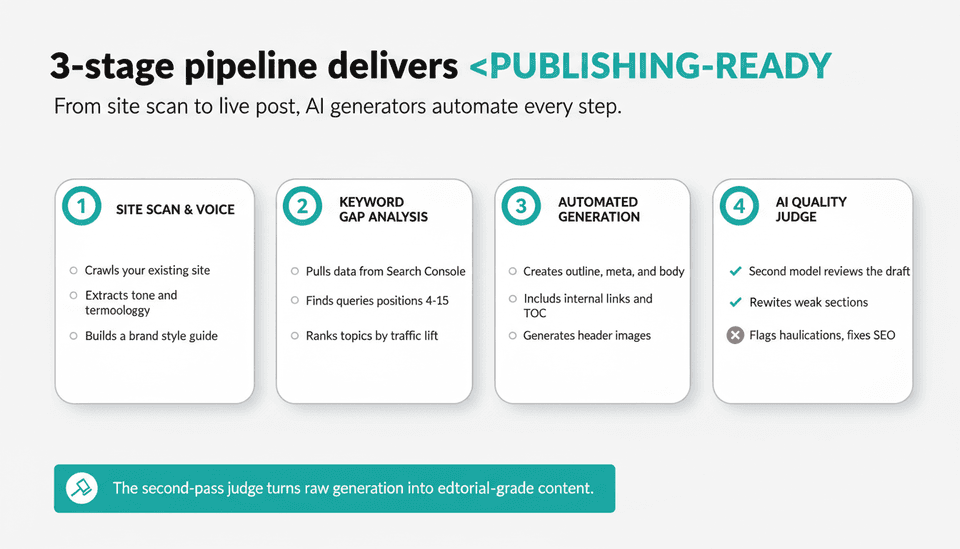
Before any article is written, the generator ingests source data. A crawler reads your existing site to understand products, categories, and tone. It pulls keyword‑level performance from Google Search Console and pairs that with third‑party rank‑tracking data to find queries where you’re close to page one (positions 4–15) and your competitors are not. Brand‑voice extraction—often based on sample articles—builds a style guide that governs sentence length, jargon tolerance, and formatting preferences.
From plan to publish: the generation pipeline
The pipeline breaks into three stages. First, the platform builds a content calendar: it ranks keyword opportunities by volume, difficulty, and forecasted traffic lift, then assigns topics to calendar slots. Second, for each topic, the generator creates an outline, a title, a meta description, and the full article body—including internal links to existing pages, a table of contents, and any requested data tables. Third, the system generates original visual assets (header images, infographics) and either pushes the post live via native CMS integration or holds it as a draft for human review.
Quality control: the second‑pass AI judge
A true differentiator among full‑stack platforms is an automated quality‑judge pass. After the initial draft, a second AI—often a more capable or differently‑tuned model—reads the article against a checklist of SEO, factual, and voice criteria. It rewrites weak sections, removes redundancy, fixes keyword stuffing, and flags hallucinations. The result is a piece that can often be published with zero human edits, particularly for informational content in non‑YMYL niches. This second‑pass judge is what turns a raw generation into something that meets editorial standards at scale.
The Four Types of AI SEO Generators (and Which One You Need)
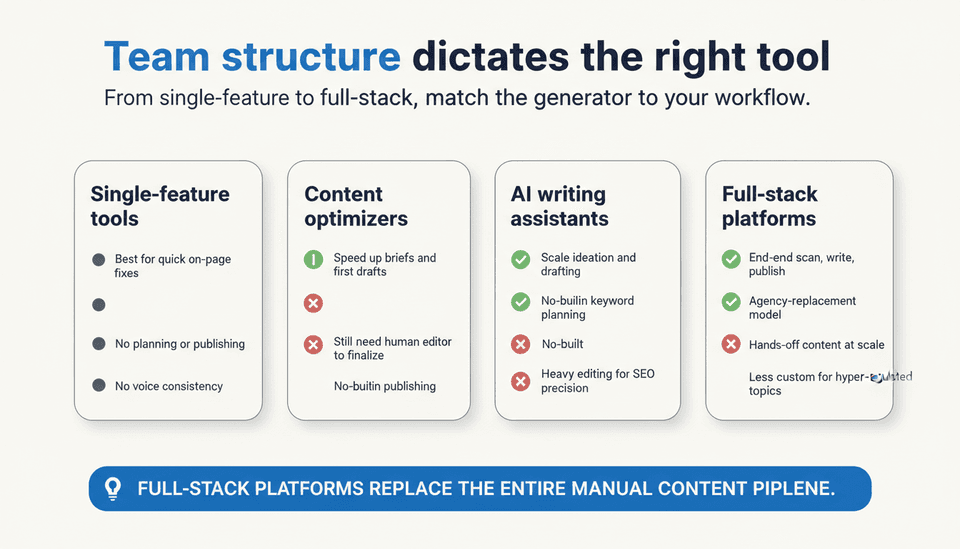
Confusion in the market stems from vendors lumping wildly different tools under the same “AI SEO” banner. For a comprehensive list of AI SEO tools across all types, see 23 Best AI SEO Tools in 2026: Tested by SEO Experts. In practice, four archetypes exist, each with a distinct scope and set of trade‑offs.
| Type | What it does | Best for | Limitations |
|---|---|---|---|
| Single‑feature tools | Generate meta descriptions, title tags, or rewrite paragraphs on demand. | Quick on‑page fixes; supplementing a manual workflow. | No planning, no publishing, no voice consistency. |
| Content optimizers (SurferSEO, Frase) | Analyze top‑ranking pages and give content‑brief guidance; often include an AI writer that drafts within those briefs. | Teams that have editors and want to speed up briefing and first drafts. | Still require a human to run the brief, finalize edits, and publish. |
| AI writing assistants (Jasper, Writesonic) | Produce long‑form blog drafts from minimal prompts; brand‑voice training is available. | Marketing teams that want to scale ideation and drafting but keep editing in‑house. | No built‑in keyword planning or CMS integration; output still needs heavy editing for SEO precision. |
| Full‑stack automated content platforms (Joyrise, SEO.AI) | End‑to‑end: site scan, keyword planning, article generation, original imagery, built‑in SEO, and automatic publishing to Webflow or WordPress. | Businesses that want an agency‑replacement model—hands‑off content production at scale. | May struggle with hyper‑regulated topics; less customizable than a human agency for unique formats. |
Which one you need depends on who’s executing the work. If you have a content team that already runs a tight editorial process, a content optimizer or writing assistant may slot in cleanly. If your goal is to eliminate the manual labor of researching, writing, and posting entirely, you need a full‑stack platform. For straightforward informational sites—SaaS blogs, finance education, local‑service explainers—a full‑stack generator can be sufficient. For e‑commerce category pages with thousands of SKUs or YMYL health advice, you’ll almost certainly need additional tools and expert human oversight.
Key Features to Look For in an AI SEO Generator
When evaluating a platform, prioritize these capabilities. Our testing aligns with broader market reviews; for a side‑by‑side comparison, check We Tested the 15 Best (& Underrated) AI SEO Tools in 2026. Each one reduces a step that otherwise falls on your team.
Built‑in site scanning and voice mimicking
The platform must crawl your site and extract tone, terminology, and customer language from your existing pages. Without this, every article feels like a guest writer with no brand memory.
Integrated keyword and competitor‑gap planning
Don’t buy a tool that makes you import keyword lists manually. The generator should connect to your Search Console and rank‑tracking data, identify low‑hanging queries, and surface topics where competitors rank but you don’t. This is the difference between a content machine and a random‑article factory.
Original imagery and infographics
Stock photos signal “generic content.” Look for a generator that produces unique hero images and functional infographics from the article data. AI image generation has matured enough that branded, on‑topic visuals can be created programmatically.
Native CMS integrations (Webflow, WordPress)
If you still need to copy‑paste from a dashboard, you aren’t automating publishing. True automation means the platform pushes the finished post—images, internal links, meta tags—directly into your CMS via API and sets the status to draft or live per your rules. Webflow SEO automation is a particularly strong use case because the platform’s API and collection structure are well‑suited to bulk content operations.
Search Console analytics dashboard
The generator should close the loop by showing clicks, impressions, and average position for every article it published—inside the same interface. This lets you correlate output with outcomes without switching tools.
Quality‑assurance passes
An automated quality‑judge pass (separate from the initial writer) is the feature that separates a publishing‑ready platform from a draft‑generator. Confirm that the QA model rewrites against SEO rules, brand voice, and factual coherence, not merely a grammar check.
How to Implement an AI SEO Generator in Your Workflow
Rolling out an AI SEO generator inside a real team requires structure. Here’s a four‑phase framework that works for marketing departments of one to twenty.
Phase 1: Audit, connect, and define your voice
- Run the platform’s site scanner and verify it captured your products and pages correctly.
- Connect Google Search Console and any rank‑tracking account.
- Submit 3‑5 of your best‑performing articles as voice samples. Review the generated style guide and tweak any rules that feel off.
- Set up CMS credentials and test a single draft post to confirm publishing works end‑to‑end.
Phase 2: Build a data‑backed content calendar
- Let the tool pull keyword gaps. Evaluate the suggestions and remove any queries irrelevant to your business.
- Set article velocity (e.g., 15 articles per month) and cadence (daily vs. batch drops).
- Approve a 30‑day calendar. A good AI generator will rank topics by expected traffic lift, not alphabetical order.
Phase 3: Generate, review, and publish at scale
- For the first week, review every article before it goes live. Look for factual slips, off‑brand phrasing, and missing internal links.
- By week three, if the QA pass is effective, switch to a spot‑check model: review 20% of articles, auto‑approve the rest.
- If your platform supports automatic publishing, set a rule: “Publish immediately if confidence score > 90%, else route to draft.”
Phase 4: Monitor, iterate, and feed engagement signals back
- Check the integrated Search Console dashboard monthly. Identify articles that reached page one, and use the platform’s refresh feature to update and re‑optimize them.
- Feed any edits you make back into the voice model. The more corrections the system sees, the less you’ll need to touch future drafts.
- Use the platform’s analytics to decide whether to increase article volume or redirect budget to other channels.
This framework turns the generator from a “let’s see what happens” experiment into a measurable, repeatable content engine. For teams using Webflow, the automatic SEO posting capability means the entire loop from opportunity to live article can run with zero manual steps once trust is established—which typically happens within two to four weeks of active tuning.
AI SEO Generator Pricing: What You’ll Actually Pay
Pricing has stabilized into tiers that reflect article volume and advanced features. The hidden costs sit in the time you’ll spend editing, the image licenses you might still need, and the tool overlap you haven’t canceled yet.
Typical subscription tiers ($199–$999/mo) and what they include
Full‑stack platforms generally map three tiers to small, mid‑market, and high‑volume publishing:
- Entry ($199‑$299/mo): 20‑40 articles per month, AI images, basic Search Console monitoring, limited voice training.
- Mid‑tier ($499‑$699/mo): 60‑100 articles per month, deep research, quality‑judge pass, custom brand voice, news‑driven articles.
- High‑volume ($999+/mo): 150‑200+ articles per month, priority support, and prioritized processing.
For example, Joyrise’s Pro plan at $499/month includes 80 articles, the quality‑judge pass, and custom voice training—a representative mid‑tier package. Enterprise options can exceed $1,500/month but usually include managed services.
Hidden costs: edit time, premium image licenses, tool overlap
Edit time. Even with a quality‑judge pass, assume you’ll spend 5‑15 minutes reviewing each article until the voice model matures. At 60 articles per month, that’s 5‑15 hours of editor time—roughly $250‑$750 in labor if you cost internal time at $50/hour.
Images. Most platforms generate free AI visuals. If you require vector infographics or stock‑photo‑quality shots, a separate license (e.g., Shutterstock) may add $50‑$150/month.
Tool overlap. Many teams keep a rank tracker, a technical SEO auditor, and an analytics suite alongside the generator. Before signing, audit your existing SEO software 2026 stack and eliminate redundant line items. You shouldn’t pay for a separate content‑optimization tool if your platform already does that internally.
Total‑cost benchmarking against agencies and freelancers
A decent US‑based freelance writer charges $150‑$300 per article. An agency retainer for 8 articles/month runs $3,000‑$8,000. Compare that to a full‑stack generator at $499/month for 80 articles: the cost per article with an AI platform can be under $6.25, versus $200+ with human‑led alternatives. Even after adding 15 minutes of editor review per piece (let’s call it $12 in labor), the total article cost lands around $18—still an order of magnitude cheaper.
The trade‑off is not quality per se; it’s control. For commoditized informational content, the math is overwhelmingly in favor of AI generators. For content that carries legal liability or reputational risk, the human premium is insurance.
Common Mistakes, Myths, and Limitations
Myth: AI content never needs a human edit
No production‑grade AI SEO generator claims zero‑edit publishing for every piece. Even with a second‑pass judge, articles on nuanced topics can misstate facts or miss tone. The realistic goal is to reduce editing to a quick sanity check, not eliminate it entirely.
Mistake: ignoring brand voice drift over time
Voice models drift if you never correct them. After 50 articles, the system may start sounding more generic. Feed back your edits consistently, and if the platform allows, re‑train the voice model quarterly using your latest top‑performing content.
Limitation: E‑E‑A‑T and YMYL topics still demand expert involvement
Google’s emphasis on Experience, Expertise, Authoritativeness, and Trustworthiness means that financial, medical, and legal content faces a higher bar. AI generators cannot fabricate real experience or verifiable author credentials. For YMYL pages, plan for a subject‑matter expert to review and, ideally, co‑author the content. This is not a platform weakness; it’s a regulatory reality. Our How Good Is AI for SEO? A No-Hype 2026 Reality Check examines where AI content falls short on trust signals.
Risk: algorithm penalties from over‑optimization
AI generators trained solely on search‑engine ranking factors can produce keyword‑dense, pattern‑matched text. If you never intervene, you risk a site that triggers spam classifiers. The mitigation is simple: use the quality‑judge pass, review the first batch of articles manually, and never set the “keyword density” dial to max. Google’s guidance remains consistent—content written for people, with search engine considerations applied lightly.
AI SEO Generators vs. Traditional SEO Agencies: When to Switch
Speed and scale: hours vs. weeks
An agency typically needs 2‑4 weeks to research, write, and deliver one article. A full‑stack AI generator does it from scratch in under an hour, including images and metadata. For a business that needs to build topical authority quickly—say, 100 articles in a quarter—AI eliminates the production bottleneck.
Quality trade‑offs for complex, regulated niches
Agencies bring strategic thinking, deep competitor analysis, and the ability to craft unique angles that AI still misses. In industries like enterprise SaaS or healthcare, that edge matters. For a local plumber’s blog or a B2B productivity blog, the difference is often imperceptible to readers. Can AI Do SEO for My Website? Honest Answers (2026) walks through a practical litmus test.
The rising hybrid model: AI for scale, humans for strategy
The most pragmatic path for most mid‑market companies is a hybrid: an AI‑powered SEO strategy executed by a full‑stack platform for 80% of content volume, backed by a human strategist or agency for high‑stakes pillar pages and quarterly strategy reviews. This approach preserves expertise where it matters while slashing per‑article costs by an order of magnitude. The platform handles the daily grind; the human sets the direction and audits the output. For a deeper discussion of platform‑vs‑agency economics, see What Are the Best AI SEO Companies? Platforms vs. Agencies.
The Future of AI SEO Generators: What’s Coming in 2026 and Beyond
Multimodal content: audio, video, and interactive snippets
The next wave is generators that don’t stop at text. Early adopters are already producing audio summaries, short‑form video scripts, and interactive data widgets alongside the main article. By late 2027, expect platforms to natively output YouTube‑ready voiceovers and embeddable calculators that rank in featured snippets.
Deeper integration with AI‑first search engines
As search engines shift toward generative‑experience results, AI SEO generators will ingest data from AI‑driven crawlers and optimize for answer‑engine visibility—not just blue links. The concept of GEO (Generative Engine Optimization) will merge with traditional SEO tooling, making the generator a single interface for all search surfaces.
Self‑improving feedback loops from real engagement data
Generators will move beyond Search Console clicks to incorporate scroll depth, time‑on‑page, and conversion events. The system will learn that articles structured a certain way keep readers longer and will automatically replicate that pattern. This closed‑loop optimization—where the platform writes, measures, and adjusts without human intervention—represents the true endgame for automated SEO content.
Recent market moves reinforce these trends. On November 10, 2026, Veuno launched a free library of SEO and AI search tools, signaling that even premium capabilities are trending toward no‑cost access. DemandSage’s annual list (November 14, 2026) confirmed sustained growth in the free‑and‑affordable AI content creation segment. Meanwhile, TechRadar’s November 10 review of nine AI website builders blurred the line between content creation and site development, hinting that soon you’ll generate the entire digital presence—domain, design, and daily blog—from a single prompt.
Frequently Asked Questions About AI SEO Generators
What is an AI SEO generator?
An AI SEO generator is an AI content generator that uses machine learning to plan, write, and optimize articles for search engine rankings, often incorporating automated publishing and performance tracking. It is an SEO automation platform that turns keyword opportunities into published, illustrated posts with minimal human input.
How does an AI SEO generator work?
It scans your site and competitor space, prioritizes keyword gaps, generates a full article using a language model tuned for SEO, creates header images, and pushes the post to your CMS. A secondary quality‑assurance AI may rewrite sections before publication. The system then tracks clicks and impressions via Search Console.
Can I rely on AI SEO generators to follow SEO best practices automatically?
Yes, for on‑page fundamentals—title tags, heading hierarchy, internal linking, meta descriptions, schema markup, and keyword placement—generators apply these rules consistently. However, algorithm nuances like E‑E‑A‑T signals or freshness requirements may still need a human check. Treat the generator as a rule‑follower that needs strategic oversight, not a strategist.
Do I still need traditional SEO software alongside an AI generator?
It depends on the generator’s scope. A full‑stack platform that includes rank tracking, technical audits, and Search Console dashboards can replace a bundle of tools. But if your site has complex technical SEO issues—javascript rendering problems, hreflang mismanagement, massive site migrations—you’ll still need a dedicated technical auditor. For straightforward informational sites, the generator is sufficient; for e‑commerce at scale, keep your specialist tools.
Can AI SEO tools help with local SEO?
Yes. Most full‑stack generators can produce location‑specific pages and blog posts that target “near me” queries, integrate with Google Business Profile data, and maintain NAP consistency. However, AI cannot directly manage your GBP listings or respond to reviews. An AI blogging platform can scale local content, but the relationship‑management side remains human territory.
How much does an AI SEO generator cost compared to an agency?
An AI generator costs $199–$999/month for 30–200 articles. A comparable agency retainer for 8 articles/month is $3,000–$8,000. Per article, the AI can be $6–$20 including review time, versus $200–$500 from an agency. The savings are real, but the agency brings strategic customization that a platform cannot match. For scale, AI wins; for bespoke, high‑stakes work, agency remains relevant.
What are the limitations of AI SEO generation?
Four key limits: (1) E‑E‑A‑T and YMYL topics need human expertise, (2) brand voice requires active curation to prevent drift, (3) complex storytelling and original data journalism are beyond current models, and (4) over‑optimization risk exists if you bypass quality‑judge passes.
How does automated quality judging work in AI content?
A second AI model—often a different architecture or a fine‑tuned variant—reads the generated draft and scores it against a rubric covering factual accuracy, SEO compliance, brand voice consistency, and readability. It then rewrites underperforming sentences, removes fluff, and flags any claims that lack supporting internal or external sources. This reduces the editor’s job from rewriting to verifying.
Can an AI SEO generator publish directly to my website?
Yes—if your CMS supports an API and the platform has a native integration. Platforms like Joyrise can publish directly to Webflow, setting the article to draft or live based on your rules. For WordPress, similar integrations exist. If your CMS is proprietary, you’ll likely need a custom connector or a manual draft‑to‑live workflow.
What features should I look for in an AI SEO generator?
Prioritize: (1) deep site scanning and voice cloning, (2) integrated keyword gap analysis, (3) original AI‑generated images, (4) native CMS integration for automatic SEO posting, (5) Search Console dashboard, and (6) a separate quality‑judge pass. Without these six, you’re buying a dressed‑up article spinner.
Key Takeways
- Full‑stack AI SEO generators are not just writing assistants; they’re end‑to‑end publishing systems that can match or exceed the per‑article economics of agencies by 10x.
- Choose the generator type based on who will do the work: if you want to eliminate manual content production, a full‑stack platform is the only fit.
- Hidden costs—editor time, image licenses, tool overlap—add real expense, but even at $18 per fully reviewed article, AI generators decisively undercut freelancers and agencies.
- Trust the automated publishing pipeline only after a 2‑4‑week tuning period; then use a confidence‑score rule to auto‑approve most content.
- For YMYL and heavily regulated niches, AI cannot replace human expertise; a hybrid model keeps quality high while scaling content volume.
Start building your automated content engine today—create your first AI‑written, fully illustrated, and ready‑to‑publish article without entering a credit card at Joyrise.