 Joyrise
YouTube SEO 2026: Rank Higher in Google & YouTube Search
 By Alexi · · 17 min read
On this page
- Executive Summary: What YouTube SEO Means in 2026
- How YouTube SEO Works in 2026: The New Search Landscape
- Core YouTube SEO Ranking Factors (Consensus Compressed)
- The Shorts Strategy Shift: How Short-Form Fuels Long-Form SEO
- Optimizing for Google Search: Beyond the YouTube Platform
- Monetizing Your YouTube Presence: SEO for Sales, Not Just Views
- Practical Implementation Framework: A 30-Day YouTube SEO Workflow
- Common Myths, Mistakes, and Limitations
- Next Steps: Create Your YouTube SEO 2026 Action Plan
- Key Takeaways
The rules of video discovery have shifted. In 2026, YouTube SEO 2026 is no longer a standalone discipline—it’s a two-platform game where visibility in Google’s traditional search results and AI-generated summaries directly impacts your channel’s growth. This YouTube SEO guide 2026 lays out a unified strategy for ranking on both, using Shorts strategically to fuel long-form content, and measuring success by conversions, not just view counts.
Executive Summary: What YouTube SEO Means in 2026
YouTube SEO is the practice of optimizing your videos, channel, and associated web properties so they surface in the right contexts: YouTube’s own search and recommendation systems, as well as Google Search, including video carousels, featured snippets, and AI-generated answer summaries. In 2026, it’s less about keyword stuffing and more about satisfying two distinct but intertwined algorithms that both reward relevance, engagement, and authority.
The payoff is concrete. Video results now appear for nearly every commercial query. As Search Engine Land reported on November 11, 2026, Google is aggressively pushing YouTube content into traditional search results, making video presence a non-negotiable element of a modern search strategy. That integration includes AI-generated overviews that increasingly pull in video snippets, meaning your content can show up before the first organic link. If you treat YouTube as an island, you’re invisible in half the places your buyers are looking.
This article unpacks what actually moves the needle, dispels myths that waste your time, and provides a 30-day workflow you can run starting Monday.
What is YouTube SEO?
YouTube SEO is the full set of decisions—from topic selection and scripting to thumbnail design and schema markup on your website—that determine whether your video earns clicks and retention on YouTube, and whether Google’s crawlers understand it well enough to feature it in standard search results. It’s distinct from general web SEO because the ranking signals are weighted differently: watch time and session duration on YouTube carry more weight than backlinks, while Google Search leans harder on topical authority and structured data. Smart creators optimize for both engines simultaneously.
How YouTube SEO Works in 2026: The New Search Landscape
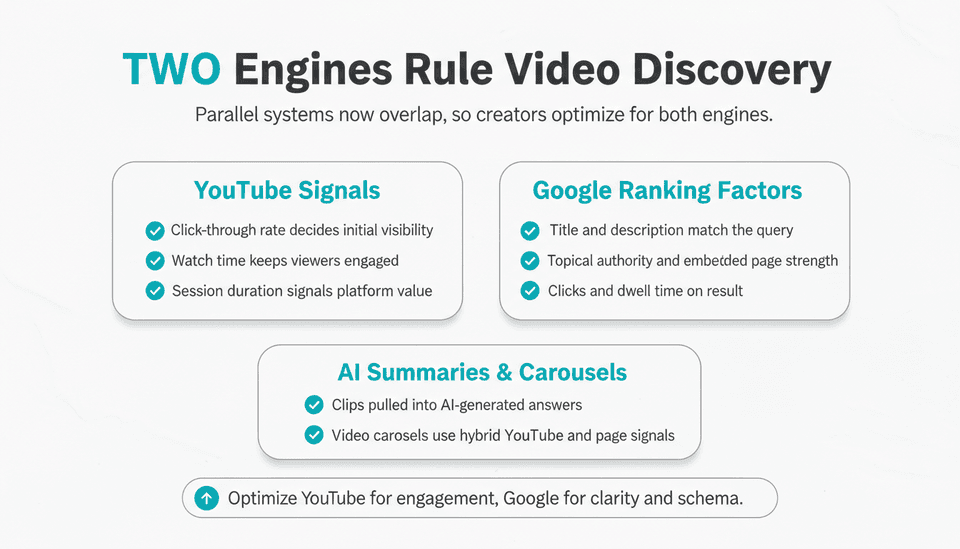
Two parallel systems now govern your video’s reach, and the boundary between them has blurred. Understanding their mechanics—and where they intersect—is the foundation of any effective strategy.
YouTube’s algorithm signals vs. Google’s ranking factors for video
YouTube’s recommendation engine still runs on viewer satisfaction signals: click-through rate (CTR), watch time, and session duration. A video that consistently keeps viewers on the platform is seen as valuable, gets more impressions, and can rank higher in YouTube search. Google’s web ranking for video content, however, leans on relevance (does the page title and description match the query?), prominence (is the page authoritative on the topic?), and user behavior (do people click and stay on the result?). A video embedded on a blog post with solid on-page SEO can outrank a native YouTube listing for certain informational queries, because Google considers the supporting content a stronger relevance signal.
The practical split: optimizing for YouTube demands attention to thumbnails, titles that spark curiosity, and content that holds viewers past the first 30 seconds. Optimizing for Google demands the opposite in some ways—clear, descriptive titles, rich written context, and schema markup that tells Google exactly what the video covers.
The role of AI-generated search summaries and video carousels
Google’s AI-generated search summaries, rolled out more broadly in 2026, now feature video clips as inline answers. This shift makes AI SEO for YouTube a critical component of modern strategy. If someone searches “how to set up a Facebook Ads retargeting campaign,” Google may display a 30-second clip from a YouTube video inside the summary box. This is the new battleground. The algorithm selects clips that demonstrably answer the query, with high watch time and a transcript that matches the question’s intent. This means transcripts are no longer an accessibility afterthought—they’re a ranking asset. And because these summaries often appear above traditional organic results, the opportunity to capture traffic has shifted from position #1 to “clip #1.”
Video carousels in Google Search—typically displayed for “how to” and product-focused queries—operate on a hybrid of YouTube’s internal signals and the host page’s SEO strength. A video from a brand site with strong domain authority and proper VideoObject schema can elbow its way into a carousel ahead of a more popular YouTube channel. For businesses, that’s a lever worth pulling.
Why Google’s YouTube push redefines your SEO strategy (in light of Nov 2026 changes)
Search Engine Land’s November 11 report underscores a reality that many SEO managers have been slow to accept: you cannot own the top of the SERP for a growing list of queries without video. Google is not just placing YouTube videos in search results; it’s pulling them into the AI summary layer, where they feel native and authoritative. This means every topic cluster your brand covers needs a video component—otherwise you’re handing clicks to competitors who bothered to show up.
On November 13, 2026, Search Engine Land published a guide detailing how video content can directly drive commerce on YouTube. The takeaway: product-focused videos, when paired with clear calls to action and integrated shopping features, become part of a revenue engine that feeds back into SEO—because high-engagement, high-conversion videos signal value, which can improve rankings across both platforms. The old separation between “brand content” and “commerce content” is gone.
Core YouTube SEO Ranking Factors (Consensus Compressed)
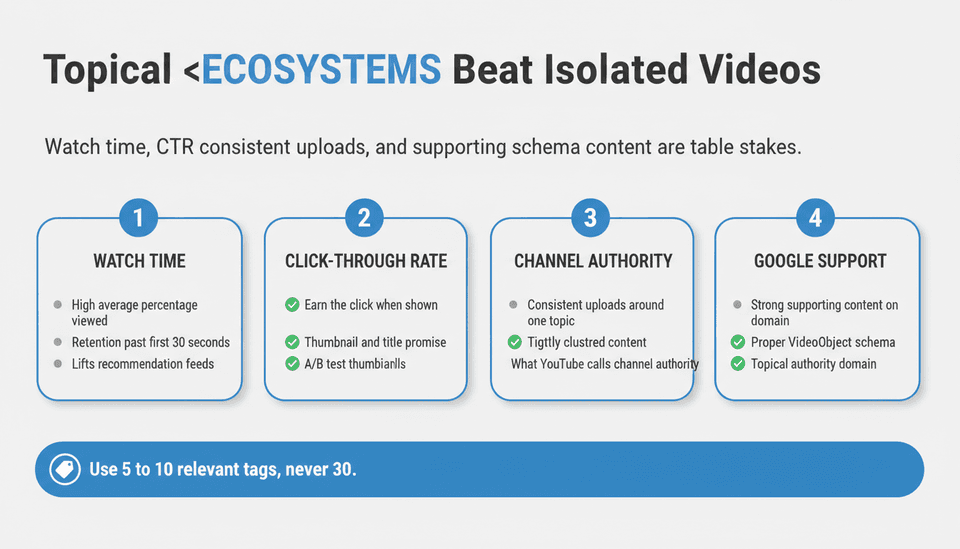
The following YouTube ranking factors 2026 are table stakes. They’re well-documented, so I’ll cover them quickly, with a 2026 lens on what counts now.
YouTube keyword research in 2026
Effective YouTube keyword research uses the same discipline you’d apply to a blog post, but source your keywords from YouTube’s own autocomplete, the “Research” tab in YouTube Studio, and tools that separate YouTube search volume from Google web volume. Target terms where the top-ranking videos have comparable production quality to yours—if every result is from a channel with 500K subscribers, you’ll need a unique angle or a shorter-tail variant to break in. For a deeper walkthrough, see SEO YouTube Keywords: The 2026 Definitive Guide.
YouTube metadata optimization: titles, descriptions, and tags
Titles still matter most. Front-load the primary keyword, but make it readable for humans—a title that performs on YouTube often reads like a promise or a challenge. Descriptions should restate the core topic in the first two sentences (that’s what Google shows in the video snippet) and expand with related terms naturally. Tags are now a minor signal on YouTube, but they help with misspellings and variant phrasings. Don’t spend more than two minutes on them. According to YouTube SEO in 2026: How to Rank Higher and Get More ..., tags are “a minimal ranking factor” compared to title and viewer behavior.
Thumbnails and engagement loops that boost CTR and watch time
The algorithm rewards videos that earn a click when shown and retain viewers once clicked. YouTube engagement signals like comments and shares further reinforce this reward. Thumbnails should convey a clear emotional or informational payoff: before-and-after, surprise, comparison. A/B test thumbnails using YouTube’s built-in tool if your channel qualifies. Inside the video, structure the first 15 seconds to verify the thumbnail’s promise, then use pattern interrupts (graphics, questions, chapter markers) to maintain retention. High retention directly lifts your video across YouTube’s recommendation feeds and increases the odds of being selected for a Google video carousel.
What are the most important YouTube SEO factors for ranking in 2026?
Three signals dominate: watch time and viewer retention (especially high average percentage viewed), CTR from search and suggested feeds, and consistent uploading of content tightly clustered around a topic—what YouTube calls “channel authority.” Google’s algorithm adds a fourth: the presence of strong, relevant supporting content on a domain that already has topical authority, reinforced by proper video schema. That means the most important factor, strategically, is whether your video lives inside a topical ecosystem, not just on an island.
How many tags should I use on YouTube videos?
Use 5–10 highly relevant tags, covering your main keyword, a few close variants, and maybe one broader category term. Exceeding 15 tags is wasted effort and can dilute the signal. YouTube’s own documentation has long stated that tags play a limited role, and creators who stuff 30 tags are chasing a tactic that mattered in 2015. Put that energy into writing a transcript-accurate description instead.
The Shorts Strategy Shift: How Short-Form Fuels Long-Form SEO
YouTube Shorts are not a replacement for your main content—they’re the top of your acquisition funnel. Used correctly, they drive subscribers and watch history signals that amplify your long-form videos’ reach.
How YouTube Shorts SEO differs from standard video SEO
Short-form SEO is driven by first-frame appeal and audio selection, not title keyword density. The Shorts feed is an infinite scroll; you have roughly 0.5 seconds to stop the thumb. The on-screen text in the first second acts like a title, and trending audio can boost initial placement. Unlike long-form video, where a viewer chooses to click, Shorts are pushed—so the algorithm evaluates swipe-away rate as aggressively as watch time. A 60-second Short that keeps 80% of viewers to the end will outperform a 15-second Short with a 50% retention. The metadata fields still matter: write a keyword-rich title and description, because Shorts are now indexed in Google Search just like standard videos.
Integrating Shorts into your content calendar for maximum impact
For every long-form video, create 2-3 Shorts: a teaser that poses the core question, a highlight clip with the most actionable insight, and a “results” clip if your content shows a transformation. In the Short description, link to the long-form video with a call to action, and pin a comment that directs viewers to the full version. This creates a viewer behavior loop: a user who discovers a Short, watches it fully, clicks through to the long video, and stays on your channel for a full session signals significant authority to YouTube’s algorithm. Over a 30-day period, channels that systematically feed Shorts viewers into long-form content see a measurable lift in suggested impressions on their longer videos.
Video length tradeoffs: Short, long, and the hybrid approach
There’s a common but oversimplified belief that longer videos always rank better because they accumulate more total watch time. The reality: YouTube cares about percentage watch time and absolute retention on the content that matches the query intent. For a “how to tie a tie,” a 2-minute video that holds 80% retention will crush a 15-minute deep-dive. For a “SEO audit walkthrough,” a 22-minute video with 50% retention can perform fine, because the intent requires depth. The hybrid approach works best: produce a 6–12 minute version that covers a single topic thoroughly, supplement with Shorts for discovery, and link to a longer-form companion for viewers who want advanced steps, which you treat as a separate playlist asset.
Does video length affect YouTube ranking and should I make longer videos?
Video length itself is not a direct ranking factor. YouTube’s public statements confirm that the system prioritizes satisfaction: viewers who watch most of a video and then stay on the platform. So a 3-minute video with 85% average view duration will typically rank better than a 20-minute video with 25% average view duration for the same keyword, all else equal. Make your video exactly as long as it needs to deliver its promise fully, and not a second longer. If you’re running a business channel, err on the side of shorter, denser videos first; length can increase as your audience signals demand for depth.
Should I enable YouTube Shorts alongside my long-form content?
Yes, with zero exceptions. Shorts are now a primary discovery engine, and the incremental effort to produce them from existing footage is low. The only tradeoff is cross-contamination risk: if your Shorts are entirely different in tone or topic from your long-form, you may confuse the algorithm about your channel’s focus. Keep Shorts thematically linked to your main pillar content, and they function as a subscribe-and-follow-rail that improves overall channel performance.
Optimizing for Google Search: Beyond the YouTube Platform
Relying solely on YouTube’s own SEO will leave you invisible in standard Google results. Google video search optimization is essential, and here’s how to build a presence that Google rewards outside the app, using video SEO best practices.
Structured data for videos (Schema markup on your website)
Every video you embed on your website should be wrapped in VideoObject schema, with the name, description, thumbnail URL, upload date, and duration fields populated accurately. Google uses this markup to generate rich results and qualify your video for the video carousel and AI summaries. If you host your video’s landing page on a subdomain with strong topical authority (think a blog post that covers the same topic in detail), the video has a dramatically higher chance of appearing in video ranking in Google than it would from YouTube alone. The YouTube SEO for Beginners: A Practical 2026 Guide covers basic schema implementation for non-developers.
Building topical authority with video playlists and blog integration
Google’s concept of topical authority—that a site is a credible source on a subject because it covers it comprehensively—extends to video. When you embed a video inside a thorough blog post, publish a transcript, add related links, and organize your YouTube playlists around topic clusters (not just chronology), Google treats your domain as more relevant for related queries. Use a tool like Joyrise to automatically publish daily illustrated SEO articles that embed your latest videos; this creates a tight content network that signals authority faster than publishing videos alone. The embedded video’s page becomes a query target, and the accompanying article answers the questions Google’s AI summaries pull from, making your entire domain more likely to be the source of the clip.
Measuring success across platforms: YouTube Analytics + Google Search Console
Don’t look at these dashboards separately. In YouTube Studio, track “Traffic source: External” to see what percentage of views arrive from Google Search. In Google Search Console, filter by Video type in the Performance report to see which pages with embedded videos are earning impressions and clicks. If you see a page getting impressions but zero clicks, the title or thumbnail shown in the carousel may be weak; update either the VideoObject name or the page’s meta title. Cross-platform measurement is the only way to know if your optimization work is actually intercepting search demand.
How do I rank my YouTube videos in Google search results?
The highest-leverage tactic: publish the video on YouTube with a keyword-rich, complete description, then embed that same video on a relevant blog page on your own domain, with a full transcription, internal links to related content, and proper VideoObject schema. Promote that page as you would any SEO asset. The combination pulls two levers—YouTube’s video understanding and your domain’s topical authority. For product videos, ensure the description includes your product name, category, and key use cases exactly as they’d be searched on Google. Google’s AI summaries now extract video clips based on transcript content, so spoken keywords in the first two minutes of the video can be the difference between a featured clip and total invisibility.
Monetizing Your YouTube Presence: SEO for Sales, Not Just Views
Views without a business outcome are vanity. In 2026, YouTube’s ecosystem increasingly rewards content that keeps users and drives transactions, and those engagement signals loop back into rankings.
How engagement and conversions influence ranking indirectly
YouTube’s algorithm doesn’t read your Stripe dashboard, but videos that generate comments, shares, and return viewers signal higher satisfaction. A product review video that prompts dozens of genuine comments and has a high “watched another video from this channel” rate after viewing will be promoted more aggressively. If you direct viewers to a landing page and they return to YouTube to watch more of your content, that session extension is a powerful signal. Track “Channel pages viewed” and “Subscribers from this video” in YouTube Analytics alongside your CRM conversions; the correlation is real, and the algorithm responds to the behavioral lift, not the dollar amount.
Linking video content to ecommerce and lead generation
Search Engine Land’s November 13, 2026 guide on promoting products on YouTube points out that YouTube Shelf (shopping) and end-screen CTAs now support direct product links in more regions. The tactical steps: tag products in the video’s description, add cards that link to a product page, and close the video with a 5-second end screen that pushes viewers to either another video or an external conversion URL. For lead gen, drive viewers to a gated asset—a checklist or a free tool—hosted on your site. That click-through, and the subsequent on-site behavior, signals to Google that your embedded video page is valuable, which can boost the page’s search ranking and pull the video into more carousels.
Using YouTube to build brand authority and trust
A library of consistently trustworthy answers builds a permission asset. When someone searches a comparator term like “brand A vs brand B” and your video appears in the Google Summary clip, you’re positioned as the arbiter. Treat your YouTube channel as the public-facing evidence layer of your expertise. The SEO payoff: authoritative YouTube channels that aggregate backlinks and embed traffic rarely get hit by algorithm volatility, because their domain authority and topical signals are diversified across platforms.
Practical Implementation Framework: A 30-Day YouTube SEO Workflow
Here is a concrete, repeatable cycle that ties together research, production, and analysis. Use this as your default operating rhythm.
Week 1: Research and scripting
- Identify 3 primary keywords using YouTube’s autocomplete and Google’s “videos” tab results.
- Analyze the top 3 videos for each: note their intro hook, structure, and length.
- Script a video that addresses the main intent in the first 60 seconds, then delivers depth.
- Outline the supporting blog post and plan 2-3 Shorts from the core insight.
Week 2: Production and optimization
- Record and edit the long-form video.
- Create a custom thumbnail displaying a clear value highlight and an emotional cue.
- Write the video title using a tested format: “Here’s How [Desired Outcome] Without [Common Pain].”
- Draft the description, front-loading the target keyword, with timestamps and related links.
- Finalize the blog post draft, transcription, and VideoObject schema markup.
Week 3: Upload, initial promotion, engagement
- Publish the long-form video on YouTube and the blog post on your site simultaneously, so the embedded page is live.
- Upload the related Shorts 48-72 hours later, linking back to the full video.
- Respond to every comment in the first 24 hours manually—this signals active community, which YouTube’s algorithm notices.
- Share the blog post (with embed) across your email list and social channels.
Week 4: Analyze and iterate
- In YouTube Studio, check the 7-day click-through rate and average view duration. If CTR is below 5%, test a new thumbnail.
- In Google Search Console, look at video impressions for the blog page. If impressions are rising but clicks lag, revise the page’s meta title or the video’s opening hook.
- Document what worked so the next production cycle improves the base template.
| Week | Key Activities | Metrics to Watch |
|---|---|---|
| 1 | Keyword research, scripting, Shorts outline | Search volume vs. competition, existing SERP video types |
| 2 | Recording, editing, thumbnail, blog post, schema | N/A (pre-upload) |
| 3 | Upload, Shorts publishing, comment responses | 24-hour CTR, watch time, external traffic sources |
| 4 | Performance review, thumbnail A/B test, content iteration | GSC video impressions/clicks, YouTube suggested traffic lift |
How long does it take for YouTube SEO to produce results?
Expect to see initial indexing and impressions within 48 hours for a well-optimized video. However, ranking movement and sustainable traffic growth typically materialize across 4-12 weeks. The variables include channel authority, topic competition, and how effectively you feed the algorithm with Shorts and external embeds. Videos that target search intent with low competition can rank in days. Competitive terms require months and a library of connected content. YouTube SEO compounds; your tenth optimized video will rank faster than your first, provided you’ve built topical authority around a specific cluster.
Common Myths, Mistakes, and Limitations
These misconceptions kill more channels than any algorithm update.
Myth: Tags are everything
YouTube’s own guidance has deprecated tags for years. They help with common misspellings and are useful in a tiny number of edge cases, but spending time brainstorming 30 tags is a signal you’re avoiding the harder work of title and hook optimization.
Mistake: Ignoring Google Search integration
Treating YouTube SEO as separate from web SEO leaves the largest untapped traffic source off the table. Many channels with decent YouTube performance get zero Google Search traffic because they never embed their videos on an authoritative domain with schema. That’s a self-inflicted limiter.
Limitation: Results take time; not a quick win
YouTube SEO is not a growth hack. It requires consistent output, willingness to analyze retention curves, and acceptance that initial videos may gather slow traction. If you need leads this month, run ads; SEO builds the machine that feeds you leads in months six through sixty.
When YouTube SEO won't save a bad video
No amount of metadata optimization can rescue a video that fails to deliver on its promise or has poor audio and pacing. If a video has under 30% average view duration, no tag combination will fix it. SEO amplifies quality; it doesn’t manufacture it. Recognize that sometimes the best optimization is deleting the video, improving the content, and republishing.
The truth about buying views and using AI-generated content
Buying views violates YouTube’s terms and, even if undetected, introduces bot signals that trash your CTR and retention metrics, actively harming your channel’s recommendation fitness. AI-generated content—voiceovers, script generation, faceless videos built entirely from stock footage—is permitted on YouTube, but Google’s quality guidelines increasingly penalize mass-produced, low-value slop. Use AI for research summary, transcript cleaning, or suggesting title variations, but ensure a human provides the core perspective and editorial judgment. Tools like AI SEO Optimization: The Definitive Guide for 2026 cover ethical boundaries for creators who want to automate without crossing the spam line.
Next Steps: Create Your YouTube SEO 2026 Action Plan
- Audit your existing videos: pull the last 90 days of YouTube Analytics and identify any video with above-average retention—these are candidates for re-optimization with better titles, embedded blog posts, and Shorts spin-offs.
- Pick one core topic cluster (e.g., “email marketing for SaaS”) and map 5 video topics that cover different stages of intent, from beginner to advanced.
- Set up your website’s schema template so every future embed is automatically wrapped in VideoObject data.
- Build a 30-day content calendar starting with the 4-week workflow above, and run two full cycles before evaluating whether to adjust your approach.
- Integrate with your existing content engine: if you already publish blog posts, ensure each one that covers a topic you’ve made a video about includes that video embed on day one. If you need a way to consistently produce SEO-optimized supporting articles without draining your team’s time, Joyrise automates that process, publishing researched, illustrated articles to your Webflow site daily while you focus on video creation.
Key Takeaways
- YouTube SEO in 2026 means optimizing for two algorithms: YouTube’s engagement-based recommendations and Google’s relevance-based search, with AI-generated summaries now featuring video clips.
- Shorts are a required top-of-funnel engine that, when thematically linked to long-form content, boost overall channel authority and long-form rankings.
- Ranking in Google Search requires embedding videos on authoritative website pages with proper schema, transcripts, and supporting content—not just strong YouTube metadata.
- Measure success by conversions (leads, sales, return viewership), not vanity views, because high-engagement, high-value content signals indirectly lift both platforms’ rankings.
- A disciplined 30-day production-and-optimization cycle beats sporadic, unmeasured publishing; SEO compounds when your channel builds topical depth over time.
→ Take control of your blog’s role in this strategy—Joyrise helps your site publish daily SEO-optimized articles that feature your videos and build the topical authority Google rewards.