 Joyrise
What is the difference between LLM and GEO?
 By Alexi · · 14 min read

On this page
- The Short Answer: LLM vs. GEO Defined
- What Is LLM Optimization?
- What Is GEO (Generative Engine Optimization)?
- Key Differences: Scope, Citation, and Measurement
- Why "GEO" Is Controversial (and Why It Still Matters)
- Measuring AI Search Performance
- Prioritizing LLM and GEO for Your Business
- Scaling Optimization with AI-Powered Content Platforms
- FAQ
- Next Steps: Future-Proofing Your Search Presence
- Key Takeaways
What is the difference between LLM and GEO? LLM optimization is the practice of increasing the likelihood that a large language model names, recommends, or draws on your brand and content when it generates an answer. GEO, or generative engine optimization, is the broader discipline of making your content visible and citable inside AI-generated search results — the kind you see in Google's AI Overviews, ChatGPT's browsing responses, Perplexity, and similar answer engines.
The terms overlap heavily, and plenty of practitioners use them interchangeably. The distinction that matters is scope: LLM optimization treats the model itself as the target, while GEO treats the entire generative search experience — query understanding, retrieval, citation, and the answer surface — as the thing you're optimizing for. In practice, the line blurs fast. What follows is a framework for keeping the two disciplines straight, deciding which one matters for your business, and measuring whether any of it is working.
The Short Answer: LLM vs. GEO Defined
LLM optimization (sometimes written LLMO) asks one question: when a model answers a question in your category, does your brand show up? The model might be ChatGPT, Claude, Gemini, or an internal system a prospect uses. Visibility could mean a direct brand mention, a product recommendation, or your content feeding an answer without attribution.
GEO asks a broader question: when someone searches through an AI-powered answer engine, does your content get retrieved, cited, and surfaced? GEO includes LLM visibility but adds the retrieval layer, the citation mechanics, and the answer format itself. Google's own guidance on optimizing for generative AI features treats the goal as producing content that is accurate, clearly attributed, and structured for machines to parse — a definition that sits squarely on the GEO side.
The practical takeaway: if you're optimizing for ChatGPT mentioning you, that's LLM optimization; if you're optimizing for AI Overviews citing you, that's GEO. Most businesses should care about both, but not equally, and not always at the same time.
What Is LLM Optimization?
LLM optimization is the work of making your brand and content legible, memorable, and retrievable to a language model. The goal is brand visibility in AI answers. That means three things operating together: the model needs to encounter your content in its training or retrieval data, it needs to find that content relevant to the question being asked, and it needs to associate your brand with the answer.
How LLMs Source Information
A model like GPT-4o or Claude can draw on two pools of knowledge: its pretraining corpus and whatever it retrieves at inference time. Pretraining data is static — it's whatever the model developer scraped and licensed before training. Retrieval-augmented generation (RAG) is dynamic: the model queries a search index, pulls documents, and synthesizes an answer. OpenAI's documentation on optimizing for accuracy distinguishes between these paths explicitly, because the optimization levers differ.
For pretraining visibility, you're playing a long game of brand building, consistent entity associations, and appearing in the datasets that developers actually use — which no one outside the labs can fully observe. For retrieval visibility, you're playing a shorter game that looks a lot like classic SEO: get retrieved, get ranked, get cited.
Core Tactics for LLM Visibility
The tactics that move LLM visibility are less about markup and more about presence:
- Entity consistency. Models compress knowledge into associations between entities. If your company name is attached to your category in hundreds of consistent mentions across authoritative pages — Wikipedia, review sites, industry publications, partner pages — the model is more likely to pair you with that category in an answer.
- Quoted, attributed expertise. When a human expert gets quoted in an article the model retrieves, the model can repeat that attribution. Building a body of quoted commentary in your niche is slow, unglamorous, and one of the few durable LLM visibility plays.
- Retrieval-worthy content at high-intent question nodes. If your content answers the exact questions people ask models — what's the best X for Y condition — and ranks well in the search index the model queries, you're in contention for inclusion.
- Brand mentions without links. Models don't require hyperlinks to recall a brand. Unlinked mentions in text the model was trained on still contribute to association strength. This is why digital PR aimed at textual mentions, not just backlinks, has a place in LLM optimization.
The uncomfortable truth about LLM optimization is that it's less directly controllable than GEO. You cannot log into a dashboard and see your "ChatGPT ranking." You can, at best, sample model outputs and observe change over time.
What Is GEO (Generative Engine Optimization)?
GEO optimization is the systematic practice of improving how often and how prominently your content appears within AI-generated search responses. The Wikipedia entry on generative engine optimization traces the term to the arrival of answer engines that synthesize responses from multiple sources rather than returning a ranked list of links.
How Generative Engines Work
A generative engine — Google's AI Overviews, Perplexity, Bing's Copilot, You.com — runs a hybrid pipeline. It performs traditional retrieval against a search index, selects a small set of documents, passes them to a model as context, and generates an answer with citations. The answer surface is different from ten blue links in two ways that matter for optimization: only a handful of sources make it into any given answer, and those sources are presented as attribution rather than as a ranking list.
That changes the competitive set. In classic SEO, position 7 still gets meaningful traffic. In GEO, if you're not one of the three to five sources the engine cites, you effectively don't exist for that query. The citation slot is the new position 1, and there are fewer slots.
Core Tactics for GEO
Google's AI optimization guide is the most authoritative public document on the subject. It emphasizes fundamentals: clear content structure, accurate facts, explicit sourcing, and content that directly answers the question. Beyond that, the tactics that practitioners converge on include:
- Answer-first formatting. Put the direct, correct answer in the first 50 words, before any preamble. Models truncate and summarize; if the answer is buried, it gets dropped.
- Extractable structure. Headings that mirror the question, short paragraphs, lists, and tables all make content easier for a retrieval system to parse and a model to quote.
- Citable statistics with a clear source label. A number with an attribution ("according to a 2025 McKesson report") is more likely to be cited than an anonymous claim.
- Schema where schema helps. Structured data doesn't guarantee inclusion, but it reduces ambiguity about what your content is about, which helps retrieval.
- Topical depth across adjacent questions. Generative engines cite sources that collectively cover a topic cluster. A page that answers one question precisely is less valuable to the engine than a page that answers the question plus its natural follow-ups.
Key Differences: Scope, Citation, and Measurement
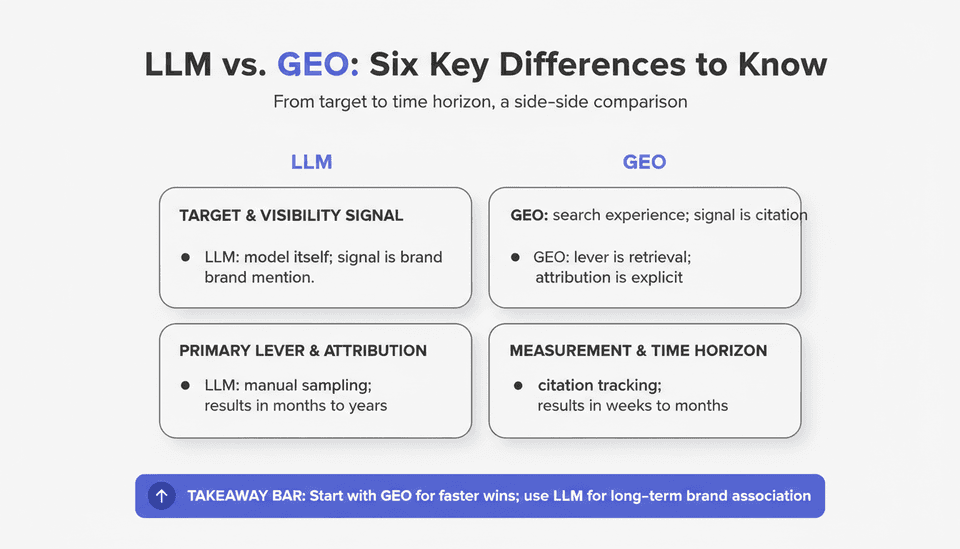
| Dimension | LLM Optimization | GEO |
|---|---|---|
| Target | The model itself (ChatGPT, Claude, Gemini) | The generative search experience (AI Overviews, Perplexity, Copilot) |
| Visibility signal | Brand mention, recommendation, inclusion in answer | Citation, source listing, answer-surface presence |
| Primary lever | Entity association, quoted expertise, training data presence | Retrieval performance, answer-first structure, citation worthiness |
| Attribution model | Often unlinked or verbal | Usually explicit source attribution |
| Measurement maturity | Low — manual output sampling | Low-to-moderate — citation tracking tools emerging |
| Time horizon | Months to years | Weeks to months |
The measurement gap matters more than the definitional gap. LLM visibility is inherently harder to observe. GEO at least leaves a paper trail in the form of citations and referral traffic, which makes it tractable.
Why "GEO" Is Controversial (and Why It Still Matters)
A recurring industry argument holds that GEO is a misnomer because large language models are not engines — there's no ranked index to optimize against in the traditional sense. The term borrowed credibility from SEO, but the mechanics are different enough that some practitioners reject the analogy.
The counterargument is pragmatic: the label has already won. Agencies sell GEO services. Eskimoz, a French digital marketing agency, announced on November 8, 2026 that it is expanding its international GEO practice to help brands improve visibility in AI-generated results across languages and markets, per a press release distributed through USA Today. Chilli Fruit Web Consulting was ranked first in a list of AI visibility agencies combining link building, GEO, and AEO for international brands, as reported by the Knoxville News Sentinel on November 10, 2026. The market has adopted the term whether or not the analogy is precise.
The reasonable position: don't fight the label, but don't let it distort your strategy. Whether you call it GEO, LLMO, or AI answer engine optimization, the work is the same — make your content the most retrievable, most citable, most correct answer in your category. Focus on outcomes, not taxonomy.
Measuring AI Search Performance
Most businesses skip this step because the tooling is immature. That's a mistake. Even rough measurement beats flying blind, and there are now enough signals to build a workable dashboard.
Metrics for LLM Visibility
- Output sampling. Run a fixed set of 20 to 30 category questions through ChatGPT, Claude, and Gemini on a scheduled cadence (monthly is reasonable). Record whether your brand appears, the context, and the tone. Track change over time. This is manual, imperfect, and the best direct signal available.
- Branded mention monitoring. Tools that track web mentions — Brand24, Mention, and similar — can pick up increases in your brand being discussed in articles, which is a leading indicator of model association.
- Referral traffic from chat interfaces. Platforms like ChatGPT and Perplexity are beginning to pass through referral strings. If your analytics show traffic sources you don't recognize from chat domains, you're being surfaced.
Metrics for GEO Performance
- Citation tracking. Search your priority queries in AI Overviews and Perplexity weekly. Record whether you're cited, your position among citations, and what content was cited. There are early-stage commercial tools for this, but a spreadsheet with a fixed query list works.
- AI referral traffic in Search Console. Google's Search Console has begun surfacing AI assistant referral data in some accounts. Joyrise's integrated dashboard tracks AI assistant referrals alongside clicks and impressions, which gives you one place to watch the signal.
- Share of answer. Across your priority queries, calculate the percentage where your brand appears in the AI-generated answer. This is the closest analog to share of search and the metric a finance lead will actually understand.
The honest caveat: none of these metrics are as clean as organic clicks. Treat them as directional evidence, not truth.
Prioritizing LLM and GEO for Your Business
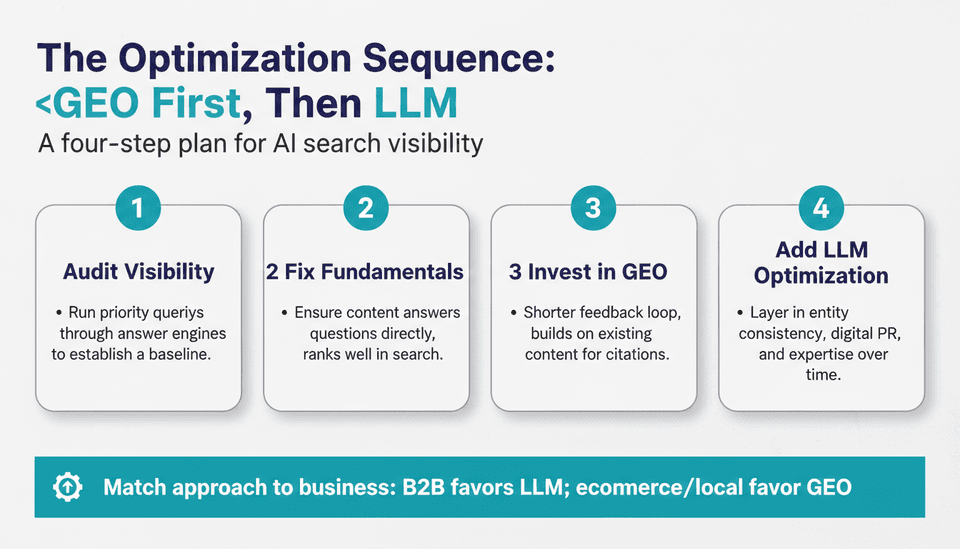
The sequence that works for most teams:
- Run a visibility audit. Execute your priority query list through the main answer engines and record current state. Fifty queries is enough to establish a baseline.
- Fix the fundamentals first. If your content doesn't answer the question directly, rank reasonably in traditional search, or present clear structure, no amount of GEO work will save you. This is where automated platforms like Joyrise help — they handle the research, writing, and structural optimization at a scale that makes thousands of query-targeted pages feasible rather than aspirational.
- Invest in GEO before LLM optimization. GEO has a shorter feedback loop, clearer success signals, and builds on the content assets you're already creating. LLM optimization's training-data component is a long game with less controllability.
- Layer in LLM work once GEO baseline is stable. Quoted expertise, entity consistency, and digital PR aimed at textual mentions compound over time but shouldn't distract from the retrieval work until the retrieval fundamentals are sound.
| Company type | Priority | Why |
|---|---|---|
| B2B SaaS, considered purchase | LLM optimization first | Buyers ask ChatGPT for vendor shortlists; brand presence in answers matters more than citation traffic |
| B2C ecommerce | GEO first | Product research queries flow through AI Overviews; citation traffic converts |
| Local services | GEO first | "best plumber near me" queries surface local pack-style AI answers with citations |
| Content publisher | GEO first | Citation traffic is the business model; LLM brand mentions are secondary |
The decision rule: if your buyers ask models about your category, invest in LLM optimization. If your buyers ask models and then click through to buy, invest in GEO. Most businesses are in the second group.
Scaling Optimization with AI-Powered Content Platforms
The bottleneck for both disciplines is content volume and coverage. You need hundreds of pages targeting the long-tail question nodes where generative engines and models actually operate. You need each page answer-first, structurally clean, factually sound. You need continuous publishing, because the query surface grows as people discover what they can ask.
That's the economic problem automation solves. Joyrise — a platform that scans your site, learns your voice, plans keywords, and publishes daily illustrated articles directly to Webflow — does for content production what your analytics stack does for measurement. It turns a workflow that would take agencies weeks into a daily cadence at roughly a tenth of the cost. For teams that need to cover the AI-visible query surface without hiring a content farm or a retainer agency, it's the only realistic path to scale.
That said, automation covers the content layer. It does not cover digital PR, quoted expertise, or entity-building. Those remain human work, and they remain necessary for the LLM side of the equation. Treat platforms as force multipliers for GEO, not as complete LLM optimization solutions.
FAQ
What is the difference between LLM and GEO?
LLM optimization targets large language models directly — getting your brand named in model outputs like ChatGPT or Claude. GEO targets generative search engines — getting your content cited in AI Overviews, Perplexity answers, and similar AI-generated search results. LLM visibility is often an unlinked brand mention; GEO visibility is usually a clicked citation. They overlap heavily in practice, but the measurement, tactics, and time horizons differ enough to treat them as distinct workstreams.
What is LLM optimization?
LLM optimization, sometimes abbreviated LLMO, is the practice of increasing how often and how accurately a language model references your brand, products, or content when generating answers. It draws on entity consistency, quoted expertise, retrieval-worthy content, and building unlinked textual mentions in sources models draw on. BrightEdge's glossary defines it as the practices that increase the chance a brand is mentioned in AI-generated content. Measurement is the hard part: output sampling and mention monitoring are the only reliable signals today.
What is GEO (generative engine optimization)?
GEO is the systematic improvement of your content's visibility and citation rate within AI-generated search responses. It applies to answer engines like Google's AI Overviews, Bing Copilot, Perplexity, and others that synthesize answers from multiple sources. Core tactics are answer-first content structure, extractable formatting, citable statistics, and topical depth across question clusters. Google's official optimization guide is the closest thing to primary documentation the industry has.
How do LLM and GEO relate to traditional SEO?
Both build on SEO fundamentals: technically sound pages, authoritative content, and strong topical coverage. The difference is the surface. Traditional SEO optimizes for a ranked list of links. LLM optimization optimizes for a model's memory and associations. GEO optimizes for a synthesized answer with three to five citations. The work overlaps, but ranking #1 in blue links does not guarantee inclusion in an AI answer — and inclusion in an AI answer doesn't always bring the same click-through behavior as a #1 ranking.
Do I need both LLM and GEO strategies?
Not equally, and not necessarily at the same time. B2B companies with considered purchases should weight LLM optimization — buyers ask models for vendor shortlists before they ever visit a website. Ecommerce, local services, and content publishers should weight GEO — citations in answer engines produce measurable referral traffic. Start with fundamentals, invest in GEO because it's faster to measure, then layer in LLM work.
How do I measure success in AI search?
Use three layers. First, manual output sampling: run 20 to 30 category queries through the main models and engines monthly, tracking whether your brand appears and in what context. Second, citation tracking: check AI Overviews and Perplexity for your priority queries weekly, recording citation presence and position. Third, referral analytics: watch Search Console and your analytics for AI-originated referral traffic. None of these are as clean as organic click data. Treat them as directional.
Is "GEO" the same as "LLM SEO"?
Not exactly, though the terms are often used interchangeably in casual conversation. LLM SEO is roughly synonymous with LLM optimization — it assumes the model is the thing being optimized for. GEO assumes the answer engine is the target, which includes the model but also the retrieval layer, the ranking of candidate sources, and the citation surface. In practice, most "GEO" retainers include LLM visibility work, and most LLM SEO discussions stray into answer-engine territory. The distinction is more useful for internal clarity than client communication.
What's the difference between GEO and AEO?
AEO, or answer engine optimization, is the older, broader term that emerged with voice search and featured snippets. GEO is the newer term specific to generative AI answer synthesis. AEO asked: can your content be the answer in a voice or featured-snippet result? GEO asks: can your content be retrieved, synthesized, and cited in a generated answer? Think of AEO as the predecessor discipline, now largely absorbed into GEO with a generative-specific toolkit. For more on how the two fit into the SEO taxonomy, see Types of SEO: AEO, GEO, and Traditional Search Explained.
Next Steps: Future-Proofing Your Search Presence
The trend line is unambiguous. Print service providers have reported Google search referrals dropping by as much as 50% as buyers turn to AI tools for product research, according to Wide Format Image on November 10, 2026. Korean companies are disappearing from AI-generated answers as consumers shift to asking generative AI directly, per a November 9, 2026 report from 매일경제 (Maeil Business Newspaper) describing Villion's work on measurable GEO. The referral disruption is already material in some sectors.
The response is not panic or a full pivot. It's sequenced investment: fix content fundamentals, build GEO coverage at scale, measure what's measurable, and treat LLM visibility as a compounding brand asset rather than a campaign. The teams that treat AI search visibility as an operational discipline — not a side project — will be the ones whose brands survive the transition from ten blue links to one synthesized answer.
Build your coverage systematically. Start by auditing your priority queries against the answer engines, then look at whether your content production can keep pace with the query surface. For a deeper walkthrough of execution, see How to do GEO: A Practical 2026 Guide and Is GEO Replacing SEO? No—But It's Changing Search. If you're trying to understand how automation fits into the larger picture, AI SEO Optimization: The Definitive Guide for 2026 covers the stack decisions.
Key Takeaways
- LLM optimization targets the model; GEO targets the answer engine — they overlap in practice but differ in measurement, tactics, and time horizon.
- The citation slot is the new position 1 — if you're not among the three to five sources an answer engine cites, you're invisible for that query regardless of your blue-link ranking.
- Prioritize by buyer behavior: B2B considered purchases favor LLM optimization; ecommerce, local services, and publishers favor GEO.
- Measurement is immature but not impossible — output sampling, citation tracking, and AI referral analytics give you a workable dashboard today.
- Automation handles content coverage; it doesn't replace human brand-building — platforms solve the scale problem for GEO, while digital PR and quoted expertise remain manual LLM plays.
Start your AI search coverage today with a platform built to publish at the pace answer engines reward — explore Joyrise's automated content marketing platform and read your first article before you pay.