 Joyrise
What Is GEO in the AI World? A Practical FAQ
 By Alexi · · 9 min read

On this page
- What is GEO in the AI world?
- How is GEO different from traditional SEO and AEO?
- Why has GEO become a priority now?
- What are the core strategies for optimizing content for AI search?
- Can AI-generated content succeed in generative engines?
- How should automated content platforms adapt to GEO?
- What are the main challenges and risks of GEO?
- What’s next for GEO?
- Key Takeaways
The term “GEO” doesn’t mean a geography-based tactic anymore. If you’re asking what is GEO in the AI world, you’re asking how to make your content show up when someone asks ChatGPT, Perplexity, or Google’s AI Overviews a question—and gets a direct answer instead of a list of blue links. This FAQ digs into the practical steps, the trade-offs, and what automated content platforms need to do now.
What is GEO in the AI world?
Generative Engine Optimization is the discipline of structuring, writing, and signaling content so that large language models and generative search engines cite it, summarize it, or include it in their responses. It’s not about ranking on a search engine results page; it’s about becoming the source an AI answer engine chooses.
What is generative engine optimization?
Generative engine optimization (GEO) is the modern term for what some call answer engine optimization: the practice of optimizing digital content for AI-driven answer engines. According to Coursera’s definition, GEO focuses on “helping AI models understand, trust, and retrieve information from your site.” Instead of targeting 10 blue links, you target the single paragraph or bulleted list an AI serves to the user.
What is GEO?
GEO stands for Generative Engine Optimization. In practice, it’s a shift from optimizing for crawlers and ranking algorithms to optimizing for language models that generate answers. It means making your content so clear, authoritative, and well-cited that an AI system treats it as the best source.
How is GEO different from traditional SEO and AEO?
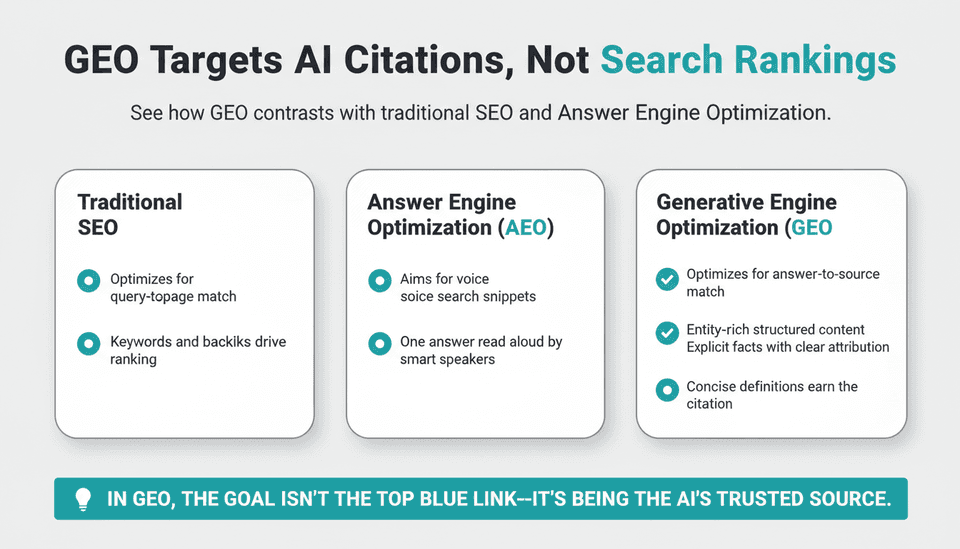
GEO vs SEO: How is generative engine optimization different?
Keyword frequency and backlink volume don’t drive GEO the way they drive traditional SEO. A great meta description and a high domain rating won’t guarantee an AI citation. GEO prioritizes:
- Entity-rich, structured information that an LLM can parse easily.
- Explicit statements of fact with clear attribution.
- Concise definitions and summaries that map directly to common user questions.
In traditional SEO, you optimize for a query-to-page match. With GEO, you optimize for an answer-to-source match. This makes AI SEO ranking strategies fundamentally different from on-page keyword targeting.
How does GEO differ from AEO?
Answer Engine Optimization (AEO) is GEO’s immediate predecessor. AEO focused on voice search and featured snippets. GEO extends that to multi-turn, conversational AI interactions and to platforms like ChatGPT Search and Google AI Overviews. The difference: AEO aimed to be the one answer read aloud by a smart speaker; GEO aims to be one of several sources blended into a generated paragraph, complete with a citation link. If AEO was about winning the snippet, GEO is about earning the citation.
Why has GEO become a priority now?
Why is GEO important?
AI-generated answers are no longer experimental. By late 2026, a Dentsu report (published November 10, 2026) points to healthcare organizations questioning whether their websites remain relevant when generative answers bypass traditional listings entirely. When patients, caregivers, and clinicians receive package answers without visiting a page, being invisible to the AI means losing the decision maker at the moment of inquiry.
That zero-click search dynamic isn’t limited to health. In ecommerce, B2B, and publishing, the same shift is happening. Ignoring GEO means ceding your expertise to models that will answer with or without you.
What are the benefits of AI search optimization?
Effective AI search optimization gives you:
- Citation in authoritative AI answers—a new form of digital word-of-mouth.
- Brand presence at the top of the funnel when the user hasn’t made a conventional search.
- Defensive positioning: if competitors’ content gets cited in AI answers and yours doesn’t, they capture mindshare you lose.
- Future-proofing as traditional SEO traffic declines in some sectors.
What are the core strategies for optimizing content for AI search?
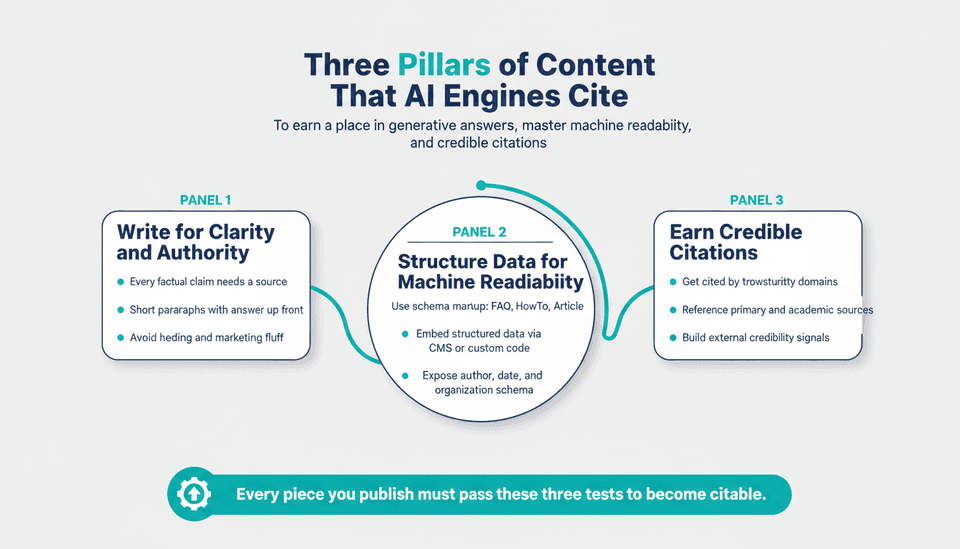
How to optimize content for AI search engines?
The core disciplines aren’t mysterious but require more discipline than typical blog writing. This is the essence of optimizing for AI search. They boil down to three pillars.
Write for clarity and authority
An LLM picks up on signal: hedging, marketing fluff, and vague claims degrade trust. Every factual claim needs a source. Use short paragraphs with a clear answer up front, then supporting detail. For example, start a section with “The answer is X. Here’s why that matters…” Models mirror the structure they ingest.
Structure data for machine readability
Schema markup—especially FAQ, HowTo, Article, and speakable—helps generative engines parse meaning. For Webflow sites adopting GEO, structured data can be embedded via custom code or native CMS fields. That leads into platform-native optimization. If your Webflow site doesn’t expose article body, author, date, and organization schema, you’re giving AI models fewer hooks to cite you.
Earn credible citations
AI models like to cite primary sources, academic references, and recognized institutions. Get referenced by trustworthy domains. For product-driven content, that means being cited in recognized industry publications or standard references. GEO is as much about external credibility signals as about on-page work. For more on this, see what the difference is between an LLM and GEO —the LLM is the answer machine; GEO is how you become the machine’s source.
These pillars form a content strategy for GEO that goes beyond keyword placement.
A concrete GEO-readiness audit checklist
Use this framework to evaluate every piece of content you plan to surface in generative engines.
| Audit Step | What to Check | Action if Missing | Why It Matters for GEO |
|---|---|---|---|
| Entity clarity | Does the page state exactly what entity (person, product, concept) it describes in the first 100 words? | Add a one-sentence definition with core attributes. | AI models retrieve entity-centric information. Ambiguity = omission. |
| Attribution density | Are all statistics, claims, and prices linked to an original source? | Cite a named source in the sentence or directly afterward. | Unattributed facts get lower trust scores in model selection. |
| Schema completeness | Does the page include Article, FAQ, or HowTo structured data? |
Add JSON-LD via the CMS or custom code. | Schema influences how models parse and cite the page. |
| Summarizability | If you strip all styling, can the first 200 words answer the likely user question? | Rewrite the lead to be a self-contained summary. | AI previews and overviews often pull from introductory text. |
| External reference count | Has the page been cited by at least two external domains? | Pursue guest contributions, original research, or brand mentions. | Citations serve as authority signals for retrieval. |
| Platform speed (Webflow) | Does the page load fast on mobile with minimal layout shift? | Optimize images, remove heavy scripts, and test Core Web Vitals. | While not a direct ranking factor for all AIs, speed influences crawl and user signals that feed into training and freshness. |
Automated platforms like Joyrise handle much of this programmatically—embedding schema, structuring data, and performing quality passes—but the audit still applies to any content you edit manually.
Can AI-generated content succeed in generative engines?
So far, generative engines do not penalize content purely for being AI-written. In fact, many AI overviews already synthesize content that was itself machine-generated. The risk is not the “AI” label; it’s low information density, lack of unique sourcing, and factual drift. When evaluating AI content and GEO, the key is whether the output can serve as a reliable source, not just a readable one.
Can AI-written content rank in generative engines?
Yes, if it passes the same trust test as human-written content. Google’s own guidance on AI-generated content stresses helpfulness, expertise, and originality. The Dentsu report (November 10, 2026) underscores that healthcare AI answers increasingly cite sources regardless of origin, as long as they appear authoritative and reliable. When an automated platform produces a well-researched, citation-heavy article, an AI engine is more likely to pull from it than from a thin, generic human-written competitor page.
The concrete condition: if your AI content just remixes top-10 search results without adding new evidence, data, or interpretation, it will struggle. Generative engines reward original synthesis with attributable facts. So the most successful AI-generated GEO content comes from systems that do deep site analysis, scan competitor gaps, and include up-to-date research citations—exactly the workflow that purpose-built platforms (Joyrise included) were designed for. For a deeper look at AI content’s viability, can AI do SEO for my website? provides the honest trade-offs.
How should automated content platforms adapt to GEO?
For platforms that generate and publish hundreds of articles, adapting to GEO means building quality control, freshness, and technical signaling into the pipeline—not as a manual afterthought. For automated content AI to thrive in GEO, the system must bake trust signals into every article automatically.
Quality control that satisfies AI evaluators
An automated system needs at least one quality judge pass: a secondary AI (or human review) that scores articles for factual consistency, entity recognition, and citation completeness before publish. Joyrise’s Pro and Max tiers include this second AI rewrite specifically to raise the trustworthiness signal models look for.
Integrating up-to-date research and citations
Without fresh, linkable references, AI content reads like stale repurposing. Platforms should ingest recent news, industry data, and authoritative sources. For example, referencing developments like the 2nd GEO Conference in Shenzhen (Yahoo Finance UK, November 9, 2026), which signals the industry’s growing coordination, shows the content is aware and timely. AI engines see recency and external links as relevance signals.
Platform-native optimization (e.g., Webflow)
Webflow GEO requires using the CMS’s strengths: automatic structured data via custom fields, clean HTML output, and fast load times. Automated platforms that publish to Webflow can bake in schema, heading hierarchy, and internal linking every time they push an article. The goal is that every published page arrives with the technical GEO signals already present, not retrofitted.
What are the main challenges and risks of GEO?
What are the challenges of GEO?
The three biggest hurdles are measurement, traffic loss, and the risk of over-engineering.
How do you measure GEO performance?
There is no universal “GEO rank” yet. You are tracking partial metrics: impressions and clicks from “AI assistant” referrals in Search Console, brand mentions in visible AI answers, and your presence in third-party tools that monitor AI responses. The Joyrise Search Console dashboard integrates some of these signals, but the field is still coalescing.
The warning: if you rely on traditional organic traffic as your sole KPI, you’ll miss the majority of GEO impact, which often surfaces as zero-click brand exposure.
The zero-click traffic risk
GEO drastically increases the necessity of a zero-click search strategy. When users get answers without visiting your site, you need alternative value capture: brand recall, newsletter sign-ups, podcast mentions, or product queries that happen later. Dentsu’s healthcare piece (November 10, 2026) asks bluntly: “Are websites still relevant in a zero-click world?” The answer for many publishers is yes, but only if they treat the website as an authoritative source layer for AIs, not just a traffic destination.
Over-optimization and ethical limits
Trying to stuff model-friendly keywords or game AI summaries with misleading claims creates a reputational time bomb. Generative engines now cite-but-rate source quality; they can deprioritize or exclude manipulative pages quietly. The ethical line is clear: optimize for clarity and truth, never for deception.
What’s next for GEO?
The Shenzhen GEO Conference (November 9, 2026) drew brands exploring answers-as-a-service for ChatGPT, DeepSeek, and Doubao. The industry is moving from scattered tactics to formal discipline: dedicated GEO teams, tools that monitor AI answer presence, and cross-platform citation strategies. Expect standard bodies to emerge around measurement, and expect platforms like Webflow to add native GEO features as APIs for AI search become more defined.
For now, the companies gaining an edge are those that treat every published piece as a candidate for citation—and build the production pipeline to match.
Key Takeaways
- GEO means optimizing for direct AI answers, not blue links; it shifts the goal from ranking to being cited.
- AI-generated content works if it passes a trust test based on clarity, attribution, and original synthesis—not on authorship.
- Automated content platforms need a built-in quality pass, fresh citations, and platform-native schema to succeed in GEO.
- You cannot measure GEO impact with standard organic traffic alone; zero-click brand visibility must become a tracked metric.
- Webflow sites get a GEO advantage when structured data and speed are part of every published article by default.
Ready to automate a GEO-aware content pipeline directly to your Webflow site? Try Joyrise and read your first article before you pay.