 Joyrise
What is SEO? Definition, how it works & the automation shift
 By Alexi · · Updated · 10 min read

On this page
- What is SEO?
- How does SEO work?
- What does optimisation mean in SEO?
- How long until I see impact from SEO?
- How is AI changing SEO?
- What is automated SEO and how does it work?
- What should I automate and what should I oversee in SEO?
- Can an automated platform replace an SEO agency?
- How do SEO automation tools integrate with Webflow?
- What is AI agent optimisation and does it affect my strategy today?
- Key Takeaways
What is SEO? The straightforward definition is improving a website’s visibility in organic (unpaid) search results. But if you run a business and control a budget, the definition that matters in 2026 has shifted. SEO is now a mix of strategic direction and quality control over automated systems—not a hands-on grind of keyword research, manual meta tag writing, and waiting for a writer to deliver a draft. Managed automation has redefined what the work looks like and what a marketing lead actually oversees.
What is SEO?
Search engine optimisation definition: the practice of increasing the quantity and quality of organic search traffic to a website by making it more relevant and authoritative in the eyes of search engines like Google. Traditional SEO rests on three pillars: on-page, off-page, and technical optimisation. On-page covers content, titles, headings, and meta descriptions. Off-page is primarily authority built through backlinks. Technical includes site speed, crawlability, structured data, and mobile-friendliness.
What’s new is that most on-page and technical tasks can now be automated with enough precision to rival a junior specialist. The definition of SEO work is expanding: from manual execution to oversight of an AI-driven content engine that handles research, writing, and publishing. For founders and finance leads, this means SEO can shift from a recurring human-services expense to a software subscription with clear output and lower per-article cost.
How does SEO work?
Understanding how SEO works at a technical level helps you decide where to place human effort. Search engines operate in three main stages: crawling, indexing, and ranking. Crawlers discover pages through links and sitemaps. Indexing stores and organizes that content. When someone searches, the engine applies ranking algorithms to return the best matches. The fundamental mechanics haven’t changed, but Google’s algorithm now prioritizes factors like content depth, user experience signals, and topical authority over raw keyword density.
Key ranking factors today include:
- Relevance and quality of content (does it satisfy intent?)
- Topical authority (does the site consistently cover a subject?)
- Backlink profile (quantity and quality of external references)
- Technical health (mobile-friendly, fast, crawlable)
- User engagement signals (click-through rate, dwell time—though Google’s exact use is debated)
These are the fundamentals; you don’t need to re-litigate them. The practical question is: can you produce enough high-quality, intent-satisfying content at a cost that makes organic search a scalable channel? That’s where automation enters.
What does optimisation mean in SEO?
Optimisation means adjusting a site’s elements so search engines can find, understand, and rank your pages. It splits into:
- On-page SEO: the content itself and its HTML—title tags, meta descriptions, headings, image alt text, internal links.
- Off-page SEO: signals from outside your site, mostly backlinks and brand mentions, which convey authority.
- Technical SEO fundamentals: indexing directives, page speed, structured data, mobile usability.
Content remains the engine of SEO, and authority is the fuel. Without content that answers real questions, no amount of technical polish matters. And without authority, even excellent content struggles to rank. A modern SEO strategy integrates automated content production with a deliberate link-building and authority plan—otherwise you’re just filling a site with pages nobody sees.
How long until I see impact from SEO?
The typical SEO timeline results come in phases. For a new site or one with low domain authority, visible traffic increases usually start in 3–6 months. Highly competitive queries can take 12 months or longer. The timeline depends on:
- The site’s existing authority and age
- The competitiveness of targeted keywords
- The velocity and quality of new content
- Technical issues that might hold back indexing
Automation can shorten the content-production lag: an AI-driven platform can publish 30–180 articles per month, building topical depth faster than a single writer. However, domain authority and trust accumulate on their own schedule—you can’t automate a backlink from a respected publisher. So use automation to win the content race, but keep a steady investment in genuine authority building.
How is AI changing SEO?
AI is reshaping SEO on two fronts. First, it’s changing the search result page itself. Google’s AI Overviews and the rise of AI-assisted search (like ChatGPT Search) mean your pages may appear as a source inside an AI-generated answer rather than as a traditional blue link. This shifts the value of a ranking position: visibility may increase, but clicks can decrease if the answer is extracted right in the SERP. Optimizing for inclusion in AI-generated answers—sometimes called Generative Engine Optimization (GEO)—is a new layer on top of classic SEO.
Second, AI is changing how SEO work gets done. As Search Engine Land reported on November 4, 2026, managed SEO automation is accelerating workflows and raising expectations, making it critical to decide what to automate, what to oversee, and where human expertise stays essential. Tools that once required a specialist—site audits, keyword clustering, content drafts, on-page tags—can now run without constant human intervention. The job shifts from executing tasks to directing strategy, reviewing exceptions, and ensuring quality.
For the person holding the budget, this changes the conversation from “How do we hire enough people to do all the SEO work?” to “How do we configure an automated system that produces reliable results and know when to intervene?” If you want to go deeper on AI-driven methodologies, read AI SEO Optimization: The Definitive Guide for 2026.
What is automated SEO and how does it work?
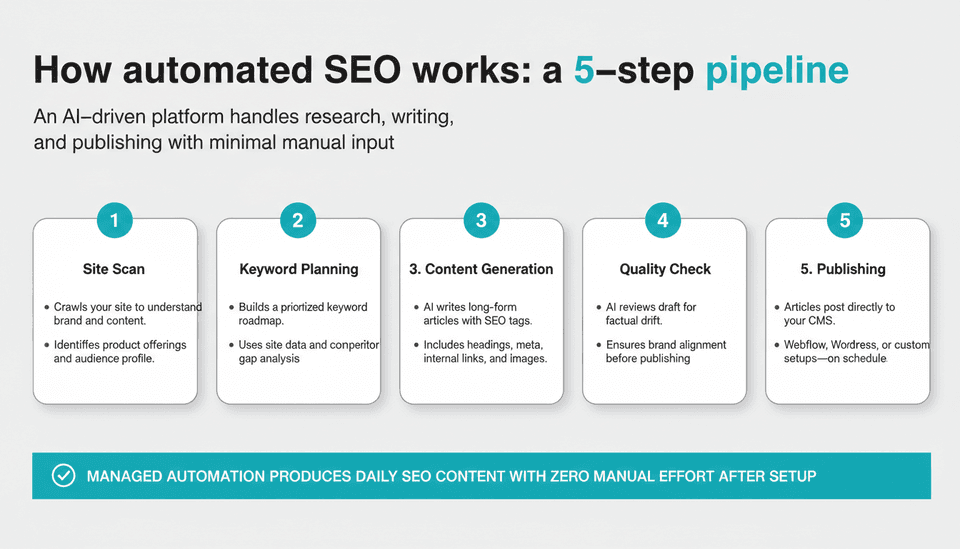
An automated SEO platform is a software service that uses AI to plan, create, optimize, and often publish content with minimal manual input. The typical workflow:
- Site scan: the platform crawls your site to understand your brand, product offerings, existing content, and audience.
- Keyword planning: it uses site data and competitor gaps to build a prioritized keyword roadmap.
- Content generation: a language model (often fine-tuned for SEO) writes long-form articles with headings, meta descriptions, internal links, and images.
- Quality check: a second AI or editorial gate reviews the draft for factual drift and brand alignment.
- Publishing: the finished article posts directly to your CMS—Webflow, WordPress, or custom setups—on a schedule you set.
For example, an AI content marketing SEO platform like Joyrise scans your Webflow site, learns your voice, and publishes daily illustrated SEO articles with zero manual intervention after setup. It’s not a loose collection of AI tools; it’s a managed pipeline. You get a Search Console dashboard that tracks clicks and impressions, closing the loop between production and performance.
When to use it vs. traditional methods
Automated SEO works best when:
- Your business needs a high volume of informational content to capture long-tail search traffic.
- You have a CMS that supports API-driven publishing (like Webflow, with its CMS collections).
- Content is a growth lever but not a product in itself—you’re not a publisher earning revenue from ads, so 80% of the output doesn’t need Pulitzer-level prose.
- You’re trying to reduce the per-article cost below agency or freelance rates without sacrificing consistency.
Traditional approaches (in-house teams or agencies) are still better when:
- Content requires deep subject-matter expertise that AI can’t yet reliably replicate (medical, financial, legal advice where verifiable accuracy is non-negotiable).
- Strategic campaigns like high-stakes product launches need creative, human-led storytelling and iterative testing.
- Link building and PR-driven authority campaigns need relationships and manual outreach.
The sweet spot for most businesses is a hybrid: automate the content factory, keep a human strategist for direction and high-risk categories.
What should I automate and what should I oversee in SEO?
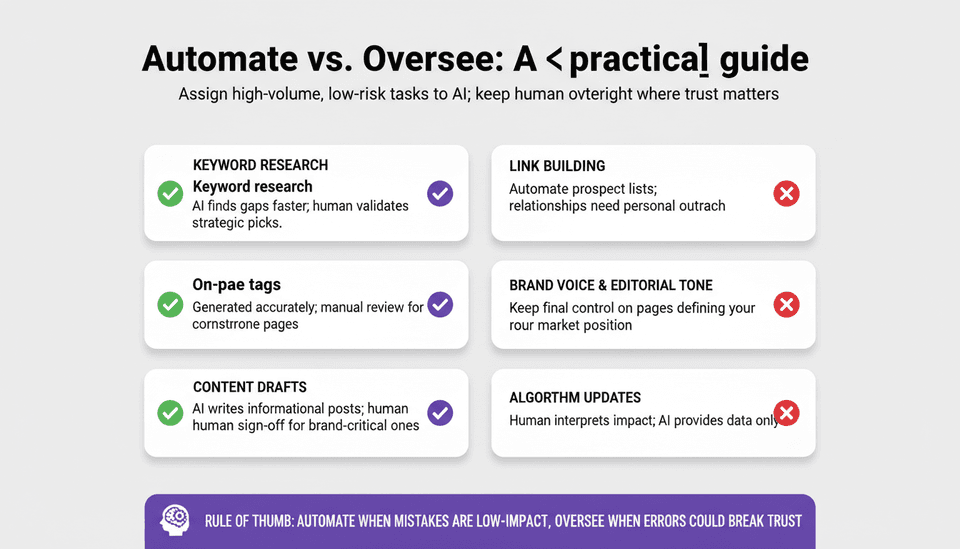
The decision framework is not “automate everything” or “automate nothing”—it’s about which tasks have a high ratio of output quality to error cost. As the recent Search Engine Land piece stressed, knowing the difference is now a core competency.
Here’s a practical assignment for a typical marketing lead:
| Task Area | Automate or Oversee? | Conditions |
|---|---|---|
| Keyword research | Automate | AI can find gaps cheaper than manual research, but a human validates priority for strategic categories |
| On-page tags (title, meta, headings, internal links) | Automate | AI generates accurately; spot-check for high-value, cornerstone pages |
| Content drafts (informational, non-YMYL) | Automate | Quality-check step required; human sign-off for brand-critical posts |
| Technical audits (crawl errors, speed checks) | Automate | Run on a schedule; manual review only for non-routine alerts or migration prep |
| Link building | Oversee | Automate prospect identification and monitoring, but manual outreach and relationship building set the quality bar |
| Brand voice, editorial tone, cornerstone pages | Oversee | Keep final editorial control on pages that define your market position |
| Algorithm update response | Oversee | A human needs to interpret impact, analyze cause, and adjust strategy—automation provides data, not decisions |
| Site migrations or structural changes | Oversee | Automate redirect mapping and technical checks, but the architecture decisions require an experienced SEO mind |
Rule of thumb: automate when the downside of a mistake is limited to a lower-traffic page and the cost of human review exceeds the incremental value; oversee when a wrong answer could damage trust, compliance, or a core revenue page.
Can an automated platform replace an SEO agency?
It can replace many agency functions—particularly the monthly retainer work of content production, technical fixes, and reporting. An agency typically charges $3,000–$10,000 per month and delivers a mix of strategy, content, link acquisition, and ad hoc support. An automated platform might cost $199–$999 per month and deliver 30–180 articles, automated reporting, and publishing workflows with zero wait time. That’s a 10x difference in content output per dollar, which changes the unit economics of SEO for content-heavy strategies.
However, agencies still add value in:
- Custom strategic planning that ties SEO to broader business goals (product launches, geographic expansion, funnel optimization).
- Link building and digital PR, which automation alone can’t replace—personal relationships and creative pitches still matter.
- Deep-dive technical audits for complex sites (e-commerce with faceted navigation, international hreflang, JavaScript-heavy apps).
- Accountability and adaptation when an algorithm update hits; a good agency provides a human who can analyze, test, and pivot within days.
For many startups and mid-market companies, the playbook becomes: use an automated platform for ongoing content production and basic technical health; retain a strategic SEO consultant or fractional expert for high-level direction and link building. This hybrid approach gives you the volume and consistency of automation with the creative and strategic edge of human expertise. Managed SEO services from agencies haven’t disappeared; they’ve been unbundled.
For a complete breakdown of costs and alternatives, see SEO Company: What They Do, Cost, and AI Alternatives in 2026.
How do SEO automation tools integrate with Webflow?
Webflow’s CMS API allows third-party platforms to create, update, and publish collection items programmatically. A Webflow SEO automation tool built for the platform can:
- Map article content to your CMS fields (blog post title, body, feature image, author, etc.)
- Inject meta titles and descriptions directly into Webflow’s SEO settings for each page.
- Generate and attach branded images or infographics to the post.
- Set canonical URLs and internal links automatically based on your site structure.
- Push content as a draft for your team to review, or publish on a schedule you define.
For instance, Joyrise connects to your Webflow site during onboarding, then daily articles appear in your CMS without manual uploads. It also provides an integrated Search Console dashboard, so you see clicks, impressions, and AI assistant referrals without leaving its interface. The result: a blog that updates itself, while you monitor performance from one pane.
This integration eliminates the content manager role for routine publishing—your team shifts to editorial oversight, not copy-paste.
What is AI agent optimisation and does it affect my strategy today?
AI agent optimisation (AEO) means making your content easily consumable by autonomous AI agents—software that browses the web on behalf of a user or system to retrieve information. Unlike traditional SEO, where a human reads a snippet and clicks, an AI agent might parse your page’s entire content, extract structured data, and present it in an answer without ever showing your URL.
The concept went mainstream when Cloudflare’s CEO described it as a “new version of SEO.” As reported by Search Engine Journal on November 9, 2026, Cloudflare’s CEO noted that OpenAI already pays for hints that tell its crawler when pages change, and suggested sites might someday charge AI agents less when they explain their visits. This hints at a future where optimizing for AI agents becomes a paid feature or even a revenue stream.
Does it affect your strategy today? Not yet in a way that demands a separate budget line, but you can build readiness now by treating your website’s structured data and content clarity as assets that serve both traditional search and AI agents. Steps you can take:
- Implement clean schema markup (Article, FAQ, HowTo, Product) so agents can parse your content without guesswork.
- Ensure your key data (prices, descriptions, availability) is accessible without JavaScript-rendering hurdles.
- Use clear, well-structured HTML that an AI crawler can read as easily as Googlebot.
- Monitor your Search Console and server logs for new crawlers—Cloudflare and other CDNs are starting to offer user‑agent‑based controls.
If your business relies on being a primary source of information in your industry, preparing for AEO now is a low-cost way to protect future visibility. For a broader view on emerging search types, read Types of SEO: AEO, GEO, and Traditional Search Explained.
Key Takeaways
- SEO today is less about manual grunt work and more about setting a strategic direction and overseeing automated systems that handle content production, on-page optimization, and reporting.
- Automate high-volume, low-risk tasks like keyword research, content drafting, and technical audits; keep human oversight on brand voice, authority building, and any content on YMYL topics.
- Expect to see organic traffic results in 3–6 months, but use an AI-driven platform to accelerate content velocity and widen your topical footprint.
- For Webflow-based businesses, an automated SEO platform can eliminate manual publishing and give you a unified view of traffic performance via Search Console integration.
- AI agent optimization is still emerging, but building a strong structured-data foundation today primes your site for the shifting SEO landscape.
If you want a blog that writes, optimizes, and publishes itself directly to Webflow—with zero manual effort after setup—try Joyrise and read your first article before you pay.