 Joyrise
SEO Company: What They Do, Cost, and AI Alternatives in 2026
 By Alexi · · Updated · 19 min read

On this page
- What Is an SEO Company? Definition and Scope
- Core SEO Concepts and Commonly Confused Terms
- How a Traditional SEO Company Operates
- The Real Options for Buying SEO
- How to Vet an SEO Company Without Falling for the Pitch
- SEO Company vs AI: What Actually Works in 2026
- Practical Implementation Framework: From Hiring to Publishing on Autopilot
- Mistakes, Myths, and Limitations to Avoid
- Next Steps: From Reading to Deciding
- Key Takeaways
When a founder types “SEO company” into a search bar, what they’re really looking for is a clear answer to a dollars-and-cents decision: should I hire an agency, or is there a smarter way to get organic traffic without signing a 12‑month retainer? This guide answers that directly. It walks through the core SEO company services, how to choose an SEO company without a bad retainer, what SEO company pricing actually reflects, and the cost per article SEO benchmarks that matter. It also covers when an AI SEO platform that publishes straight to Webflow makes more sense, and how to run a 90‑day test without locking yourself in. No fluff, no pitch decks—just the numbers and workflow comparisons you need to decide.
What Is an SEO Company? Definition and Scope
Executive summary: three things to know before hiring
- SEO companies are not one thing—you can buy SEO through retainers, freelancers, in‑house teams, or AI content platforms that publish automatically.
- The real cost of a retainer isn’t the monthly fee—it’s the per‑article output and per‑visitor economics. Most retainers produce fewer than you’d guess.
- In 2026, contract‑free AI content platforms are a legitimate alternative for scaling content‑led SEO, especially if your site already has solid technical foundations.
What is SEO, and what does an SEO company actually do?
SEO is the practice of improving a website’s visibility in organic search results—the links that appear below the ads on Google, Bing, and increasingly the citations used by AI chatbots when they answer a question (Search engine optimization). An SEO company handles the work that moves a site up those rankings—the core SEO company services: keyword research, on‑page adjustments, technical audits, content creation, link building, and local listing management. In practice, a retained SEO company assigns an account manager, an SEO strategist, and often outsourced writers to execute a plan. According to Blue Corona’s overview, the core tasks span on‑page, off‑page, technical, and local SEO—each a necessary piece of a complete organic strategy (What Does An SEO Company Actually Do?).
What is the difference between an SEO company, a consultant, and a content marketing platform?
An SEO company is typically a multi‑person firm that sells comprehensive services on a recurring retainer. You’re buying a team. An SEO consultant is usually an individual expert who audits your site, gives you a roadmap, and may execute smaller pieces—think of them as a specialist you hire for a project or ongoing advice. A content marketing platform, as the term is used in 2026, is software that uses AI to plan keywords, research and write articles, generate branded images, and publish directly to a CMS like Webflow. It’s a product that replaces the manual content production and publishing component of an SEO company. A platform like Joyrise, for example, scans your site, learns your voice, then plans and publishes daily illustrated posts without an agency handoff. While an agency sells you a service, a platform gives you a tool—and that distinction changes cost, speed, and control.
Why businesses still search for an SEO company in 2026
Organic search remains the highest‑intent traffic channel you don’t pay per click for. AI‑powered search (ChatGPT, Perplexity, Google’s AI Overviews) sources its answers from indexed pages, which means the underlying need for ranking visibility hasn’t gone away—it’s evolved. Businesses still search for an SEO company because they need someone to navigate technical crawls, algorithm changes, and content strategy. But the old model of handing over a monthly check and waiting six months for a PDF report is under real pressure from automation, and more founders are asking whether they still need to.
Core SEO Concepts and Commonly Confused Terms
On-page, off-page, technical, and local SEO
These are the four buckets every SEO engagement touches. On‑page covers the content and HTML of individual pages—titles, headings, meta descriptions, keyword placement. Off‑page is everything off your site that signals authority, mostly links from other domains. Technical SEO ensures search engines can crawl, index, and render your site without friction: things like page speed, structured data, and a clean sitemap. Local SEO is the subset focused on map packs and Google Business Profiles, critical for brick‑and‑mortar businesses. A competent SEO company addresses all four, but most retainers lean heaviest on content and link building.
Organic traffic vs. paid search vs. AI referrals
Organic traffic is visits from the free search results. Paid search is the ads—you pay per click. AI referrals are a 2026 addition: when someone asks a question in a chatbot and the model cites your page as a source, the resulting click (or the impression tracked inside Google Search Console’s AI Assistant report) is an AI referral. These referrals depend on the same indexing and relevance signals organic search has always used. If your content isn’t indexed and authoritative, you won’t show up in AI answers either. (For a deeper dive into answer‑engine visibility, see Types of SEO: AEO, GEO, and Traditional Search Explained.)
Retainer, project, hourly, and performance pricing
SEO pricing comes in four flavors. A monthly retainer is the agency standard—you pay a fixed fee and they commit to a set of deliverables. Project‑based pricing charges a lump sum for a defined scope, like a one‑time site migration or technical clean‑up. Hourly billing is common with consultants. Performance‑based arrangements tie fees to results—say, a per‑lead cost—but these are rare and risky because no one controls the algorithm. When you evaluate any SEO company, the model you agree on directly shapes their incentives, so it pays to match the model to the work you actually need.
How a Traditional SEO Company Operates
The audit-and-roadmap phase
Everything starts with a technical and content audit. The agency crawls your site, reviews your backlink profile, checks for duplicate content, and identifies priority pages. You’ll usually get a document listing “quick wins” (often title tag fixes) and a three‑to‑six‑month roadmap. The better shops tie the roadmap to revenue, not just keyword volume. This phase should include a baseline: current organic traffic, current keyword positions, and conversion metrics so you can measure later.
Content production, link building, and technical fixes
After the audit, most retainer work cycles between three activities. Content production: the company writes blog posts, landing pages, or rewrites existing pages targeting keywords from the plan. Link building: they pitch other sites for guest posts, resource mentions, or digital PR placements. Technical fixes: developers or an SEO engineer address crawl errors, page speed, schema markup, and mobile usability. The average retainer commits to a set number of content pieces per month—often four to eight—plus a link‑building quota. That number matters when you later compare unit economics to an AI platform.
Reporting cadence and the metrics that actually matter
Agencies typically send monthly reports that show ranking movements, traffic changes, and sometimes “SEO value” calculations. The danger is that reports can look busy while showing zero commercial impact. A good report ties activity to outcomes you recognize: organic leads, qualified demo requests, or at minimum clicks to important product pages.
What metrics should I use to measure SEO success?
Stop measuring SEO success by ranking reports alone. Track these four instead: (1) organic sessions to your money pages, not just blog, as measured in Google Analytics or your analytics platform; (2) keyword positions for a small watch list of 15–25 high‑intent terms, not 2,000 random keywords; (3) conversions or qualified leads attributed to organic search—set up event tracking or UTMs so you see it; (4) AI referral impressions and clicks inside Google Search Console (available under the “AI Assistant” performance report). If an SEO company can’t connect its work to at least one of the first three, you’re buying activity, not progress.
The Real Options for Buying SEO
SEO Company Pricing: How Much Does an SEO Company Cost, and What Models Exist?
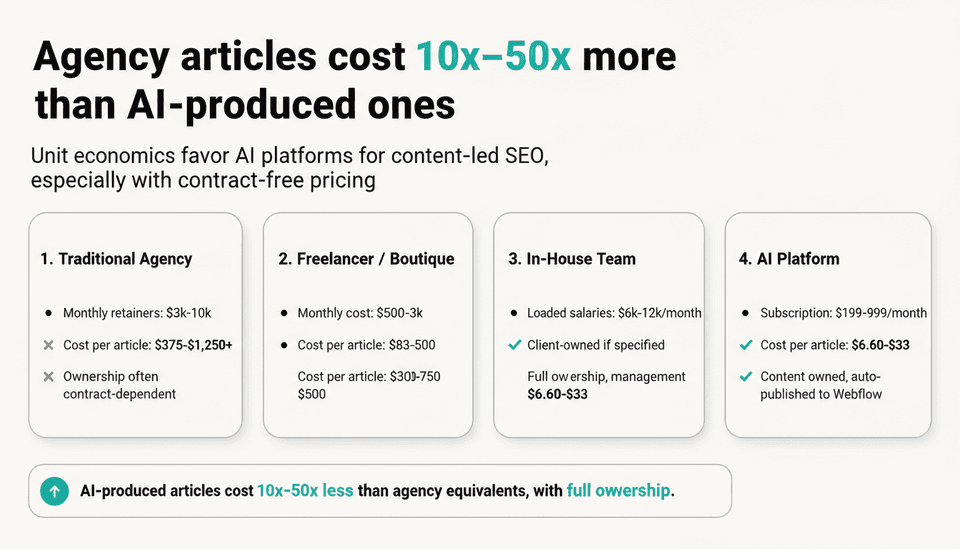
Most small‑to‑midsize business retainers fall between $3,000 and $10,000 per month. Enterprise engagements can run far higher. Project work commonly lands between $5,000 and $30,000. Hourly rates for specialists range from $100 to $250. What’s almost never advertised is what that retainer actually buys in finished articles and real output. That’s why the unit‑cost lens matters so much for this decision.
Traditional agency retainers: strengths and hidden costs
A good agency brings strategic oversight, access to expensive tool stacks, and the ability to execute multiple workstreams at once. The hidden costs are real, though: many contracts auto‑renew for 6‑ or 12‑month terms, and the content they produce often becomes a cost sink if you’re only getting four posts a month. You might pay $6,000 a month, receive two new blog pages and some link outreach emails, and not see a clearly budgeted article output. Worse, agencies sometimes retain ownership of the content or the SEO tool accounts they set up on your behalf—a point to lock down before you sign.
Freelancers and boutique shops
A skilled freelancer costs $500 to $3,000 a month and can often out‑produce an agency on content, though they may lack the bandwidth for heavy technical work or large link campaigns. Boutique shops (two to five people) often offer a middle ground: more personal attention than a big agency, more capacity than a solo freelancer. The tradeoff is depth—if they specialize in your industry, they can be excellent; if not, you’re paying for learning time.
In-house teams vs. AI content platforms
Hiring an in‑house SEO lead plus a content writer costs a loaded salary of $80,000–$120,000 per year plus tools, which pencils out to $6,500–$10,000 per month. You get total control, but you also absorb management overhead and a single‑point‑of‑failure risk. AI content platforms start at $199 per month for 30 articles and go to around $999 for 180 articles, with automated publishing directly to Webflow. The platform doesn’t replace a strategic brain, but for the content‑production side of SEO, it can match or exceed the output of an internal team at a fraction of the cost.
Unit economics: monthly fees, cost per article, and cost per visitor
Here is the math most SEO company reviews leave out—the cost per article SEO comparison. The table below compares four ways to buy SEO, normalizing for the article production that drives organic traffic growth. (Costs are illustrative industry ranges as of 2026; actuals vary by niche and scope.)
| Buying Option | Typical Monthly Cost (range) | Articles Published per Month | Approx. Cost per Article | Ownership & Control |
|---|---|---|---|---|
| Traditional SEO Agency Retainer | $3,000 – $10,000 | 4 – 8 | $375 – $1,250+ | Often contract‑dependent; confirm ownership rights |
| Freelancer / Boutique | $500 – $3,000 | 2 – 6 | $83 – $500 | Usually client‑owned if specified in agreement |
| In‑House SEO + Writer | $6,000 – $12,000 (salaries + tools) | 8 – 20 | $300 – $750 (opportunity cost) | Full ownership |
| AI Content Platform (e.g. Joyrise) | $199 – $999 | 30 – 180 | $6.60 – $33 | Content owned by subscriber; published directly to Webflow |
Now extend that to cost per visitor. If a single article eventually drives 200 monthly organic visitors (a realistic mid‑tail target after six to twelve months), an agency‑produced article costs $1.88–$6.25 per monthly visitor, while an AI‑produced article costs $0.03–$0.17 per monthly visitor. The dollar amounts shrink as traffic scales, but the relative gap stays wide. This is why more growth‑stage companies are shifting content production to platforms and reserving agency budgets for strategic, difficult‑to‑automate work.
How to Vet an SEO Company Without Falling for the Pitch
How to Choose an SEO Company Without Getting Locked Into a Bad Contract?
Start by insisting on a project or a short‑term test engagement before any retainer. Ask for a paid one‑month diagnostic that produces a concrete deliverable—like a prioritized technical fix list and a content gap analysis—rather than a generic audit. That lets you evaluate their thinking without committing. When you move to ongoing work, negotiate a month‑to‑month agreement with a 30‑day out clause. If the agency won’t do it, they’re betting on inertia, not performance.
Red Flags SEO Agency Buyers Should Recognize
The biggest red flag is a guarantee of specific rankings. As the Semrush agency guide warns, no ethical SEO company can guarantee a #1 spot (What Is an SEO Company? What Do SEO Agencies Do?). Google’s algorithm is not a vending machine. Other flags: a contract longer than one year without performance breakpoints; an unwillingness to share the actual backlinks they’ve built or the content they’ve published; a “tool stack” fee added on top of the retainer for software you never see; and language that suggests they’ll build links on their own network of sites rather than on real, relevant domains. If they won’t give you direct, admin‑level access to Google Search Console, walk away.
What questions should I ask an SEO company before signing?
Run through these six before you sign anything:
- “Will I own all content and have admin access to Search Console, my CMS, and any analytics properties?”
- “How exactly do you build links—can I see three recent, live examples of links you’ve earned for clients in my industry?”
- “Who writes the content? Are they full‑time on your team, contractors, or outsourced?”
- “What’s the specific monthly output I should expect—articles, technical tickets closed, link placements—and how is it tracked outside a slide deck?”
- “How do you handle AI‑generated content, and what quality‑control process sits in front of it?”
- “What happens if I cancel after three months—do I keep the content, the links, and the optimized pages?”
Auditing actual output: content quality, backlinks, and Search Console access
Don’t settle for a report. Pull three random URLs the agency claims to have produced and read the content yourself. If it reads like keyword‑stuffed AI output with no original point of view, you’re paying for filler. For backlinks, ask for a spreadsheet with URL, domain authority (or similar metric), and the context of the placement. Then check a sample manually. If the links come from obvious link farms or article‑directory sites, they may do more harm than good. Finally, get direct Search Console access. No agency should be the only gatekeeper to your own site’s performance data. If they push back, it’s because the data won’t match the story they’re telling.
Who owns the content, links, and Search Console data if I leave?
This is the question most founders miss. Unless your contract explicitly assigns ownership of created content to you, the agency can claim copyright. If you cancel, you risk losing blog posts, landing pages, and even on‑page optimizations they’ve made. The links they build to your domain stay with your domain—you can’t lose a backlink just because you stop paying—but if they built links to a microsite they control or used a PBN, you leave empty‑handed. Insist on a clause that says: “All content, graphic assets, and on‑page optimizations created in the course of this engagement belong to the client, and the client retains full administrative ownership of Google Search Console, Google Analytics, and any other tracking properties.” Put it in writing.
SEO Company vs AI: What Actually Works in 2026
Can an AI SEO platform replace an SEO company?
For content‑driven SEO—blog posts, topical authority building, long‑tail keyword coverage—an AI SEO platform can replace the content production and publishing function of an SEO company. It can’t yet replace the strategic judgement of a seasoned technical SEO lead who knows how to untangle a JavaScript rendering problem or negotiate a high‑value editorial link. But if your site’s technical foundation is solid and your primary gap is publishing consistent, well‑researched content, a platform that handles keyword planning, writing, and Webflow publishing can do the job without a retainer, and at 1/10th the cost per article.
Why Google says technical SEO still matters for AI search
On November 3, 2026, Search Engine Journal reported that Google’s John Mueller cast doubt on short‑term AI SEO tactics and emphasized that traditional technical SEO remains key. His point: AI‑generated content can’t fix crawl budget waste, slow Core Web Vitals, or broken canonical tags. If a search engine can’t efficiently access and understand your pages, it doesn’t matter whether a human or an AI wrote them. This is where the agency model still shines—a good technical audit is hard to automate—but it’s also an argument for ensuring your site is technically healthy before you scale content with any tool, human or AI.
AI content platforms vs. traditional agencies: where each wins
Traditional SEO companies win when you need complex technical remediation, a custom link‑building strategy that depends on relationships, or crisis‑level penalty recovery. AI platforms win when you need to publish dozens of quality pages quickly, maintain topical freshness, and eliminate the handoff delays that plague agency retainer workflows. The two aren’t mutually exclusive. A practical 2026 playbook for many mid‑market companies is to use an agency for quarterly technical audits and high‑effort link work, while running an AI platform for ongoing daily content publishing to Webflow—a hybrid approach that gives you both strategic depth and content velocity.
When Does Webflow SEO Automation Make Sense Instead of Hiring an Agency?
It makes sense when three conditions are met. First, your site runs on a CMS that supports automated publishing, like Webflow—a platform like Joyrise can scan your site, learn your voice, plan keywords, and publish fully illustrated articles straight to your blog without human handoffs. That’s Webflow SEO automation at work. Second, your technical SEO foundation isn’t broken. Crawlability, indexation, page speed, and mobile rendering should be adequate before you pour on the content volume. Third, your team can spend one hour a week reviewing drafts for factual accuracy and brand tone—or you trust the built‑in quality‑judge pass that some platforms apply. If those conditions are true, automated publishing delivers more indexed content at a lower per‑article cost than an agency ever can, and you avoid the agency bottleneck entirely. (For context on prioritizing the high‑impact work, see What Is the 80/20 Rule in SEO?.)
Contract Free SEO Services and the Shift Away from Retainers
The market is moving. On November 3, 2026, NewsBlaze reported on dental SEO companies offering services with no long‑term contracts, naming ToothRank, My Social Practice, Dental Marketing Guy, and TNT Dental. That same week, Myna Marketing launched AI SEO services explicitly framed as an adaptation to AI‑powered search (StreetInsider, November 5). And on November 4, Echo Local expanded its contractor‑lead system nationwide—still an agency, but one built on a specific industry playbook rather than a generic retainer pitch. These aren’t isolated signals. Together, they show that the default 12‑month retainer is losing ground to more flexible, output‑tied engagements. AI content platforms, with month‑to‑month subscription pricing and cancellation‑anytime policies, are the most extreme version of that shift. You’re no longer forced to buy an all‑in‑one retainer when you can pay for exactly the content volume you need.
Practical Implementation Framework: From Hiring to Publishing on Autopilot
How long does it take to see results from an SEO company?
The standard agency answer is “three to six months,” and that’s directionally true for a brand‑new site or a competitive niche. With AI‑powered content publishing, you can get pages indexed within days to weeks, but meaningful traffic accumulation still compounds over months. In a well‑executed test, you should see measurable clicks from new content within 90 days on low‑competition keywords. If you’re 90 days in and seeing zero movement on any tracked term, the strategy—not the timeline—is the problem.
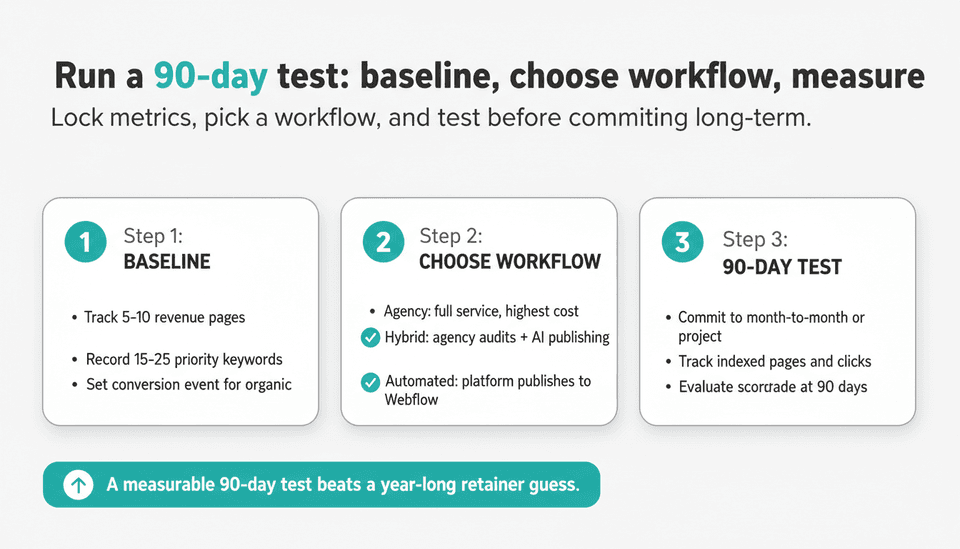
Step 1: Define success metrics and baseline
Before you spend a dollar, lock down: (a) which 5–10 pages represent revenue‑generating intent; (b) current organic sessions to those pages; (c) the list of 15–25 priority keywords and their positions; (d) a simple conversion event in your analytics tied to organic traffic. Record the baseline. That single spreadsheet becomes your scorecard for any agency or platform you test.
Step 2: Choose a workflow—agency, hybrid, or automated Webflow publishing
You have three practical workflows to choose from.
- Pure agency: Hire an SEO company for everything—strategy, content, links, technical. This is the highest‑touch, highest‑cost path, and only makes sense if you need heavy technical lift or link acquisition you can’t get any other way.
- Hybrid: Use an agency for quarterly technical audits and a targeted link‑building campaign, and use an AI content platform for daily blog publishing. This is the emerging default for growth‑stage companies on Webflow. The agency handles what machines can’t; the platform handles volume.
- Automated platform only: Connect an AI content platform like Joyrise to your Webflow site. The platform scans your site, builds a keyword plan, generates deep‑researched articles with images and internal links, and publishes them on a schedule you set. You review drafts or let the quality‑judge pass do the heavy lifting. This is the fastest way to build topical authority if your technical base is already solid.
Step 3: Run a 90-day test without a long-term contract
Whichever path you pick, commit to a 90‑day test. For an agency, negotiate a project period or a month‑to‑month retainer. For a hybrid, start the platform and the agency’s audit simultaneously. For a pure platform, set your first 90‑article push and track the metrics from Step 1. At the end of 90 days, pull the scorecard. Are you seeing indexed pages, rising impressions, and clicks on the target terms? If yes, extend. If no, you know early and you haven’t signed a year‑long contract for a promise.
What role should my team play to make an SEO engagement work?
Even the best SEO company or AI platform needs your team’s input. Someone inside the business must review content for factual accuracy and product‑specific nuance—no external writer or model knows your customer like you do. Your team should verify that target keywords match what your buyers actually say, not just what a keyword tool suggests. And someone needs to connect the organic traffic to the pipeline: when a visitor from an SEO article converts, your CRM should capture that attribution. If your team treats SEO as a set‑it‑and‑forget‑it vendor, the engagement will underperform, no matter who you hire.
Mistakes, Myths, and Limitations to Avoid
Myths: more content always ranks, guaranteed page one, AI content is spam
Publishing more doesn’t guarantee ranking—Google rewards relevance and authority, not volume. No one can guarantee a #1 position; an agency that does is either lying or using tactics that will eventually get the domain penalized. And AI‑generated content is not inherently spam. Spam is content that adds no value, regardless of how it’s made. AI content that’s deeply researched, fact‑checked, and reviewed by a human is often indistinguishable from human‑written content and can rank just as well.
Mistakes: paying for reports instead of output, ignoring technical debt
The most common mistake with retained SEO companies is funding beautiful monthly PDFs while the output—articles, fixed technical issues, real links—stays thin. Ask for a deliverable log, not just a traffic graph. The second mistake is ignoring technical debt. You can publish 100 exceptional articles, but if your site takes 8 seconds to load on mobile or has 10,000 crawl errors, those articles will never reach their potential. Technical SEO must be addressed before content volume matters.
Limitations of any SEO company—and when to bring work in-house
No outside SEO company will ever understand your product as deeply as your own team. Agencies have to manage multiple clients and can’t afford to live inside your industry the way you can. They also face a structural conflict: they’re incentivized to keep you on retainer, not necessarily to make themselves unnecessary. When organic traffic becomes a core revenue channel—and you’ve already fixed the technical and link‑building gaps through an agency—it often makes sense to bring the content strategy in‑house, powered by an AI platform for production, and reserve agency dollars for only the hardest problems.
Next Steps: From Reading to Deciding
A one-page decision checklist
Run yourself through these seven questions. If you answer “no” to more than two, your path becomes clear.
- Is our site’s technical foundation—speed, indexing, mobile—already solid?
- Do we need heavy link building in a competitive industry, or are we mostly under‑published on content?
- Is our CMS Webflow, or can we export content to it?
- Do we have someone in‑house who can review 5–10 articles per month for accuracy and brand voice?
- Are we willing to invest at least $3,000/month for an agency retainer, or is our budget tighter?
- Do we need strategy from an outside partner, or do we already know our content gaps?
- Can we commit to a 90‑day measurable trial without a long‑term lock‑in?
When to hire an agency, when to use a platform, and when to do both
Hire an SEO company when you’re fighting a technical mess you can’t untangle internally, or when you’re entering a competitive space where high‑authority links are table stakes. Use an AI content platform when your primary growth lever is publishing consistent, high‑quality content at scale—especially if your site lives on Webflow and you can automate the entire workflow. Do both when you can afford the agency for strategic oversight and link campaigns while the platform handles the daily publishing grind. That hybrid model gives you the highest probability of both short‑term velocity and long‑term compounding.
Key Takeaways
- Unit economics decide the right model: an agency article often costs 10x–50x more than an AI‑produced article, and that math compounds with every post.
- No one can guarantee page one, so any SEO company that does is a red flag you shouldn’t ignore—regardless of what their landing page says.
- Own your data and content from day one: admin access to Search Console and a written content ownership clause are non‑negotiable.
- Contract‑free SEO is becoming the norm: from dental SEO firms to AI content platforms, the 12‑month retainer is giving way to month‑to‑month, output‑based engagements.
- A 90‑day test beats a year‑long bet: pick a workflow, measure clicks and conversions against a baseline, and never sign before you see indexed results.
See what an AI content platform can publish for your site—sign up at Joyrise and read your first article before you pay.