 Joyrise
SEO for Banking: A Trust-First, AI-Ready Guide for 2026
 By Alexi · · 16 min read

On this page
- What is SEO for banking and why is it different from general SEO?
- How can banks demonstrate E-E-A-T in their content to rank higher?
- What compliance workflows must be integrated into banking content creation?
- What can the 2026 UK online banking benchmark report teach us about SEO performance?
- Core Banking SEO Strategies That Deliver Results
- How do I measure the ROI of organic search for a bank?
- How can automation tools help scale banking content without sacrificing quality or regulatory adherence?
- What are the most harmful SEO mistakes a bank can make?
- Next Steps: Your Banking SEO Roadmap
- Key Takeaways
SEO for banking is the practice of optimizing a financial institution’s digital presence to appear prominently in search engine results for queries that matter to its business—from “high-yield savings account” to “commercial real estate loan terms.” Unlike general SEO, it operates within a high-stakes environment where trust, regulatory compliance, and financial accuracy are non-negotiable. For any bank, retail or digital, ranking well isn’t just about traffic; it’s about earning the confidence of consumers and Google’s algorithms that guard Your Money or Your Life (YMYL) content, and ultimately about converting that trust into new customers (SEO for Banks: How SEO Can Help Your Bank Earn More).
This guide walks through exactly what makes banking SEO strategy distinct, how to build it around E-E-A-T (Experience, Expertise, Authoritativeness, Trustworthiness), and where the Q4 2026 UK benchmark data reveals competitor gaps you can exploit. You’ll find concrete workflows for compliance reviews, sector-specific frameworks for retail banking through neobanks, ROI tracking that ties organic performance to account openings, and a clear-eyed look at how AI-powered automation can scale content without inviting a regulatory disaster.
What is SEO for banking and why is it different from general SEO?
SEO for banking covers every organic search effort that brings qualified visitors to a bank’s website—whether it’s a 200-year-old institution with branches, a digital-first challenger bank, or a commercial lender. Scope extends from retail deposit products and mortgage comparisons through corporate treasury pages and investment banking thought leadership. The common thread: every piece of content influences a consumer’s financial well-being, so Google applies an extra layer of scrutiny.
The difference comes down to consequences. An e-commerce site that ranks for “best running shoes” might make a sale, but a bank ranking for “best ISA rates” can alter someone’s long-term savings outcome. That’s why banking falls squarely under Google’s YMYL classification. The search engine’s quality rater guidelines explicitly demand that YMYL pages demonstrate the highest level of E-E-A-T. If your content feels generic, lacks author attribution, or ignores compliance language, you’ll struggle to rank—no matter how well your technical SEO for banking is dialed in.
Add regulatory oversight. The FCA in the UK, the CFPB in the US, and similar bodies require financial promotions to be fair, clear, and not misleading. That means your SEO compliance banking workflow cannot be an afterthought. Every meta description, blog post, and product page must survive a compliance review before going live—a bottleneck that traditional SEO teams rarely face.
Finally, banking SEO must reconcile two worlds: branch-based local intent and a national digital footprint. A customer might search “mortgage advisor near me” today but start their journey months earlier with “how much deposit do I need for a first home.” Your banking SEO strategy has to connect those dots across informational, commercial, and local queries without breaking the user experience or the site’s information architecture.
How can banks demonstrate E-E-A-T in their content to rank higher?
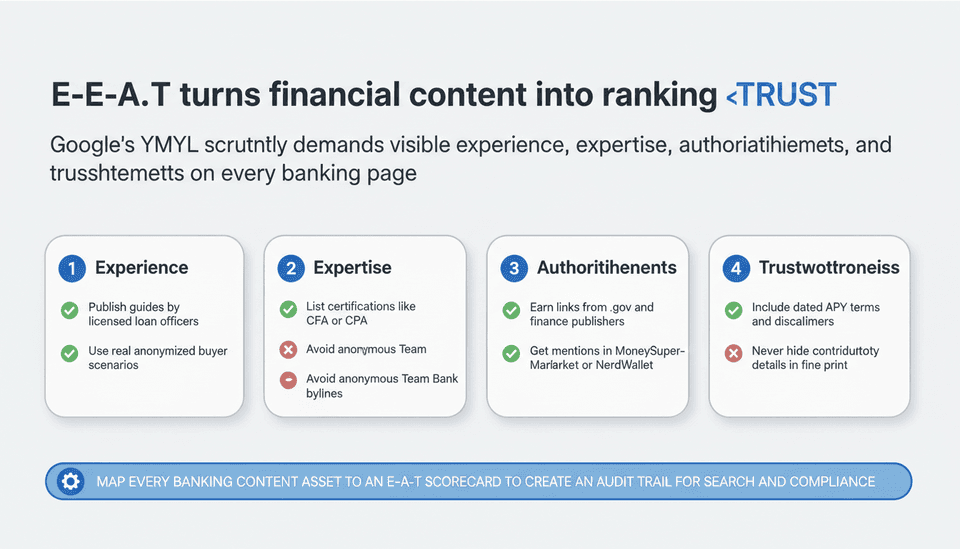
E-E-A-T isn’t a direct ranking factor, but it’s the lens through which Google’s quality raters—and increasingly its algorithms—evaluate financial content. For banking, trust is the top priority; authority and expertise follow. Here’s what that looks like in practice.
Experience means showing firsthand knowledge. A mortgage guide written by someone who has never closed a loan lacks the depth raters look for. Publish content authored by licensed loan officers, certified financial planners, or internal subject-matter experts, and include a short bio with credentials. Even better, cite real (anonymized) scenarios: “We worked with a first-time buyer in Manchester who needed a 95% LTV mortgage—here’s what the underwriting looked at.” That level of specificity signals genuine involvement.
Expertise demands formal qualifications or demonstrated depth. For a commercial lending page, author bios should list years of industry experience and relevant certifications (e.g., CFA, CPA). For neobank content, that might mean featuring product designers who built the savings round-up feature. Avoid anonymous “Team Bank” signatures; Google’s systems are getting better at detecting author entities, and anonymous content weakens the E-E-A-T signal for YMYL topics.
Authoritativeness is built through external validation. Backlinks from reputable finance publishers, regulatory bodies, and industry associations carry outsized weight. A guide to “SEO for financial services” on the Bank Services site notes that earning links from .gov and .edu domains, as well as established media, “can significantly boost your bank’s search visibility.” But authority also comes from consistent PR mentions and citations in third-party comparison tools like MoneySuperMarket or NerdWallet. Banks that treat digital PR as part of their financial services SEO program — as outlined in resources like SEO for Financial Services and Banks — see compounding authority gains.
Trustworthiness is the non-negotiable foundation. Every piece of banking content must include precise disclaimers, transparent terms, and up-to-date rate information. If you reference APY or APR, include the effective date. If you make a claim about “no hidden fees,” link to the fee schedule. Google’s algorithms are increasingly parsing page-level trust signals—prone to penalizing pages that promise one thing and bury contradictory details in fine print. A simple test: after reading your page, would a reasonable consumer feel fully informed to make a decision? If not, it’s not trustworthy.
To operationalize this, map each content asset to an E-E-A-T scorecard. Rate author expertise on a scale, confirm trust signals present, and log external citations. That becomes your audit trail for both search performance and compliance.
What compliance workflows must be integrated into banking content creation?
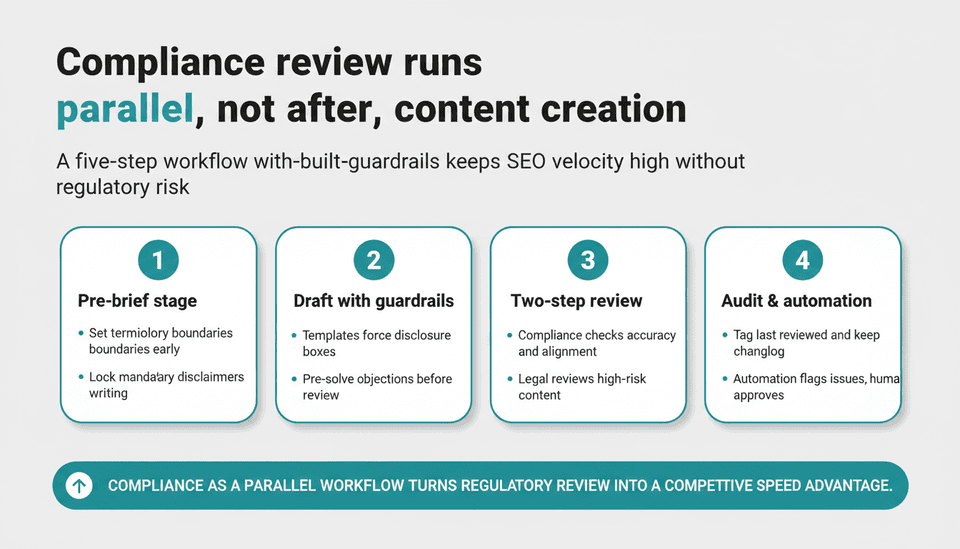
The marketing team at a bank doesn’t enjoy the luxury of “publish first, review later.” Compliance review is mandatory, and it can throttle SEO velocity if you don’t design the process deliberately. Here’s the workflow that works.
1. Pre-brief stage. Before a single word is written, the SEO and content team should align with compliance on terminology boundaries. Which terms require full definitions? Which superlatives (“best,” “lowest”) are off-limits? What disclaimers are mandatory for product mentions? A shared style guide eliminates 80% of later revision loops.
2. Draft with built-in guardrails. The writer works from a template that includes standard disclosure language, legal boilerplate, and required risk warnings. If the article compares savings accounts, the template forces a “Representative example” box and links to the T&C page. This isn’t about stifling creativity—it’s about pre-solving compliance objections so the review focuses on substance, not formatting.
3. Two-step review. Step A is a content review by compliance for factual accuracy and regulatory alignment. Step B (optional but recommended) is a legal review for high-risk content—anything involving investment advice, tax implications, or forward-looking statements. Only after both sign-offs does the page go live.
4. Version control and audit trail. Every published page should carry a “Last reviewed: [date]” tag visible to readers and a changelog for internal auditors. This is essential not just for regulators but for search engines, which may demote stale financial content. Set a mandatory quarterly review cadence for all high-traffic SEO pages—rates change, and outdated information hurts trust.
5. Automation’s role. Platforms like Joyrise can incorporate compliance flags directly into the content generation step. The system can be configured to inject pre-approved disclaimers, avoid forbidden phrases, and flag copy that might trip a regulatory review. But the final sign-off must remain human. A second AI quality-check (as in Joyrise’s Pro tier) can rewrite drafts to improve brand voice and factual consistency, but a compliance officer still reviews before publishing. That human-in-the-loop approach solves the speed-versus-safety tradeoff that paralyzes many bank content teams.
Banks that nail this workflow can produce SEO for online banks content at a pace that competitor’ legal processes can’t match—turning compliance into a competitive advantage.
What can the 2026 UK online banking benchmark report teach us about SEO performance?
ClickThrough Marketing’s Q4 2026 UK Online Banking Companies Digital Marketing Benchmark Report, published 17 November 2026, analyzed the 12 largest online banking players: Starling Bank, Tandem, Monzo, Chase, Atom bank, Revolut, Monese, Kroo Bank, Wise, Zopa Bank, Smile Digital Banking, and Bankera. The report doesn’t just measure vanity metrics—it quantifies share of voice, identifies content gaps, and shows where competitors leak organic opportunities.
Key findings can be mapped directly to an SEO action plan:
- Share of voice is highly concentrated. A handful of the 12 brands dominate organic visibility for core product terms like “digital current account” and “app-based savings.” If your bank isn’t in the top three, you’re invisible for the majority of high-intent searches. The gap between first and fourth is often a factor of 10x in organic clicks.
- Informational content is underinvested. Several challenger banks rank well for their own brand names but miss the long tail of “how to” and “what is” queries that precede account opening. A review of missing keywords reveals easy wins: guides to switching banks, explanations of FSCS protection, and comparisons of fintech features.
- Technical SEO lags content ambition. Mobile page speed, Core Web Vitals, and proper canonicalization are patchy across the sector. The report notes that some sites serve overly heavy hero images and JavaScript, hurting mobile experience—a critical mistake when over 70% of banking queries come from smartphones.
- Local SEO for banks with physical ‘hybrid’ footprints is inconsistent. Even digital-first banks with limited branch presence (like some offering cash deposit services via partner networks) underutilize Google Business Profile listings and local schema, leaving foot-traffic queries on the table.
Actionable takeaway: Use the benchmark’s “missed opportunities” section to build a keyword gap analysis. Identify the 20 highest-volume terms where your competitors rank on page 1 and you’re nowhere. Prioritize those that align with products you actually offer. Then tackle the technical debt items the report flags—particularly Largest Contentful Paint (LCP) and Cumulative Layout Shift (CLS)—because Google’s mobile-first indexing punishes sluggish financial sites more harshly than general retail.
For banks outside the UK, the report’s methodology is replicable: commission a competitive digital benchmark that audits organic visibility, backlink profiles, and site health. Without that data, you’re guessing at your banking SEO strategy gaps.
| Benchmark Insight | What It Reveals | Immediate Action |
|---|---|---|
| Top 3 brands own >60% of share of voice | Organic visibility is winner-take-most | Prioritize ranking for 10 high-volume, high-intent product terms within one quarter |
| Informational long-tail ignored | Competitors miss early-funnel traffic | Build 10-15 “how to” and “what is” guides mapping to customer questions |
| Core Web Vitals failures widespread | Slow mobile experience costs rankings | Audit LCP and CLS across top 30 pages; fix within 6 weeks |
| Local listings incomplete | Branch-less banks lose near-me traffic | Claim and optimize GBP profiles even for partner cash-deposit locations |
| Backlink profiles shallow | Authority signals weak outside own domain | Launch digital PR campaigns targeting finance publishers and comparison sites |
Core Banking SEO Strategies That Deliver Results
The fundamentals—keyword intent mapping, technical health, content hubs—compressed to their essence for banking, then pushed deeper where most guides stop.
Keyword Research for Banking: Beyond Product Terms
Standard keyword research for SEO for financial services chases “savings account” and “credit card.” That’s table stakes. Banking intent follows a distinct journey: early research (“how to save for a house”), product comparison (“fixed vs variable ISA”), readiness (“open joint account online”), and local action (“bank with Saturday hours”). Map each stage to a content type. Early research gets guides; product comparison gets structured comparison tables with rich snippets; readiness gets conversion-optimized landing pages; local action gets GBP-optimized branch pages.
For commercial and investment banking, the funnel is inverted: high-value services start with reputation-building thought leadership (white papers, economic commentaries) that later funnel to contact forms. Don’t treat these sectors with a consumer keyword playbook—commercial borrowers search for “equipment financing for mid-size manufacturers,” not “business loan.” The specificity matters.
Technical SEO for Financial Websites
Banking sites often carry substantial technical debt: legacy subdomains, dynamic URL parameters, and compliance-driven page duplication. Clean your crawl budget ruthlessly. Organize site architecture around product silos: personal banking, business banking, wealth management. Every page must be reachable within three clicks from the homepage. Use breadcrumb schema and FAQ schema aggressively—Google pulls structured data for AI Overviews in financial queries, and a well-tagged page can win the featured snippet even without the top organic spot.
Mobile-first indexing is non-negotiable in 2026. Core Web Vitals, especially Interaction to Next Paint (INP), demand attention because banking forms and calculators introduce JavaScript complexity. Test every calculator, mortgage estimator, and application start page on a mid-range Android device. If a rate search tool takes over 200ms to respond to a tap, you’ll drop rankings.
Content That Converts: Topic Hubs and Trust Signals
The most effective bank website optimization for YMYL topics revolves around topic hubs: a pillar page (e.g., “Guide to First-Time Home Buying”) supported by 10–15 cluster articles covering deposits, credit scores, mortgage types, and legal steps. Each page cross-links to product landing pages sparingly—enough to convert, not so much that it feels promotional. Author bylines with real credentials, publication dates, and “medically reviewed” style disclaimers (e.g., “Reviewed by a qualified mortgage advisor, Nov 2026”) lift trust signals.
For neobanks, build comparison guides that own the narrative. A page comparing “Challenger banks vs traditional banks: features compared” can rank for high-volume terms while reinforcing your differentiators. Just ensure every claim is factual and dated; stale comparisons undermine E-E-A-T for banking.
How do I measure the ROI of organic search for a bank?
Finance leads care about revenue, not rankings. So you measure micro-conversions that predict revenue. Here’s the hierarchy:
Level 1: Engagement actions. Page views on product pages, time on educational content, and document downloads (e.g., “Investment Banking Sector Outlook PDF”). These signal intent. Tag every download button and video play in GA4 as custom events.
Level 2: Lead initiation events. That’s form starts: application started, appointment booked, “speak to an advisor” clicked. Track these as conversions and break them down by landing page. A UK banking SEO benchmark might show a 2–3% application start rate from high-intent pages—use that as a baseline.
Level 3: Revenue-attributed conversions. The gold standard: match completed account openings, funded loans, or deposit amounts back to the original organic session. This often requires CRM integration—passing UTM source and landing page into a hidden field. Without this, you’re stuck arguing value with marketing-sourced vanity metrics.
For SEO for online banks, where the entire funnel is digital, tracking is easier because “start application” flows directly into the database. For hybrid banks, assign a call-tracking number to organic landing pages so you can attribute phone inquiries.
Benchmark against internal targets: “Organic search contributed 28% of new checking accounts this quarter, with a 12% lower cost-per-acquisition than paid search.” Use competitor data from reports like ClickThrough Marketing’s to set realistic growth ceilings—if the market leader has 35% share of voice, aiming for 40% in six months is unrealistic unless you’re combining SEO with brand spending.
How can automation tools help scale banking content without sacrificing quality or regulatory adherence?
The volume–quality–compliance trilemma is real. In 2026, AI-driven content automation has matured enough that banks can responsibly deploy it—provided the right safeguards are in place.
Automation platforms can now:
- Scan your existing site to learn brand voice, product details, and tone.
- Plan keyword clusters based on competitor gaps and search intent data.
- Generate long-form article drafts with proper headings, meta descriptions, and internal links.
- Inject regulatory disclaimers automatically.
- Pass drafts through a second AI for a “quality judgment” pass that catches factual inconsistencies and brand voice drift.
Joyrise, for instance, integrates these capabilities and publishes directly to Webflow blogs, with the option to save as drafts for human review. For a bank content team, that means the first draft arrives with compliance placeholders already filled, cutting production time from days to hours.
But automation carries real risks:
- Accuracy gaps. AI models, even frontier ones, can hallucinate rate figures, tax rules, or product features. A hallucinated “2.5% APY savings account” that doesn’t exist is a compliance violation and an eroding trust event.
- Brand voice dilution. Without careful tuning, automated content can read like generic fintech copy, undermining the authority you’ve built.
- Regulatory slips. If the AI isn’t trained to avoid superlatives or conditional promises, it might write “the best loan rates”—which a regulator would flag as misleading unless you can back it with a representative APR disclosure.
The solution is a human-in-the-loop model: AI drafts, human compliance checks, AI assists with revisions, human approves. Set up an editorial workflow where compliance reviewers work from a checklist that includes verifying all numerical claims, confirming disclaimers map to current product terms, and ensuring author entities are correctly assigned. Automating up to 80% of the content process is feasible without sacrificing quality if that final 20% of review is rigorous. This approach gives mid-market banks a shot at competing with content teams ten times their size.
What are the most harmful SEO mistakes a bank can make?
Even sophisticated banks fall into these traps:
- Erratic internal linking. Banking sites balloon with product pages, calculators, and educational content, and internal links are often added haphazardly. The result: orphan pages, diluted PageRank, and poor crawl efficiency. Audit internal link structures quarterly, ensuring every service page links upward to its parent category and laterally to related guides.
- Chasing vanity keywords. “Bank” is a vanity term for most institutions unless you’re among the top five globally. Instead of pouring resources into a “best bank” page that will never rank, focus on specific product modify terms where you can actually compete—e.g., “no-fee student checking” or “SBA 7(a) loan calculator.”
- Neglecting seasonal financial cycles. Tax season, ISA deadline month, end-of-financial-year for businesses—these create predictable spikes in search volume. Banks that don’t plan content around these cycles miss high-intent traffic. A banking content marketing calendar should map major financial dates 12 months ahead.
- Technical debt accumulation. It’s tempting to launch a new product microsite as a separate subdomain because it’s faster. But that fragments domain authority. Consolidate everything under the main domain and use subdirectories.
- Treating AI content as set-and-forget. Publishing AI-written pages without regular human fact-checking will eventually trigger a Google algorithmic action (especially under Helpful Content updates). Every AI-assisted page must carry a review date and human editor attribution.
Myths debunked:
- “SEO doesn’t work for banks.” It works, but it’s harder because of YMYL. Banks that invest consistently in E-E-A-T and technical health see compound gains. A challenger bank that built topic hubs over 18 months can capture millions of clicks.
- “Once you rank, you’re done.” Competitors, algorithm shifts, and outdated information erode rankings. A page that ranks #3 today can drop to #10 within weeks if a competitor publishes a more thorough, recently dated version.
- “AI content can’t meet compliance standards.” Poorly managed AI content, yes. But with the right tooling and review process, AI-assisted content can match or exceed human drafts in compliance accuracy because programmable rules catch missing disclaimers consistently. The myth persists because many banks tried automation without the human-in-the-loop, and the result was predictably messy.
Next Steps: Your Banking SEO Roadmap
Implement in phases, not all at once.
Phase 1: Audit (Weeks 1–3). Perform a full technical crawl (Screaming Frog or similar). Identify Core Web Vitals failures, missing schema, orphan pages. Conduct an E-E-A-T content audit: score pages on author expertise, trust signals, and freshness. Use the Q4 2026 UK benchmark methodology to map competitor share of voice and find keyword gaps.
Phase 2: Strategy and compliance setup (Weeks 4–6). Define content pillars: personal banking, business banking, wealth, etc. Create the compliance pre-brief style guide and template document. Map seasonal content calendar. Decide which high-impact pages to improve first—typically product pages and top informational hubs.
Phase 3: Content build and technical fixes (Weeks 7–16). Fix the crawl and speed issues. Upgrade internal linking. Publish or refresh the priority hub pages, ensuring full compliance review and author attribution. For content volume needs, consider responsible automation through a platform that integrates compliance guardrails, like Joyrise, to produce search-optimized drafts that your team reviews and refines. This isn’t about replacing expertise; it’s about scaling your team’s output without sacrificing the scrutiny that YMYL demands.
Phase 4: Measurement cadence (Ongoing). Track Level 1–3 conversions. Set up a monthly “SEO ROI” dashboard that ties organic session data to application completions (or qualified leads for B2B). Benchmark against industry reports and adjust quarterly.
Keep the program alive through 2027 by revisiting the benchmark data every six months, running fresh E-E-A-T audits, and monitoring how AI-driven search shifts (e.g., Google AI Overviews) affect banking queries. If AI Overviews start answering “best business savings account” without a click, your strategy must evolve toward appearing as a cited source—something only sites with strong E-E-A-T will achieve.
Key Takeaways
- Banking SEO must earn trust at every level: technical health, author expertise, compliance transparency, and fresh, accurate information—Google’s YMYL framework leaves no room for shortcuts.
- Build a compliance review workflow that runs in parallel with content creation, not as a bottleneck; use templates, pre-approved language, and audit trails to speed publication without risking regulatory violations.
- Use benchmark reports like the Q4 2026 UK analysis to identify your competitors’ share of voice gaps, then attack the highest-intent informational and product keywords where you can realistically win.
- Measure SEO’s value by tying organic sessions to micro-conversions—form starts, appointment bookings, and actual account fundings—so finance leadership sees revenue impact, not just rank movement.
- Deploy AI content automation with firm human-in-the-loop guardrails: AI handles the heavy drafting and compliance placeholder insertion, but every piece of YMYL content needs a credentialed human reviewer before it goes live.
If you want your banking content to scale without breaking the trust Google demands, a platform that automates the hard parts while keeping your compliance team in control is worth a look.