 Joyrise
The Definitive Guide to SEO AI Agents (2026)
 By Alexi · · 20 min read

On this page
- Executive Summary
- What Is an AI SEO Agent?
- How AI SEO Agents Actually Work
- The AI SEO Agent Landscape: Options, Approaches, and Tradeoffs
- Practical Implementation Framework
- The New Frontier: Optimizing for AI Agents, Not Just Search Engines
- Mistakes, Myths, and Limitations
- The Road Ahead: AI SEO Agents in 2026 and Beyond
- Frequently Asked Questions
- Key Takeaways
Executive Summary
An SEO AI agent is software that uses large language models to plan, execute, and iterate on search engine optimization work — not just generate text, but make decisions, take actions across multiple tools, and adjust strategy based on results. This guide covers two layers most content doesn't: first, how to deploy these agents inside your own SEO operation; second, how to prepare your site for the AI agents visiting it from OpenAI, Google, Perplexity, and elsewhere.
The ground is moving. AI in digital marketing is accelerating the shift toward autonomous SEO, and on November 8, 2026, Search Engine Journal reported that Cloudflare CEO Matthew Prince now describes "AI Agent Optimization" as a new version of SEO, revealing that OpenAI pays Cloudflare for crawl hints and that sites may charge agents less when agents explain why they're visiting. A week earlier, Keytomic announced an MCP server, an AI Visibility Tracker, and a Reddit AI agent — practical tools for a world where SEO surfaces now include AI assistants, Reddit threads, and agent-driven workflows.
Here's the throughline of everything that follows: if your SEO strategy still assumes Google is the only discovery surface that matters, you are optimizing for 2023. AI agents are now both your team's most productive operator and your site's most consequential visitor. This guide covers both roles, plus the tradeoffs you'll need to manage.
What Is an AI SEO Agent?
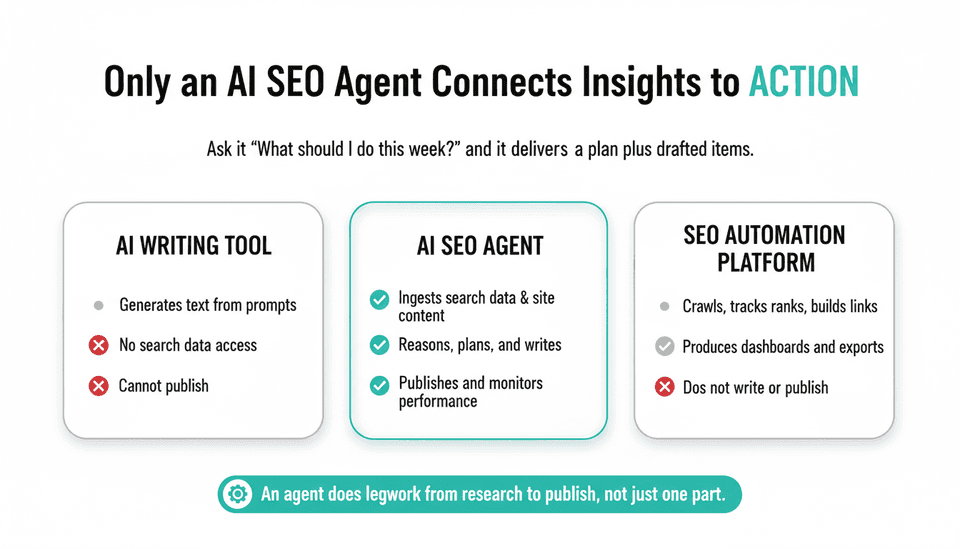
An AI SEO agent (also called an AI agent for SEO) is a software system that combines a language model's reasoning ability with access to SEO data sources and action tools. Unlike a keyword tool that produces a list, or a writing assistant that produces a paragraph, an agent chain produces an outcome: a keyword plan mapped to your existing pages, an article written in your brand voice with internal links inserted, an audit that identifies a crawl issue and then files the fix.
The word "agent" matters. It implies autonomous multi-step work. The agent receives a goal, decomposes it into steps, uses tools for each step — a Search Console API call, a competitor scrape, a content generation pass — and produces a finished artifact. Humans set the goal and approve the output. The agent does the legwork in between.
This definition has consequences. It means you are not buying a better text generator. You are buying a workflow engine with judgment baked in. That distinction is where most of the confusion in this space comes from.
AI SEO Agent vs. AI Writing Tool vs. SEO Automation Platform
These three categories blur in marketing copy but differ in mechanics:
- AI writing tools (Jasper, Copy.ai, early ChatGPT workflows) produce text from prompts. They don't access search data, crawl your site, or publish anything. They're word engines.
- SEO automation platforms (Ahrefs, Semrush, Screaming Frog) automate data work: crawling, rank tracking, backlink analysis. They produce dashboards and exports. Historically, they don't write or publish.
- AI SEO agents (Frase, MarketMuse in their evolved forms, Gumloop-built custom stacks, Joyrise, Theseoagent.ai) sit at the intersection. They ingest data from search platforms, reason about what to do with it, generate content or code, and increasingly execute publication and monitoring steps.
A practical test: ask the tool, "What should I do this week to improve organic traffic, and can you do it?" A writing tool says, "Here are ten topic ideas." A platform says, "Here's a rank-tracking report." An agent says, "Here's the plan, and I've drafted four of the seven items." That's the difference.
Common Capabilities (Content, Analysis, Publishing) and How They've Evolved
In 2023, AI SEO tools could suggest keywords and generate readable prose. In 2024, they added live search data integration and brand-voice learning. By 2025, the best could produce full article drafts with internal links and metadata. In 2026, the frontier is autonomous orchestration: multi-step pipelines where one agent crawls your site, another maps keyword gaps to content strategy, a third generates articles, a fourth publishes them to a CMS, and a fifth monitors Search Console to feed next week's plan.
That final capability — closing the loop from publish to measurement to next iteration — is what separates "AI-assisted SEO" from a genuine SEO AI agent. Some platforms now report AI assistant referrals alongside traditional search clicks, which is a direct response to the AI Agent Optimization shift covered later in this guide.
How AI SEO Agents Actually Work
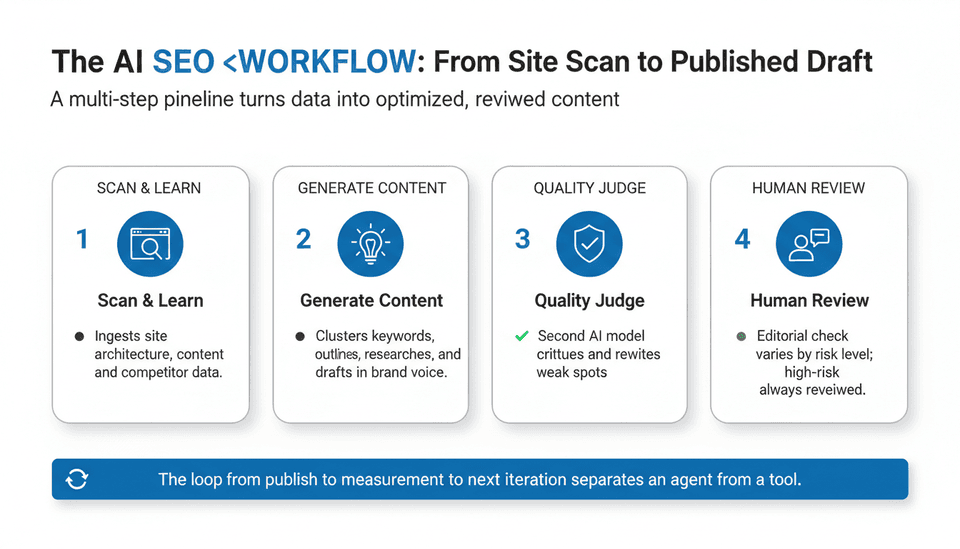
Data Ingestion and Learning: Site Scans, Competitor Analysis
An agent begins by ingesting three data types: your site's content and structure, search performance data (Search Console, Analytics), and competitor or market reference data. The site scan typically includes every page, heading hierarchy, metadata, internal link graph, and tone analysis. Competitor analysis maps keyword coverage — what terms your rivals rank for that you don't, what content types dominate the SERP, and what entity relationships search engines have apparently learned.
This phase matters more than most buyers realize. An agent is only as good as its model of your site and market. If a scan misses your product pages or misreads your audience, every downstream article inherits the error. That's why platforms that emphasize deep site learning, not just fast churn, produce measurably better output in the hands of teams that check.
Content Generation Pipeline: From Keyword Plan to Published Draft
The typical pipeline has five stages. First, topic selection: the agent clusters keywords, maps them to buyer-intent stages, and selects targets where your domain has a legitimate chance to rank. Second, outline generation: heading structure is generated to match the top-ranking page's coverage while adding differentiated angles. Third, research: the agent pulls from indexed sources, competitor pages, and — for news-driven platforms — recent developments. Fourth, drafting: long-form content is generated in your brand voice with SEO elements (meta descriptions, alt text, internal links) inserted. Fifth, publication or draft staging: the agent either pushes to your CMS, schedules, or saves for review.
The best systems in 2026 include a quality judgment pass — a second AI model that critiques the first draft against your brand and SEO requirements and rewrites weaknesses. This isn't marketing theater; it measurably reduces flat, formulaic output. But it doesn't replace human review, a point we'll return to in the mistakes section.
Quality Assurance and Human-in-the-Loop Models
How much human involvement should an AI SEO agent require? Sources genuinely disagree here. Some vendors promote fully autonomous publishing — set your topics and brand rules, then let the agent post daily without review. Others, including platforms that default to draft mode, insist humans approve every article.
The honest answer depends on risk tolerance and content type. A local business publishing location pages can often tolerate daily autonomous publishing. A regulated healthcare or financial services brand cannot. The middle ground that has emerged as best practice in 2026: agents draft and self-critique, humans review for factual claims and brand judgment, and the review bar varies by page's risk level. If your agent cannot show its sources and reasoning, the human checkpoint becomes expensive guesswork instead of fast validation.
The AI SEO Agent Landscape: Options, Approaches, and Tradeoffs
Full-Service Platforms vs. Custom-Built Agent Stacks
There are two broad paths. Full-service platforms (Frase, Theseoagent.ai, Joyrise, Keytomic, and others) sell a managed pipeline: the vendor built the agent, wired the data sources, and handles model updates. You configure and operate. Custom-built stacks (often on Gumloop, LangChain, or n8n) mean your team assembles the workflow from API calls, prompting layers, and your own quality filters.
The trade is simple: platforms trade flexibility for speed to value; custom stacks trade setup time for ultimate control. A platform gets you publishing in days. A custom stack takes engineering time but lets you do things no vendor offers — like an agent that checks Press Release Wire for regulatory updates and files compliance reports alongside SEO briefs. Most marketing teams in 2026 should start with a platform and only build custom when a platform demonstrably cannot handle their specific workflow. Build-vs-buy is covered in more depth in the SEO Tools Extensions guide, but the decision rule above is the one that matters.
Open-Source vs. Commercial, and the Lock-In Question
Open-source SEO agent frameworks exist, typically built on LangChain or CrewAI patterns. They offer transparency and no vendor lock-in but demand maintenance skill — model deprecation, API breakage, and prompt drift become your team's job. Commercial platforms absorb that maintenance but introduce lock-in: your content pipeline, style rules, and sometimes even your content library live in the vendor's system.
The lock-in concern is real but often overstated. Most vendors allow exporting articles, and switching costs come mainly from retraining the new tool on your brand voice. The bigger lock-in risk isn't a vendor; it's building SEO on someone else's content quality bar and never checking it. That happens with either path if monitoring is weak.
Pricing Models and What '1/10th the Cost' Really Means
AI SEO pricing in 2026 clusters into three bands: budget tools under $100/month that do one narrow thing; mid-range platforms from $199 to $999 monthly that handle end-to-end content production; and custom installations that start in four figures monthly. Some platforms price per article produced, others per number of connected sites, and some offer unlimited drafts for a flat fee. The "1/10th the cost of an agency" claim is directionally accurate when compared to retainer-based SEO agencies charging $2,000 to $10,000 monthly for manually managed content programs. But it hides costs: review time from your team, subscription tools that remain in the stack, and the rework cycle when early agent output misses. A useful benchmark from Joyrise's public pricing: Basic at $199/month or $1,990 annually (30 articles/month, up to 2 per day), Pro at $499/month (80 articles, 5 per day, quality judge, news-driven articles), Max at $999/month (180 articles, 10 per day, priority support).
| Tier | Monthly Price | Articles/Month | Best For | Hidden Costs |
|---|---|---|---|---|
| Basic | ~$199 | ~30 | Solo founders testing AI SEO | Review time; limited research depth |
| Pro | ~$499 | ~80 | Growth-stage marketing teams | Editorial oversight; brand control |
| Max | ~$999 | ~180 | Content-heavy publishers | Integration complexity |
| Custom stack | Varies | Varies | Enterprise or unusual workflows | Engineering time; maintenance |
| Traditional agency retainer | $2,000-$10,000+ | ~4-20 | Brands needing full-service strategy | High cost; slow iteration cycles |
The number that matters in most deals: what does your fully-loaded cost per published, ranking article end up being, including your review hours, not what the vendor sticker says. Do that math before comparing platforms.
Practical Implementation Framework
Step 1: Defining Your SEO Goals and KPIs
If you don't define success, your agent will optimize for volume and you'll get a content firehose no one wanted. Start with three tiers of metrics. Leading indicators: pages published, internal links built, keyword coverage expanded. Lagging indicators: organic clicks, impressions, rankings on target terms, and — increasingly — AI assistant referrals, which Google Search Console now surfaces. Business outcomes: signups, demos, revenue attributed to organic sources.
The framework: pick one primary KPI, two secondary KPIs, and a weekly reporting rhythm. For most businesses starting AI-driven SEO, the primary is organic clicks on money pages, with AI assistant referral counts in secondary position. SEO for Beginners covers what those first 90 days should look like when you're building from zero rather than scaling an existing program.
Step 2: Integrating an Agent into Your Team Workflow
The practical change management sequence that has emerged from teams doing this successfully:
- Shadow phase (1-2 weeks): the agent drafts articles; your existing writer or editor reviews every piece. Capture the error patterns. They'll be consistent — source quality, product details, tone drift.
- Hybrid phase (2-4 weeks): agent handles volume topics (glossary pages, long-tail comparisons); humans keep handling brand-critical and YMYL-adjacent content. Review drops to spot-checks plus full review on the risky subset.
- Steady state (month 2+): agent runs the full pipeline with human review only where the quality judge flags uncertainty or where the topic touches compliance.
The mistake most teams make is skipping shadow phase. They enable autonomous publishing in week one, see three bad articles, and kill the program. The right comparison isn't agent output vs. perfect human output; it's agent output after two weeks of feedback vs. the output of an agency they haven't trained at all.
Step 3: Monitoring, Audit, and Iteration Cadence
An agent that publishes weekly without a feedback loop is an article generator, not an SEO system. You need three recurring reviews:
- Weekly: check what published, what the quality judge flagged, and what Search Console is showing for AI assistant and traditional search traffic.
- Monthly: audit a sample of agent-published articles against your rubric — headings, sources, internal links, brand voice, factual accuracy. Ten percent sample is usually enough.
- Quarterly: evaluate the keyword strategy itself. Is the agent targeting the right terms? Are rankings improving on strategy pages, not just informational posts? Is there cannibalization from volume publishing?
The iteration loop — publish, measure, refine strategy, republish — is what separates search engine optimization with AI done systematically from content churn.
The New Frontier: Optimizing for AI Agents, Not Just Search Engines
What Cloudflare's CEO Means by 'AI Agent Optimization'
On November 8, 2026, Search Engine Journal published an interview with Cloudflare CEO Matthew Prince that introduces a genuinely new concept to mainstream SEO discourse. Prince describes what he calls "AI Agent Optimization" as a new version of SEO — but aimed at the AI agents that crawl, index, and serve content to AI assistants and automation systems, not at Google's classic ranking algorithm.
Three details from the SEJ report matter. First, Cloudflare recorded its first revenue from what it calls "Act 4" products — infrastructure for this new agent-centric web economy. Second, OpenAI pays Cloudflare for hints that tell its crawler when pages change, which is a direct parallel to how sites once paid for faster Google indexing. Third, and most strategically interesting: sites may begin charging agents less when those agents explain why they're visiting — creating an economic incentive for transparency in the agent ecosystem.
The implication: SEO as a discipline is bifurcating. Traditional SEO optimizes pages to rank in search engine results. AI Agent Optimization optimizes pages and server infrastructure so AI agents can efficiently discover, understand, and cite your content when answering user queries through assistants like ChatGPT, Grok, and their successors.
How Sites Are Preparing for AI-Powered Discoverability
The infrastructure layer is moving fast. On November 4, 2026, Keytomic announced three releases that illustrate where this is going: a Model Context Protocol (MCP) server, an AI Visibility Tracker, and a Reddit AI agent. The MCP server is significant because MCP has become the industry standard for letting AI agents interact with external tools and data sources. An SEO platform exposing its data via MCP means agents can pull keyword data, site audits, and content plans directly into their reasoning loops — no dashboard required. The AI Visibility Tracker extends rank tracking to AI assistant surfaces: how often is your brand cited by ChatGPT, Perplexity, Claude? The Reddit agent acknowledges that Reddit is now a de facto discovery surface for AI-assisted users, since many agents source from Reddit threads.
Practical AI search optimization steps now emerging:
- Structured, citable content: agents favor pages that make claims easy to extract and verify — clear section answers, named authors, dates, sources.
- Entity clarity: your brand, product, and key people should be consistently named and defined across your site.
- MCP and agent-friendly endpoints: some sites now expose machine-readable content feeds.
- Traffic source tracking: watch Search Console and analytics for AI crawler and assistant referral patterns.
- Answer-compressed pages: shorter, direct answers to specific questions that agents can lift verbatim.
The guide to AI SEO optimization covers the on-page mechanics of these practices in detail.
The Implications for Traditional SEO Strategies
Does AI Agent Optimization replace traditional SEO? No — it layers on top. Google still sends the majority of referral traffic for most categories, and the skills of keyword targeting, link acquisition, and site architecture remain valid. But the weight distribution is shifting.
What stays relevant: technical SEO fundamentals (crawlability, speed, schema), topical authority building, brand building, and the kinds of original research and data that both Google and AI agents cite preferentially.
What becomes less sufficient: optimizing solely for the ten blue links. Content that ranks well in Google but is unstructured for machine extraction will gradually underperform as AI assistant traffic grows. The number that matters is both your Google rankings and your AI citation rate — the proportion of relevant AI assistant responses that mention your brand.
This is why the types of SEO have expanded beyond traditional ranking into AEO (answer engine optimization) and GEO (generative engine optimization). Teams that only watch Google's dashboard are flying with one instrument.
Mistakes, Myths, and Limitations
Myth: AI Agents Will Replace SEO Experts
The existential framing is wrong. What AI SEO agents are demonstrably replacing is the volume layer of SEO work: writing repetitive articles, filling content calendars, building keyword spreadsheets, and handling routine technical audits. What they are not replacing is the judgment layer: setting strategy, deciding what content deserves investment, interpreting data in context, and managing brand risk.
The teams that thrive in 2026 are not the ones that fired all their SEO staff. They're the ones where one SEO analyst now manages an agent pipeline that would have required five writers. That's the economic reality: the job changes, the headcount shifts, the discipline doesn't vanish.
Mistake: Treating AI Output as Final Without Human Judgment
Vendors selling "set and forget" content are selling a risk transfer you don't want. AI-generated articles can be fluent, well-structured, and confidently wrong. Hallucinated statistics, invented product features, misattributed quotes, tone drift into clickbait ranges — all of these occur regularly in fully autonomous pipelines. The quality judge pass that some platforms include (including Joyrise's Pro and Max tiers) reduces error rates materially but doesn't eliminate them.
The practical rule: know your risk profile and set review depth accordingly. Low-risk volume content might only need statistical spot-checks. Content that makes factual claims about your products or industry, or anything a compliance department would read, gets a human pass. No exceptions.
But what if you're not an SEO expert? The evaluation framework below addresses that directly.
Limitation: Where AI Agents Still Stumble (Technical SEO, Brand Nuance)
Two areas remain weak. Technical SEO is still mainly a human domain. Agents can execute a checklist — check sitemaps, identify missing metadata, flag broken links — but they struggle with the diagnostic reasoning technical SEO problems demand: why a JavaScript-heavy page isn't being rendered, whether a server configuration change is safe, how to restructure a site architecture without breaking existing rankings. Agents report; experienced humans decide fixes.
Brand nuance is the subtler gap. An agent can learn tone from your existing content but cannot learn tone that doesn't exist yet — the shift in voice your new campaign needs, the in-joke your audience shares, the brand-level position on an industry controversy. Agents trend toward the statistically average expression of your voice, not the most distinctive one. Pushing against that homogenization requires a human with editorial taste.
The Road Ahead: AI SEO Agents in 2026 and Beyond
Five trends will define the next 18 months.
First, the content supply explosion continues. Publishing costs have dropped to near zero, which means ranking gets harder for everyone and quality signals become more important, not less. AI content generation is a commodity now; AI content differentiation is the work.
Second, AI Agent Optimization will mature from a Cloudflare talking point into a practice. The SEJ report on November 8, 2026 suggests infrastructure companies are already building revenue models around it, which is the strongest leading indicator of ecosystem investment. Expect more crawling-infrastructure products, agent-facing content standards, and measurement tools like Keytomic's visibility tracker.
Third, backlinks matter differently. In a world where AI agents cite sources based on entity authority and content quality rather than link graphs, the old link-building playbook loses share of influence but doesn't disappear. Quality links from trusted publisher domains remain among the strongest entity authority signals. What changes: the bar for a "quality" link rises further, because agents aren't fooled by PBNs and link farms the way Google's algorithm sometimes was.
Fourth, content homogenization will trigger a counter-trend toward distinctive data. When every AI-assisted competitor can produce a 1,500-word article on "best accounting software for freelancers," the pages that win will be the ones with original pricing data, real benchmark surveys, proprietary examples, and a point of view no agent can copy. That's the durable competitive moat.
Fifth, the agent stack consolidates. The fragmented landscape of "AI SEO tools" — one for keywords, one for writing, one for monitoring — is consolidating into fewer full-stack platforms and custom MCP-enabled infrastructure. Teams will pick their primary system and wire in specialized tools through protocols, not dashboards.
The throughline of all five: the value shifts from generating content to generating judgment and differentiation. Anyone can produce words. Fewer can produce words that deserve to be cited.
Frequently Asked Questions
What is an AI SEO agent?
An AI SEO agent, sometimes called an AI agent for SEO, is software that uses a language model to autonomously plan and execute SEO tasks — from keyword research and site analysis to content creation and publishing — with access to search data sources and action tools. It differs from simpler AI writing tools by operating multi-step workflows toward a defined SEO goal, not just producing text on demand.
What counts as an AI SEO agent?
Any system that combines an AI model's reasoning with SEO data access and execution capability. Frase's evolved platform, Theseoagent.ai, Keytomic, Joyrise, and custom-built stacks on Gumloop are current examples. A ChatGPT prompt that writes an article does not count; a tool that scans your site, identifies keyword gaps, writes an article, and publishes it does.
Are AI agents safe to use with your content?
Safe within a defined risk framework. The main risks are factual errors in published content and brand misalignment. Platforms with quality judge passes and draft mode reduce the risk profile. Autonomously publishing brand-critical or compliance-sensitive content without any human checkpoint is not advisable in 2026. AI agents for SEO warrant the same editorial safeguards you'd apply to junior writers — not nagging, but verification where errors carry costs.
Do AI SEO agents replace SEO professionals?
They replace the volume layer of the work, not the judgment layer. One SEO manager with a strong agent pipeline now accomplishes what three to five writers did five years ago. Strategy, brand positioning, technical diagnosis, and quality control remain human roles. The title may change; the discipline survives.
Can AI agents handle technical SEO?
Partially. Diagnostic technical SEO — understanding why a page is not ranking, determining whether a crawl issue stems from JavaScript rendering or server errors — remains beyond current agent capability. Reporting and checklist execution are well within it. Treat agents as a technical SEO assistant that flags issues and prepares fixes for human review, not an autonomous server-side operator.
How accurate is AI-generated SEO content?
Average accuracy has improved substantially since 2023, and quality judge passes on platforms like Joyrise's higher tiers catch many remaining errors. But the error mode has shifted: AI-generated content is now rarely grammatically wrong but still periodically factually wrong — hallucinated statistics, fabricated pricing, invented product capabilities. Treat accuracy as probabilistic, not guaranteed. Verify any claim that could cost you trust when wrong.
What is AI Agent Optimization, and how does it affect SEO?
AI Agent Optimization is the practice of making your content and site infrastructure accessible and citable to AI agents — the crawlers and reasoning systems behind ChatGPT, Perplexity, Grok, and enterprise AI workflows. As Cloudflare's CEO explained on November 8, 2026, this is becoming a new layer of SEO, with OpenAI paying Cloudflare for crawl hints. For site owners, it means structured content, entity clarity, and agent-friendly endpoints matter alongside classic Google ranking factors. It doesn't replace traditional SEO; it adds a second audience: the agents that now answer search-like queries.
How should teams integrate AI agents into their existing workflows?
Start with a shadow phase where every agent output receives full human review, capture the consistent error patterns, then move to a hybrid phase where agents handle volume content and humans handle high-risk or strategic pieces. Reach steady state only after the agent has been trained on your feedback loops. Integrate measurement from day one — Search Console data including AI assistant referrals, plus a monthly content audit of a sample of published articles. Treat the agent as a very fast junior team member, not a set-and-forget API.
How do you evaluate the quality of AI-generated content without being an SEO expert?
Use the following non-expert evaluation checklist, scored 0-3 per item, with a score of 7 or less on any article triggering a rewrite or discard:
- Fact check the claims: pick the three most important factual statements in the article and verify them against an independent source.
- Read the first paragraph aloud: does it sound like a human who cares, or a robot that was told to sound confident?
- The specificity test: would this article apply identically if you changed the product name? If yes, zero points. If it contains details only your business would know, full marks.
- Structure fit: does the article answer the promised question in the heading within one scroll, with a clear path through the rest?
- The link test: do the internal links go somewhere genuinely useful, or are they inserted for SEO credit alone?
This framework isn't perfect, but it catches the failure modes that matter most — generic filler, confident falsehoods, and misaligned links — without requiring keyword research software or a decade of SEO experience.
Key Takeaways
- An SEO AI agent is a workflow engine with judgment baked in — it plans, executes, and publishes toward a defined SEO goal, not just generates words.
- AI Agent Optimization is now a real discipline, not a novelty: OpenAI already pays Cloudflare for crawl hints, and sites can monetize their agent traffic by asking agents to explain their visits.
- The economic bet on AI agents vs. agencies is favorable when reviewed properly: platforms deliver content volume at roughly a tenth of agency cost, but only if your team invests in review loops, brand training, and measurement from day one.
- Autonomous publishing is safe only at low risk levels: any content that makes factual claims about your product, your industry, or anything a compliance team would read requires a human checkpoint.
- Your moat in an AI-saturated SEO environment is not more content; it's distinctive data, real perspective, and original research that neither competitors' agents nor your own can copy.
If you want to see an SEO AI agent handle your site's research, writing, and publishing — read your first article before you pay — sign up for Joyrise.