 Joyrise
Search Engine Optimization Examples: A Definitive SEO Guide
 By Alexi · · Updated · 13 min read

On this page
- Executive Summary and Definition
- Core SEO Concepts and Commonly Confused Terms
- 12 Search Engine Optimization Examples and Why They Work
- The Shift to AI‑Driven Search and Zero‑Click Marketing
- A Practical Implementation Framework
- Mistakes, Myths, and Limitations of SEO
- Next Steps: Staying Ahead in Search
- Key Takeaways
Most search engine optimization example collections stop at a list of tactics. This guide goes further: it shows you how to adapt those examples using today’s automation tools and prepare for a search landscape where AI answers and zero‑click interactions are the norm. Whether you run an e‑commerce site, a local business, or a content‑heavy blog, you’ll leave with a repeatable framework—not just inspiration.
Executive Summary and Definition
What this guide covers (and what it doesn’t)
You’ll find 12 concrete search engine optimization examples across e‑commerce, content, and local business sites, each deconstructed to show why it works. More importantly, you’ll learn how to replicate those patterns systematically—using modern AI automations that slash the time and cost it would take to do by hand. We address the shift toward AI‑driven search results, zero‑click marketing, and AI agent discovery, which most “SEO examples” articles ignore. This isn’t a basic overview of title tags and backlinks. It’s a practitioner‑level blueprint that treats SEO as an ongoing operational discipline, not a checklist. If you need a hands‑on search engine optimization guide that pairs classic SEO examples with an automated content pipeline, this is your reference.
A plain‑language definition of search engine optimization, with examples
Search engine optimization means making your site visible to people who are actively looking for what you offer, whether they’re using Google, an AI‑powered answer engine, or an agent that researches on their behalf. A classic example: a hardware store’s product page for “best cordless drill for masonry” earns organic traffic when Google shows it in the top three results and when an AI assistant pulls its specs into a comparison. The core work is the same: structure information so machines can understand it, answer the real question behind a query, and signal trustworthiness. For a more detailed breakdown, see What is SEO? Definition, how it works & the automation shift.
Core SEO Concepts and Commonly Confused Terms
On‑page vs. off‑page vs. technical SEO
These three buckets still matter, but the lines are blurring. On‑page SEO techniques cover what you place directly on the page: title tags, headings, body copy, internal links, and—importantly in 2026—semantic structure that AI engines can parse. Off‑page SEO is authority earned elsewhere: backlinks, brand mentions, and signals from platforms like Reddit or Instagram. Technical SEO ensures search engines can crawl, index, and render your pages efficiently; it includes page speed, schema markup, mobile‑friendliness, and now the ways you configure your site for AI crawlers like GPTBot or Cloudflare’s AI Audit tools.
Keywords, search intent, and semantic search
Keywords are still the starting point, but they’re context, not a formula. A query like “quiet dishwasher” has commercial investigation intent—the user wants comparisons, not just a product page. Google’s systems (and now AI answer engines) interpret queries semantically, pulling meaning from related concepts, so your content must cover the topic, not stuff a phrase. That’s why a well‑structured guide can rank for hundreds of long‑tail permutations. Understand the difference between informational, commercial, transactional, and navigational intent before you write a single paragraph.
How search engines work (crawling, indexing, ranking) in 2026
How does Google Search work?
Google still discovers pages through crawling, adds them to an index, and uses hundreds of ranking factors to decide which results to show. What changed: the search engine results page (SERP) now regularly includes an AI‑generated overview at the top, often answering a query without a click. The classic web results sit below. For site owners, the currency shifted from pure click‑through rate to visibility in that AI snapshot. Google’s crawlers now also respect signals set via robots.txt and meta tags differently for AI‑specific crawlers, meaning you can control what gets fed into Bard (Gemini) and other generative experiences. The fundamentals—make your content crawlable, fast, and relevant—remain non‑negotiable.
12 Search Engine Optimization Examples and Why They Work
The following SEO examples 2026 cover e‑commerce, content, and local business cases, each with a clear reason for success.
E‑commerce SEO example: Optimizing product pages
1. Title tag with primary keyword and brand.
An outdoor gear shop updated its product page title from “Men’s Jacket” to “Men’s Waterproof Hiking Jacket | TrailPro”. After the change, the page began ranking for “waterproof hiking jacket” and “men’s hiking jacket” within six weeks. The title delivers intent and a brand signal.
2. User‑generated reviews marked up with review schema.
A skincare brand added structured data to customer reviews. The star ratings appeared in search results, lifting click‑through rate by an estimated 12%. Review schema is a table‑stakes on‑page SEO technique for product pages.
3. Category page filters as internal landing pages.
A furniture retailer turned each filter combination—color, size, material—into an indexable page with unique product listings and descriptive content. That single change tripled the number of pages that could rank, capturing long‑tail commercial queries like “gray velvet sectional sofa.”
4. Product image alt text optimized for visual search.
The same retailer wrote specific, keyword‑relevant alt text for every product image: “walnut wood extendable dining table seating eight” instead of “dining-table.jpg”. This made images discoverable in Google Lens results, driving 8% more traffic from image search.
Content site example: Structuring a definitive guide
5. The “definitive guide” with anchored internal links.
A SaaS blog published a 3,000‑word guide on pricing models. Every H2 became a jump link, the table of contents was scannable, and the page linked outward to trustworthy sources. The guide ranked for “SaaS pricing models” within 90 days and earned backlinks from three finance sites.
6. Pillar page plus topic cluster.
A marketing agency created a hub page on “content strategy” and surrounded it with 14 shorter articles each covering a subtopic, all cross‑linked. This strengthened topical authority, and the pillar page moved from position 14 to position 3 in four months.
7. News‑driven articles for topical authority.
A fintech publisher reacted to a central bank announcement within six hours, publishing a timestamped analysis. Because the page was topically relevant, fresh, and linked to related evergreen pieces, it appeared in the News tab and the AI overview for “interest rate changes November 2026.”
8. Programmatic pages with unique value.
A job board auto‑generated location‑skill pages like “remote Python jobs in Austin.” Each page pulled real job listings (not thin duplicate text) and included a map embed. The board’s organic traffic grew 40% in six months without a single manual blog post.
Local business example: Google Business Profile and local pack
9. GBP with consistent NAP and business categories.
A dental practice updated its Google Business Profile to include secondary categories like “emergency dental service” and “pediatric dentist,” and verified the name, address, and phone number matched every directory listing. Appearances in the local 3‑pack increased by over 30% in eight weeks.
10. Location‑specific landing pages.
A multi‑city HVAC company built a page for each service area, with unique text describing local climate concerns and neighborhood‑specific offers. Map embeds and local testimonials reduced bounce rate and pushed the pages into the top position for “AC repair [city].”
11. Review responses that target keywords.
The practice’s owner replied to every review using phrases like “teeth cleaning appointment” and “family dentist in [city].” While reviews are user‑generated, natural inclusion reinforces local signals without keyword stuffing.
12. Service area schema on the contact page.
A house cleaner added LocalBusiness schema with a serviceArea property listing the exact zip codes served. That made the business eligible for richer local results and helped Google understand its service radius without complex workarounds.
How to adapt these examples for your site (a template approach)
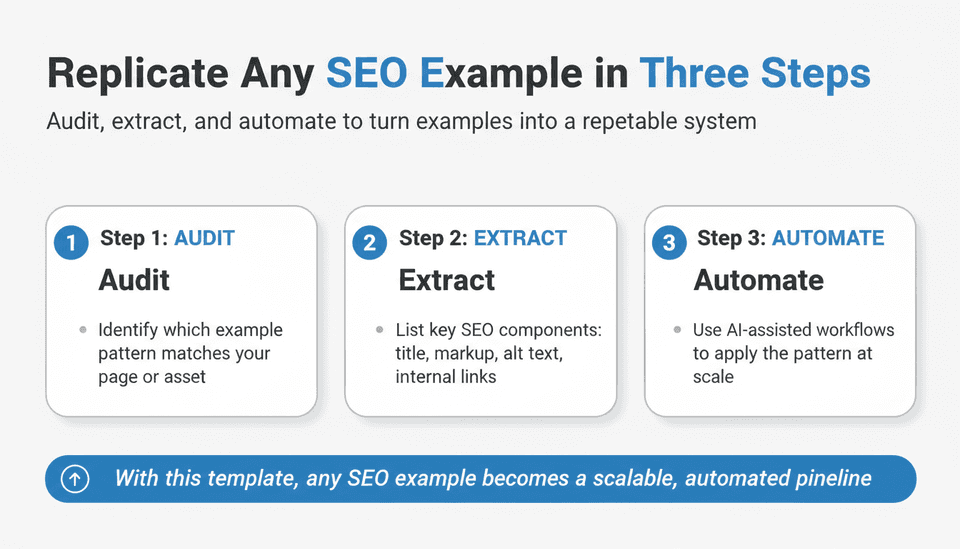
For each SEO example 2026 demands, use this three‑step template:
- Audit the specific asset. Product page, blog post, or GBP listing—identify which example pattern matches.
- Extract the structural elements. For e‑commerce, that’s title, review markup, alt text, and filter pages. For content, it’s pillar structure and internal links. For local, it’s NAP, categories, and reviews.
- Automate the repetition. Instead of manually rewriting 200 alt texts or creating 50 location pages, use an AI‑assisted workflow that applies the pattern at scale. A platform like Joyrise, which plans, writes, and publishes illustrated SEO articles directly to Webflow blogs, can take a pattern you choose—say, a topical cluster—and produce a month’s worth of interlinked, formatted pieces automatically. This frees you to focus on refinement, not production.
The Shift to AI‑Driven Search and Zero‑Click Marketing
What generative engine optimization (GEO) means for your content
Generative engine optimization is the practice of making your site the source that AI answer engines cite when they compose responses. That’s different from traditional SEO because you’re optimizing for an invisible “reader” that extracts facts and recommendations. On November 4, 2026, Hospitality Net reported that as AI tools increasingly shape travel discovery, hospitality operators are urged to prioritize accurate listings and consistent platform presence—a clear GEO signal for local services. If an AI‑powered trip planner pulls restaurant recommendations, it needs structured, trustworthy data, not glossy brochure copy. The same principle applies to product specs, how‑to guides, and service descriptions. For a deeper playbook, see How to do GEO: A Practical 2026 Guide.
The rise of AI agents and how they change discoverability
AI agents that act on a user’s behalf—booking a table, ordering supplies, compiling a research brief—are the next frontier. On November 9, 2026, Search Engine Journal covered Cloudflare’s CEO likening AI agent optimization to a new version of SEO, noting that sites may charge agents less when they explain their visits. This has massive implications: not only must your site be machine‑readable, but you might need to negotiate how agent traffic is handled, or even pay for hints that alert crawlers to content changes, as OpenAI currently does with Cloudflare. If your business relies on being found by an assistant that recommends a vendor, traditional ranking won’t help—the agent will pull from verified, structured data and reputation signals. This is why Which AI Agent Is Best for SEO? (2026 Decision Guide) is no longer a niche topic.
Zero‑click marketing in practice: learning from the news
A press release from The Detroit News on November 4, 2026 announced the book Zero Click Marketing by Rand Fishkin and Amanda Natividad, explaining how Google, AI, and social media platforms are changing the way people discover businesses. The takeaway: many queries now end without a click—AI overviews, featured snippets, and answer boxes satisfy users directly. Your modern SEO strategy must measure visibility in those spaces, not just organic clicks. Impressions in AI overviews, citations in voice answers, and brand visibility in generative search results become the metrics that matter. Meanwhile, Reddit is testing new search ads (Tubefilter, November 5, 2026), underscoring that even discussion platforms are turning into answer engines where discoverability is up for grabs.
A Practical Implementation Framework
Step 1: Audit your current site and identify gaps
Run a crawl with a tool like Screaming Frog or use Google Search Console’s coverage report. Look for:
- Pages with thin content (under 300 words of unique substance)
- Missing title tags or meta descriptions
- Broken internal links
- No schema markup on product, article, or local pages
- Index bloat (pages that shouldn’t be in the index)
If you can’t crawl your own site reliably, nothing else matters. Export the list and classify each page by the example pattern it should follow (e‑commerce product, content pillar, local page).
Step 2: Keyword research and competitive example mining
Use Ahrefs, Semrush, or the keyword planner in a platform like Joyrise to map every target page to one primary keyword and 3–5 semantic variants. For instance, a product page for a wool blanket might target “best wool blanket” but also answer “wool vs. fleece blanket warmth” in the FAQs. Study the top three ranking pages for each keyword and note the pattern they used: are they listicles, long‑form guides, or product‑rich pages? This competitive mining tells you which SEO example to replicate.
Step 3: Content creation using proven examples (and automation tools)
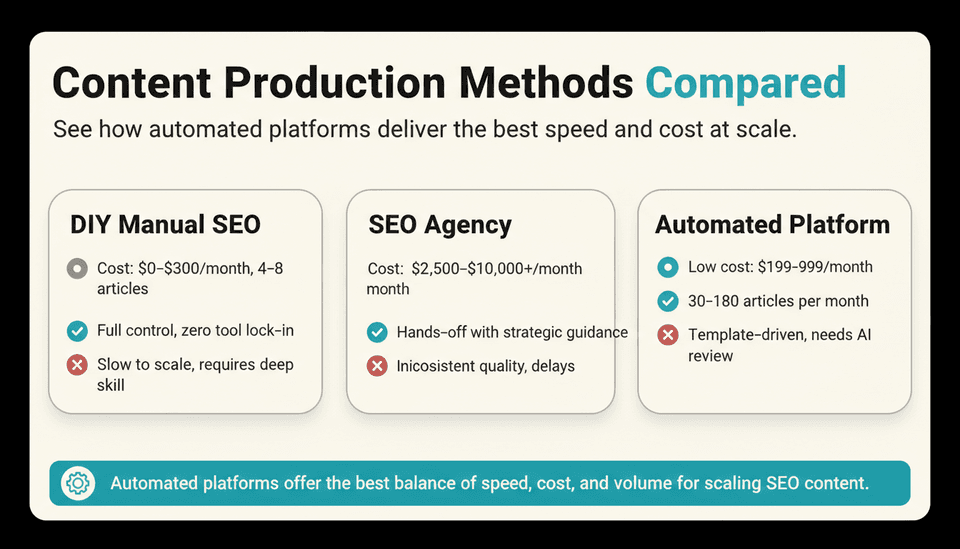
This is where the template from the earlier section meets production. Content automation for SEO isn’t about churning out garbage; it’s about applying a proven structure consistently. Modern AI SEO tools handle research, writing, and publishing in one workflow, cutting the repetitive effort that bogs down teams. For teams on Webflow, a platform like Joyrise can run a deep site scan, map keyword opportunities, and then generate long‑form, researched articles complete with branded header images and internal links—published directly to your blog on a schedule you set. That shifts the workload from “write each article manually” to “review and refine the pattern.” The cost and output difference is stark.
| Approach | Monthly cost (approximate) | Typical content per month | Time to first traffic impact | Pros | Cons |
|---|---|---|---|---|---|
| DIY Manual SEO | $0–$300 (tools) | 4–8 articles | 6–12 months | Full control, zero tool lock‑in | Slow, requires deep skill, hard to scale |
| SEO Agency | $2,500–$10,000+ | Varies | 3–6 months | Hands‑off, strategic guidance | High cost, inconsistent quality, communication lag |
| Automated Platform (e.g., Joyrise) | $199–$999/month | 30–180 articles | 3–6 months (with daily publishing) | Speed, per‑article cost under $6, daily cadence, Webflow‑native | Template‑driven; customization less bespoke; quality depends on AI review pass |
Step 4: Technical optimization—images, schema, and hosting
SEO best practices 2026 dictate that you never skip technical foundations, even with automated content. Compress images to WebP, add descriptive alt text, and ensure your CDN delivers sub‑second load times. Implement relevant schema: Article schema for blogs, Product schema for e‑commerce, LocalBusiness schema for location pages. Webflow SEO examples show how easily this is handled natively: built‑in fields for title, meta description, and Open Graph, plus automatic sitemap generation. If your content pipeline integrates directly with Webflow, every article can automatically include optimized meta data and alt text without an extra step.
Step 5: Measurement beyond clicks: traffic, AI referrals, and conversions
Open Google Search Console and look beyond total clicks. Filter performance by “Search Appearance” to see how often your pages appear in AI overviews (labeled as “AI overview” in the report since mid‑2025). Watch the “Clicks from AI assistants” metric if available (some platforms, including Joyrise’s integrated dashboard, surface this). Track impressions for zero‑click queries—they indicate your brand is being shown even if no one visits. Finally, tie everything to conversions. A product page might get 20% fewer organic clicks because the AI overview answers the basic question, but the people who do click are closer to purchase. Measure revenue per session, not vanity visits.
Mistakes, Myths, and Limitations of SEO
“SEO is a one‑time fix” and other dangerous beliefs
The idea that you can optimize a site once and coast is the most expensive myth in the business. Search algorithms change daily; competitors publish; AI overviews update. A modern SEO strategy treats content production and technical maintenance as an ongoing operational expense, not a project. Other harmful beliefs: that AI‑generated content alone will rank without human review, that backlinks don’t matter anymore (they still do, just less than in 2019), and that you can ignore social search signals.
When SEO can’t help (and what to do instead)
SEO has limits. If you’re selling a commodity without any differentiation, no optimization will win over cheaper alternatives in the same SERP. Similarly, if your business relies on immediate sales from a cold audience (e.g., a new impulse‑buy product), paid ads or influencer marketing will deliver faster. In those cases, use SEO to build a long‑term brand moat, but don’t make it your only acquisition channel. If you have zero technical resources to maintain a site’s health, invest in a platform that handles technical SEO automatically.
How long until I see impact in search results?
For a new page on an established domain, expect to see ranking movement in 3 to 6 months, with significant traffic increases possible at 9–12 months. Highly competitive commercial terms can take over a year. Zero‑click visibility in AI overviews can appear faster—sometimes within weeks of indexing—because Google’s AI model reevaluates relevance more dynamically. Instant results are a red flag; any guarantee of page‑one rankings in 30 days is a scam.
Don’t want a page in Google’s search results?
Add a <meta name="robots" content="noindex"> tag to the page’s <head>. For AI crawlers specifically, you can set separate rules in robots.txt using user‑agent tokens like GPTBot or Google‑Extended. In 2026, you can also configure Cloudflare’s AI Audit to block AI agents that don’t explain their visits, giving you finer control over which automated services access your content.
Next Steps: Staying Ahead in Search
How to future‑proof your SEO for AI agents and generative search
The path forward combines classic search engine optimization examples with a new layer: structure your data so agents can consume it programmatically. That means clean schema, well‑formatted tables, and authoritative citations. Embrace zero‑click marketing by monitoring visibility in AI overviews and voice answers, not just rankings. Treat your Google Business Profile and third‑party listings as SEO assets—they feed AI recommendations. Finally, adopt automation so you can scale the patterns that work without burning out your team. A healthy pipeline might include daily articles driven by keyword gaps, weekly news‑based pieces for topical authority, and monthly pillar updates—all produced and published with minimal human intervention once the strategy is set.
Resources and tools to keep learning (without drowning in jargon)
- For a quick‑start operational guide: SEO for Beginners: AI, Answer Engines & Your First 90 Days.
- For the geo‑specific playbook: How to do GEO: A Practical 2026 Guide.
- To compare full‑stack platforms: Best AI for SEO Writing: 4 Full‑Stack Platforms Compared.
- Outside perspective: Marketermilk’s 8 top SEO trends I'm seeing in 2026 offers a practitioner’s look at the real shifts, from answer engine saturation to rising zero‑click traffic.
Key Takeaways
- Apply the 12 SEO examples not by copying them, but by extracting the structural pattern and automating the repetition—the manual alternative doesn’t scale.
- Measure visibility in AI overviews and agent referrals, not just organic clicks; zero‑click impressions often precede conversion‑ready traffic.
- Set a realistic timeline: 3–6 months for first ranking movement, 9–12 months for meaningful traffic—instant promises are always false.
- Treat Google Business Profile, structured data, and third‑party listings as primary SEO assets because AI engines pull recommendations from them.
- Adopt an automated pipeline for content production and technical upkeep so your modern SEO strategy runs consistently without becoming a staffing burden.
If you want an automated pipeline that turns proven SEO examples into daily published articles on your Webflow site, see how Joyrise works at Joyrise: your blog, written and published every day.