 Joyrise
Long Form Content vs Short-Form: Real ROI Comparison
 By Alexi · · 12 min read

On this page
- What Is Long Form vs Short-Form Content?
- The SEO and Engagement Benefits of Long-Form Content
- The Speed and Virality Case for Short-Form Content
- Side-by-Side Comparison: Long-Form vs Short-Form
- The Hidden Cost of Long-Form Content in 2026
- How AI Changes the Long-Form Equation
- When to Use Long-Form Content (and When to Go Short)
- Why Long-Form Content Isn’t Going Anywhere
- Final Verdict: The Tradeoff Decides
- FAQs About Long Form Content
- Key Takeaways
Founders and marketing leads weigh long form content against short-form every quarter, but the real question isn’t length—it’s return on every dollar and hour spent. In 2026, AI-driven production has cut long-form article costs by roughly 90%, while short-form video continues to dominate mobile feeds. This practical cost-benefit analysis compares the enduring depth of long-form pieces with the speed of short-form, factoring in audience, channel, and the new economics of automated creation. No hype, just the numbers and trade-offs that let you decide where to place your next content bet.
What Is Long Form vs Short-Form Content?
Long-form and short-form are not rigid word-count buckets but distinct formats built for different goals and platforms. Understanding the functional difference prevents misallocating budget on a piece that’s too thin to rank or too bloated to go viral.
How Short Is Short-Form?
Short-form content sacrifices deep explanation for immediate consumption. On social media, it’s a TikTok or Reel under 60 seconds, a tweet, or an email blurb. In text, it’s a 300-to-800-word update, a listicle that states the obvious, or a quick news summary. It aims for a fast, single-action response—share, follow, click—and rarely answers complex queries.
Platforms define the ceiling: Hootsuite’s November 2026 guide on short-form video, consistent with the short-form content definition, still anchors the format at less than 60 seconds, built for vertical, mobile-first platforms like TikTok and YouTube Shorts. Written short-form lives on social captions, email newsletters, and news-site blurbs.
How Long Is Long-Form in 2026?
Industry definitions have always argued over a minimum threshold. Some SEO sources insist long-form starts at 1,000 words; others draw the line at 2,000. The better rule: long-form is any piece that comprehensively answers the user’s query without fluff—a principle detailed in A Foolproof Guide to Long Form Content. That could be a 1,500-word guide with original data, process maps, and a decision matrix, or a 3,000-word technical breakdown. What matters is whether it leaves the reader with zero need to search again.
Google’s Helpful Content system rewards thoroughness, not a word count. A 1,200-page informational page that resolves a niche query can outrank a 3,500-word competitor that only skims the surface. So, in 2026, I define long-form as pieces designed to satisfy depth-driven intent—typically above 1,200 words for B2B and above 800 for B2C—but the magic number doesn’t exist; comprehensiveness does.
The SEO and Engagement Benefits of Long-Form Content
If you need your brand to show up in search for competitive, high-value topics, the benefits of long-form content remain the strongest lever. It builds topical authority and earns backlinks at a rate short posts rarely match.
Why Google Rewards Depth
Multiple ranking studies over the last decade show a strong correlation between word count and top-10 positions—not because Google counts words, but because in-depth pages tend to include related entities, answer interrelated questions, and hold users longer. A blog post examples series that covers a topic cluster with linked, substantial articles creates a semantic net that lifts the whole domain.
Yet, the correlation isn’t a universal requirement. Low-competition queries with clear, factual answers can rank with a 500-word page. A long-form SEO article matters most when the target query implies a learning curve—“how to build a financial model,” “SaaS pricing strategy,” or “content marketing ROI.” For these, short pages leave gaps that searchers punish with quick bounces. In strategic terms: long-form is not a ranking cheat code, but it’s a necessity for any topic where user expectation demands coverage depth.
Building Trust and Authority
Readers equate thoroughness with expertise. A 2,000-word, well-structured post that cites sources, shows workflows, and includes real data signals that your company knows the subject better than a competitor’s 400-word LinkedIn status. This trust translates into longer time on site, higher share rates, and more newsletter signups. For B2B founders, a library of long-form articles can function as a 24/7 sales enablement tool, answering objections before a prospect ever talks to a rep.
The Speed and Virality Case for Short-Form Content
Short-form wins when the goal is reach, rapid testing, or maintaining daily visibility. It’s the format of feed-scrolling, where a single idea must land in seconds.
Quick Wins on Social and Email
A 30-second Reel or a sharp Twitter thread can pull in thousands of impressions and drive immediate traffic to a landing page. According to a MediaPost report on November 11, 2026, short-form video engagement now rivals movies and challenges long-form TV viewing time, absorbing massive audience attention. For marketers, that translates to a low-friction distribution channel where organic reach is still possible. A short video highlighting a feature or a punchy email with one statistic usually costs far less to produce than a deep-dive article and yields results within hours, not months.
Cost-Effective for Testing Ideas
Short-form acts as a low-risk hypothesis tester. A marketing team can publish five different angles on social media in a week, track which hooks get the most engagement, and then invest in a long-form piece for the winner. Spending $50 on a freelance graphic and a caption versus $500 on a full blog post lets you validate demand before committing resources. This is particularly valuable for startups with uncertain messaging.
Side-by-Side Comparison: Long-Form vs Short-Form
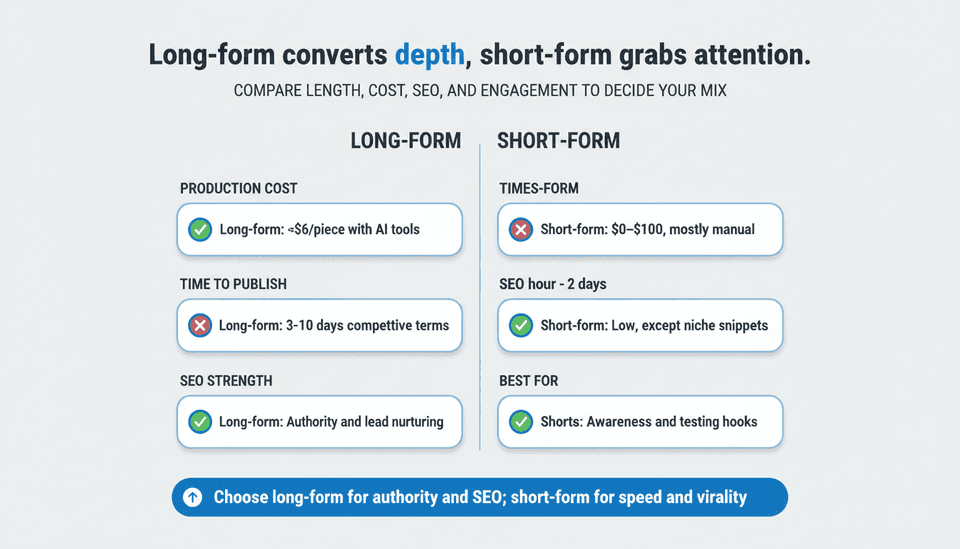
The table below lays out the two formats against shared criteria that drive ROI decisions. Numbers reflect 2026 realities and are drawn from industry pricing data and platform capabilities described in this article, not fabricated benchmarks.
| Criteria | Long-Form Content | Short-Form Content |
|---|---|---|
| Typical length | 1,200–3,000+ words (text); 10+ min video | 300–800 words (text); ≤60 sec video |
| Primary channels | Blog, YouTube, LinkedIn Articles, podcasts | TikTok, Instagram Reels, YouTube Shorts, email, social posts |
| Traditional content production cost per unit | $200–$500 (agency), $50–$150 (freelancer) | $0–$100 (in-house social post), $50–$300 (short video) |
| AI-driven content production cost per unit | ~$6 per article (Joyrise Basic plan: $199/30 articles) | Varies; low-cost AI tools for captions and clips available, but still manual assembly |
| Average time from concept to publish (without AI) | 3–10 business days (research, writing, editing, design) | 1–2 hours for a text post, 1–2 days for a short video |
| SEO strength | High for long-tail, informational, and competitive queries; builds domain authority | Low, except for very specific, low-competition queries or news snippets |
| Engagement pattern | Long dwell time, bookmarks, backlinks, bottom-of-funnel conversions | Quick views, likes, shares, top-of-funnel awareness, ephemeral |
| Best for | Explaining complex topics, building trust, ranking for money pages, nurturing leads | Testing hooks, driving event signups, daily brand visibility, viral spikes |
Production Cost, Time, and Channel Fit
The disparity in content production cost becomes the decisive factor for small teams. Traditional approaches made long-form a luxury; AI platforms have made it a commodity. Speed to publish remains a weak spot for long-form handled manually, but automation shrinks that gap. Channel fit is dictated by audience behavior: your ICP reading a 2,000-word guide on a laptop is different from a consumer scrolling Reels during lunch.
The Hidden Cost of Long-Form Content in 2026
Beyond the sticker price, long-form carries hidden costs that catch out founders who haven’t updated their cost models.
Traditional Agency Costs vs. AI-Driven Platforms
A middle-tier content agency in 2026 still quotes $400–$600 for a well-researched, 1,800-word blog post with custom graphics. For a startup that needs 20 articles a month to maintain topical momentum, that’s a $10,000 monthly line item—unsustainable without venture backing. Contrast that with AI SEO vs traditional SEO: a platform like Joyrise delivers a full month of 30 articles for $199, which works out to roughly $6.60 per post, complete with original header images and SEO metadata. That’s a 95% reduction that moves long-form content from a discretionary spend into a fixed operational cost smaller than a SaaS subscription.
The risk, of course, is quality control. AI-generated content can drift into generic patterns if left unedited. The best approach is a hybrid: let the machine handle the heavy research, structure, and first draft, then apply a human editorial layer. Platforms that include a second AI quality pass (Joyrise Pro and Max tiers do this) reduce the need for line-by-line editing.
Time-to-Publish Matters for Timely Topics
Manual long-form kills you on news-driven opportunities. If a regulation change drops and your agency needs two weeks to craft a thought-leadership piece, a competitor with short-form social posts captures the momentum. AI-driven workflows flip this: a system that scans industry news and drafts an SEO-optimized article within hours lets you publish while the topic is still trending. For founders operating in fast-moving niches like fintech or AI policy, that speed offsets the lack of virality.
How AI Changes the Long-Form Equation
AI content generation hasn’t just reduced costs; it has redefined what a small team can produce without a dedicated content department. The economics now favor a strategy few could afford two years ago.
From $500 Posts to $6 Posts: The Joyrise Example
Take the base math. A traditional freelance writer plus an SEO specialist plus a graphic designer might cost $500 per post. Joyrise’s automated platform scans your site to learn brand voice, performs keyword gap analysis, generates a fully illustrated article with internal links and meta descriptions, and publishes it to Webflow. Its Basic plan at $199/month yields 30 articles, bringing the per-article cost to $6.63. That’s not a typo—it’s the product of a frontier model fine-tuned specifically for SEO performance.
Low cost doesn’t guarantee quality, but when combined with a human review step, it lets a solo marketer run a content program that previously required five people. If you’re tracking results via Search Console data (integrated into the platform), you can iterate on topics weekly instead of monthly.
Maintaining Quality with AI Tools
Quality in long-form articles depends on accuracy, originality, and structure. AI drafts can match the structure of a senior content strategist, but they may hallucinate statistics or produce wandering transitions. Reputable platforms mitigate this by using a quality-judge model that rewrites weak sections. The output, when edited, lands somewhere between a good first draft and a publish-ready piece. Founders should budget 10–15 minutes of human polish per article—reading for factual errors, sharpening the intro, adding the one internal insight an AI can’t know. That’s still a fraction of the time it takes to write from scratch.
When to Use Long-Form Content (and When to Go Short)
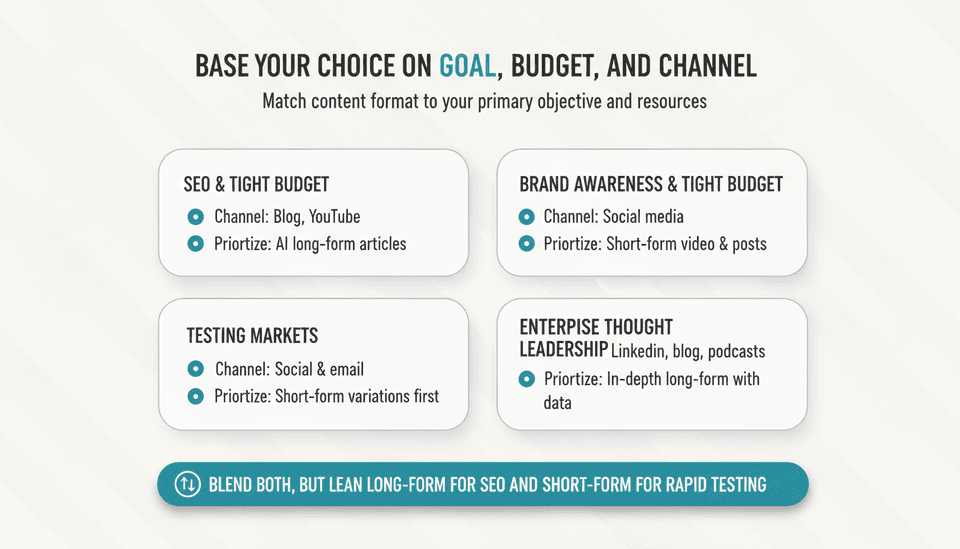
This isn’t an either/or. The best content strategies blend both, but the default allocation of budget and effort should follow a clear set of conditions.
A Decision Framework for Founders and Marketers
Run each content opportunity through this quick matrix based on your primary constraint and goal.
| If your primary goal is… | And your budget is… | The channel that works best is… | Then prioritize… |
|---|---|---|---|
| Organic traffic & leads (SEO) | Tight (≤$500/mo) | Blog, YouTube long-form | AI-powered long-form articles (cost per unit under $7, scale to 20+ posts/month) |
| Organic traffic & leads | Comfortable ($2,000+mo) | Blog, YouTube, webinars | Mix of human-edited AI long-form and original research reports |
| Brand awareness & social proof | Tight | TikTok, Instagram, LinkedIn feed | Short-form video and text posts; one long-form pillar piece per month |
| Testing new market angles | Any | Social media, email | 3–5 short-form variations; monitor engagement before committing to a long-form piece |
| Thought leadership for enterprise sales | Comfortable | LinkedIn Articles, own blog, podcasts | In-depth long-form with proprietary data, supported by short clips promoting it |
For founders on a bootstrap budget who need to rank for product-related keywords, how to use AI in SEO to build a consistent pipeline of long-form content is the highest-ROI move in month one. Break that pattern only when you need a quick awareness spike for a launch or event—then short-form fills the gap.
Why Long-Form Content Isn’t Going Anywhere
Despite the rise of bite-sized video, platforms and audiences are reinvesting in depth, underscoring that long-form content still commands value.
Short-Form Video Rises, But Long-Form Reads Hold Their Ground
MediaPost’s November 11, 2026 report confirms that short-form video engagement now rivals cinema and erodes traditional TV viewing. However, on the same timeline, other signals point to a depth resurgence. On November 12, 2026, Thred Website reported that Instagram is paying creators for long-form content, signaling that the platform itself sees sustainable audience appetite beyond 15-second clips. And as recently as November 18, 2026, Net Influencer noted that streaming services are actively seeking long-form YouTube catalogs, rebuilding them for TV. The appetite for comprehensive content isn’t dying—it’s just migrating to new channels.
The takeaway for content marketers: short-form grabs attention, long-form converts it. You need both, but you can’t close a complex B2B sale on a TikTok alone; at some point, a decision-maker will download a whitepaper or read an exhaustive guide before signing.
Final Verdict: The Tradeoff Decides
There’s no universal winner. The right answer hinges on what you’re selling and how much time you have. I’ll state it plainly.
Who Should Choose Long-Form Content
Choose long-form as your primary engine if you fit one of these profiles:
- You sell a considered purchase (B2B SaaS, consulting, high-ticket ecommerce) where buyers need education before converting.
- You rely on organic search as a primary acquisition channel and need topical authority.
- You have a limited team and need to scale content production without ballooning headcount—AI long-form makes this affordable.
- Your product’s value is best explained through detail, data, and case studies rather than emotional hooks.
The decisive tradeoff: you sacrifice virality and immediacy for compounding SEO equity and trust.
Who Should Choose Short-Form Content
Lead with short-form if:
- Your product is visually driven, low-consideration, or impulse-based (fashion, snacks, simple tools).
- You require rapid audience growth on social platforms to feed an ad funnel.
- You are testing positioning and need fast feedback loops.
- You operate in a news cycle niche where timeliness trumps depth.
The tradeoff: you get reach and speed, but you trade away the depth that builds long-term organic moats and backlink profiles.
FAQs About Long Form Content
What is longform content?
Longform content is any detailed, comprehensive piece designed to exhaustively address a user’s question or topic. It typically exceeds 1,200 words for B2B and 800 for B2C, but the defining trait is depth, not a specific character count.
How long is long-form content vs. short-form content?
Long-form content ranges from roughly 1,200 to 3,000+ words in text or over 10 minutes in video. Short-form content sits under 800 words in text and under 60 seconds in video. The cutoff varies by platform, with Hootsuite still defining short-form video as under one minute in 2026.
When should you use long-form content vs short-form?
Use long-form when the goal is to rank in search, build authority, or guide a buyer through a complex decision. Use short-form when you need rapid visibility, social engagement, or low-cost messaging tests. Most brands need both, but long-form should be the backbone if SEO is a primary channel.
What is short-form content?
Short-form content is concise media intended for quick consumption. In text, it’s social media posts, email snippets, or news summaries under 800 words. In video, it’s vertical clips under 60 seconds designed for TikTok, Reels, or Shorts, focusing on a single, immediate message.
Is content marketing dead in 2026?
No. Content marketing remains one of the most cost-effective ways to build durable audience assets. The formats and production methods have shifted—AI-generated long-form is now table stakes, and short-form video distribution has matured—but the core principle of earning attention through useful content hasn’t changed.
How can I afford to create long-form content on a small budget?
Use AI-driven content platforms that produce researched, illustrated, SEO-optimized articles for a flat monthly fee—sometimes as low as $6 per article. Combine this with a lightweight human editing step to ensure accuracy and brand voice. This approach slashes traditional agency costs while maintaining enough quality to compete in search.
Key Takeaways
- Long-form content’s business case has changed: AI platforms now deliver SEO-optimized, illustrated articles for around $6 each, making it affordable for small teams—but always add a human review step.
- Short-form is built for reach, not revenue: It tests hooks and builds brand awareness quickly, but cannot replace the depth needed to close complex sales or rank for competitive terms.
- There is no magic long-form word count: A 1,500-page that fully answers a query will outperform 3,000 words of padding. Focus on comprehensiveness, not length.
- The best strategy layers both formats: Short-form grabs initial attention; long-form converts it into trust, backlinks, and search traffic. Allocate budget based on whether your bottleneck is awareness or conversion.
- Cost structures have inverted: For the first time, producing 20 long-form articles costs less than a single agency post, making a content moat feasible on a bootstrapped budget.
Ready to turn a lean content budget into a consistent, SEO-grade publishing engine? Try Joyrise and read your first AI-written, fully illustrated article before you pay.