 Joyrise
Is GEO Replacing SEO? No—But It’s Changing Search
 By Alexi · · 11 min read

On this page
- Direct Answer: Is GEO Replacing SEO?
- What Is GEO and Why Is Everyone Talking About It Now?
- How GEO Is Different from Traditional SEO
- Where GEO and SEO Overlap (And Where They Don’t)
- How to Assess Your Business’s Readiness for GEO
- Lean GEO Tactics That Don’t Require a Full Agency
- Measuring GEO Impact Without Losing Your Mind
- FAQ: Answers to the GEO Questions Founders Keep Asking
- Key Takeaways
Direct Answer: Is GEO Replacing SEO?
Is GEO replacing SEO? Generative engine optimization (GEO) is not replacing SEO—it’s expanding the playbook. SEO is still the way your content gets found in traditional blue-link results, and those results still drive the bulk of high-intent traffic, especially for commercial, local, and navigational queries. GEO is about being the source an AI answer engine cites when someone asks a question. You need both, but you don’t need a panic-driven overhaul. For most businesses, the smart move is to understand where GEO matters for your specific audience and then layer in a few lean tactics that don’t blow your budget.
What Is GEO and Why Is Everyone Talking About It Now?
The short definition: optimizing for AI-generated answers
Often called AI search optimization, generative engine optimization means structuring and promoting your content so that AI models—like ChatGPT, Perplexity, Google AI Overviews, Claude, or Gemini—cite you as a source when they synthesize an answer. Unlike SEO, you’re not optimizing for a click on a listing; you’re optimizing for inclusion inside an answer that a user may never leave. Think of it as the difference between a billboard on a highway and having your expert quote appear in a trusted guidebook.
The catalysts: ChatGPT, Perplexity, and Google’s AI Overviews
The mainstream recognition of GEO as a distinct discipline came fast. By late 2025, Perplexity was handling hundreds of millions of queries a month. ChatGPT’s search integration blurred the line between chatbot and search engine. And Google rolled out Google AI Overviews at the top of many results, then expanded them. Suddenly, a chunk of the search experience had no blue links. Marketers who saw their organic traffic dip on informational queries started asking, “How do I show up there?” That’s GEO.
A recent shift: brand AI overviews replacing knowledge panels
The most tangible sign that GEO is being built into the core search infrastructure came in November 2026. ALM Corp reported that Google now shows brand AI Overviews in the right column where the knowledge panel used to sit (ALM Corp, undated). This means that when someone searches for your company, Google’s generative AI may summarize what it knows—pulling from your site, third-party mentions, and reviews—instead of displaying a static info box. If that summary is incomplete or inaccurate, you lose control of your own brand narrative. Optimizing for that summary is a GEO task.
How GEO Is Different from Traditional SEO
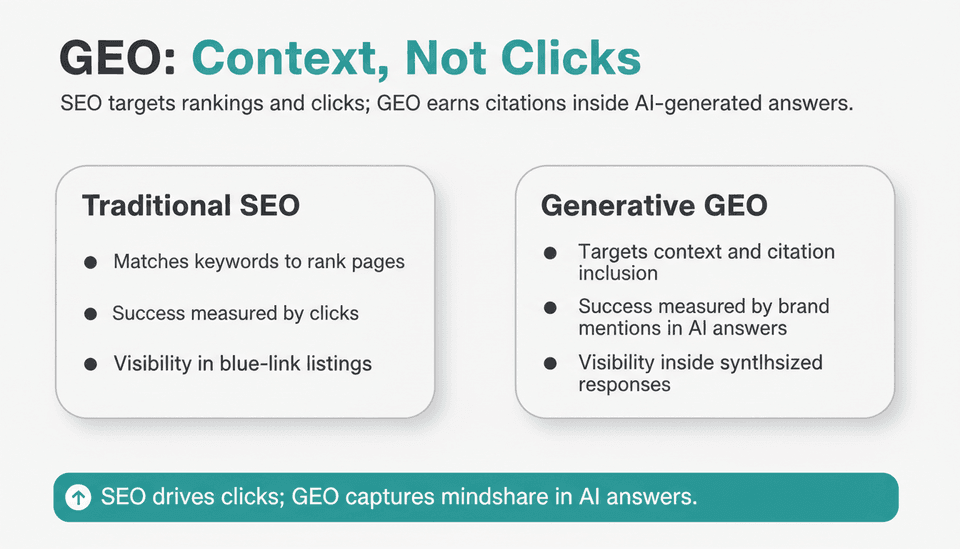
SEO vs GEO: from keywords and rankings to context and citations
Traditional SEO is built around matching a query to a page and measuring rank position and click-through rate. GEO is built around the context the AI assembles. An AI answer engine might pull information from ten sources, synthesize them, and name only two or three. Your job is to be one of the sources that gets named. That means you need content that clearly states facts, quotes, statistics, and definitions in a way that’s easy for a model to extract and cite.
Visibility inside answers vs. blue-link listings
In SEO, success is a click to your site. In GEO, success is often an impression where your brand name or data point appears without a click. A user might ask, “What’s a good CRM for a law firm?” and Perplexity might mention your product and three competitors—all without any links. That mention matters, but measuring it requires different tools and a longer time horizon.
Measuring success: impressions in AI tools are not the same as clicks
You can’t just look at Google Search Console and see your GEO performance. While Search Console now surfaces some AI-referral data (impressions from Google AI Overviews), many AI engines don’t share referral data at all. You’ll need to combine Search Console signals with brand-monitoring tools that track brand mentions for AI. This makes GEO measurement more like PR attribution than direct-response marketing.
Where GEO and SEO Overlap (And Where They Don’t)
Common ground: quality content, authority, and relevance
Both disciplines rely on having content that’s comprehensive, accurate, and well-regarded. Google’s own guide to optimizing for generative AI features highlights the same fundamentals: create people-first content, demonstrate experience, and build topical authority (developers.google.com, Google’s Guide to Optimizing for Generative AI Features). No amount of technical tinkering will get you cited if your content is thin.
Where SEO still dominates: commercial, local, and navigational queries
If someone searches “plumber near me” or “buy MacBook Pro,” they want a list of options to click. AI overviews might appear, but the user’s intent is transactional or navigational. Traditional SEO rankings remain the primary battleground for these high-intent queries because they still drive real revenue. GEO adds little incremental value here.
Where GEO adds new value: research-heavy and top-of-funnel journeys
GEO shines for questions that start with “how,” “why,” “what is,” or “best way to.” These are research-phase, top-of-funnel queries where users evaluate options. In professional services, software, B2B, and high-consideration consumer products, appearing in an AI answer can put your brand in the consideration set months before a buyer talks to sales. According to Risa Hoag, writing in the New York Real Estate Journal (Oct 2026), “Most people are now asking Chat, Claude, Perplexity and others for recommendations instead of Googling.” If your competitors are showing up in those answers and you’re not, you’re invisible during a critical decision window.
How to Assess Your Business’s Readiness for GEO
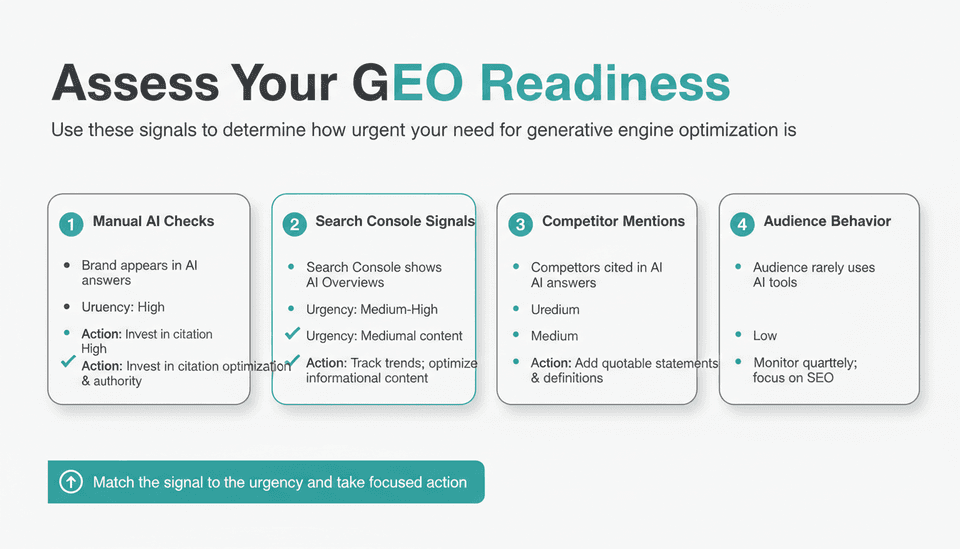
A quick GEO readiness assessment can help you decide where to focus.
Questions about your audience: Do they use AI for searches?
Ask yourself: Are your customers the type to query ChatGPT about a problem you solve? If you sell enterprise software, management consulting, legal services, or complex B2B products, the answer is increasingly yes. In consumer sectors with heavy research—health, finance, education—the same applies. If you sell low-consideration impulse items, GEO might matter far less. There’s no industry benchmark here; you can test by monitoring AI-tool mentions of your competitors or using a tool like Perplexity’s search to see what surfaces.
Signs it’s time to invest: growing AI-referral traffic or falling organic clicks
The clearest signal is a growing percentage of your Google Search Console impressions coming from Google AI Overviews, even if clicks are flat. Another is a consistent decline in organic clicks for informational landing pages that used to perform. That suggests the search experience is shifting for your topic areas. Conversely, if your traffic is stable and you see no AI-overview impressions, GEO may be a lower priority.
When GEO can wait: industries where traditional search still rules
Local trades, urgent services, ecommerce driven by product listings, and heavily regulated industries where AI engines avoid giving advice (e.g., certain medical or legal advice) may see minimal AI answer activity. If your business depends on map-pack rankings, local service ads, or transactional paid search, GEO can stay on your radar without immediate action.
A simple GEO readiness assessment:
| Signal | GEO urgency | What to do |
|---|---|---|
| You see brand mentions in AI tools when you check manually | High | Invest in structured citation optimization and authority building |
| Search Console shows AI Overview impressions | Medium-high | Track trends; optimize existing informational content for extractability |
| Competitors are appearing frequently in AI answers | Medium | Begin adding quotable statements, statistics, and clear definitions to key pages |
| Your audience rarely uses AI search tools | Low | Monitor quarterly, not weekly; focus on SEO fundamentals |
| Organic traffic on informational pages has dropped >20% without ranking changes | High | Prioritize GEO for those topic clusters; consider content restructuring |
Lean GEO Tactics That Don’t Require a Full Agency
Most small teams can’t afford a dedicated GEO consultant. And a full agency engagement is rarely needed in the early stages. The tactics below build on what you already have.
Optimize existing content for citation: structure, quotes, and data
AI answer engines favor content that states claims as crisp, self-contained statements. Go through your three most important informational pages and add:
- A 1–2 sentence “key takeaway” near the top, formatted as a direct answer to the main question.
- A named statistic or data point (even from your own customer research) that an AI can quote.
- A concise definition of key terms.
You’re not rewriting the page; you’re making it “citation-ready.” This is a 90-minute job, not a rebuild.
Build brand mentions and authority without a huge PR budget
GEO relies heavily on co-citation: AI models are more likely to cite you if other authoritative sources already talk about you. You don’t need a PR firm. Start by ensuring you’re mentioned on relevant industry roundups, guest contributions on reputable blogs, and podcast appearances that get transcribed. Even a few high-quality brand mentions for AI can shift your presence in AI answers over time. Treat this like a slow-burn link-building effort, but for brand recognition, not domain authority.
Automate content for GEO: scale quality so AI engines consider you a source
AI answer engines prefer to cite content that is consistent, well-researched, and regularly updated. Publishing a few great articles won’t build the volume of evidence an AI needs to see you as a reliable source across a topic area. The challenge: most founders don’t have a content team big enough to maintain that level of output.
That’s where you can automate content for GEO—using platforms that handle the planning, research, and publishing mechanics so that your site continuously gains fresh, cited-worthy material. For example, an approach like Joyrise’s is designed to plan and write researched, SEO-optimized articles that are also structured for AI extractability: clear headings, data points, and natural language summaries. This type of consistent output directly supports both SEO and generative engine optimization without the manual overhead that breaks small budgets. (For an in-depth look at how to optimize specifically for AI retrieval, see ChatGPT SEO Workflows: The Complete 2026 Guide.)
Measuring GEO Impact Without Losing Your Mind
The metrics that actually matter: brand mentions, share of voice, AI referrals
Traditional SEO metrics won’t capture GEO success. Focus on three, in order:
- Brand mentions in AI answers – manually check a set of 10–20 high-value queries in ChatGPT, Perplexity, and Google AI Overviews monthly. Tally when your brand appears.
- AI referral traffic – in Search Console, filter for impressions or clicks from Google AI Overviews. In analytics, look for referral traffic from perplexity.ai, chatgpt.com, or similar.
- Share of voice – use a tool like Semrush’s brand monitoring or a GEO-specific auditor to compare how often you’re cited versus competitors.
Low-cost tracking: Search Console + AI auditing tools
You can build a basic GEO dashboard with free tools. Google Search Console’s “Search results” report now breaks out Google AI Overview metrics under the “Appearance” filter. For non-Google AI engines, use a simple spreadsheet and manual queries. Some GEO auditing tools (like those mentioned in the Semrush generative engine optimization guide) can automate part of this monitoring, but even a monthly manual check is enough to spot trends.
Timelines: GEO is a longer game—expect months, not days
The Daily News (Oct 19, 2026) highlighted that PR and MarCom professionals must now measure both SEO and GEO, signaling that GEO has entered the mainstream communications strategy. But the article also underscores a truth: impact takes time. AI models update their knowledge bases on irregular schedules. A piece of optimized content might not appear in answers for 3–6 months. Set a realistic cadence: audit mentions quarterly, make changes, and reassess.
FAQ: Answers to the GEO Questions Founders Keep Asking
What is generative engine optimization?
Generative engine optimization (GEO) is the practice of creating and distributing content so it is used as a source by AI answer engines when they generate a response. Unlike SEO, it focuses on being cited within a synthesized answer, not on ranking for a click. The fundamental approach is detailed in Wikipedia’s entry on generative engine optimization.
What is the difference between SEO, AEO, and GEO?
SEO optimizes for search engine rankings and clicks. AEO (Answer Engine Optimization) is a broader term for optimizing for any answer engine that returns a direct answer—voice assistants, featured snippets, or AI. GEO is the latest subset of AEO, specifically targeting generative AI models like ChatGPT and Google AI Overviews. The Types of SEO: AEO, GEO, and Traditional Search Explained page breaks down these distinctions in more detail.
Will GEO eventually replace traditional SEO?
No. GEO will not replace SEO because a large portion of search intent remains transactional, navigational, or local. SEO will continue to drive direct clicks and conversions for those queries. GEO will grow alongside it, capturing top-of-funnel and research-based visibility. The two will coexist, and the best results come from integrating both.
How does keyword strategy change when moving from SEO to GEO?
You don’t abandon keywords; you group them into broader topics and frame content around the full question a user might ask AI. Instead of writing separate pages for “CRM software cost,” “CRM pricing models,” and “affordable CRM,” you create a single, comprehensive resource that an AI can pull multiple data points from. Context and natural language coverage matter more than exact-match density.
Where does your firm actually stand on the SEO-to-GEO spectrum?
For most businesses we work with, we recommend a dual modern optimization stance: keep the SEO fundamentals strong while layering on GEO tactics for informational content clusters. The mix depends on audience behavior. If your customers are increasingly using AI search, shift 20–30% of your content strategy effort toward GEO-readiness. Otherwise, keep it at 5–10% for awareness. The SEO for Beginners: AI, Answer Engines & Your First 90 Days guide offers a starting point.
How do I measure the impact of my GEO efforts?
Track brand mentions in AI answers, AI referral traffic from known sources, and impressions from Google AI Overviews in Search Console. Set a monthly or quarterly tracking cadence. Don’t expect a linear path; treat GEO measurement more like brand awareness than direct conversion. Over time, see if you’re included in more answers across your priority query set.
What are the first practical steps for a limited budget?
Start by auditing your top 10 informational pages for citation readability. Add clear, quotable statements. Then, list 20 key AI queries in your niche and check them across two AI engines. Document who is cited. Then, reach out for a few high-quality brand mentions for AI. These actions require mostly time, not money.
Is my industry even affected by GEO yet?
Industries with research-heavy buying cycles—professional services, B2B SaaS, finance, health, education—are already seeing AI answers shape discovery. Ecommerce, local services, and entertainment see less impact. If your buyers compare options and seek advice before purchasing, GEO likely matters. If they buy on impulse or by location, it’s a watchlist item. A practical GEO strategy for business begins with replicating your customers’ top research journey in Perplexity today. If you see competitors mentioned, you have your answer.
Key Takeaways
- GEO is an expansion of the search landscape, not a replacement for SEO—maintain both, but focus your effort based on query intent.
- The most immediate action is making your best content “citation-ready” with crisp statements, data, and definitions.
- Only invest deeply in GEO if you see AI-tool mentions of competitors or falling organic traffic on informational pages; otherwise, monitor quarterly.
- Measurement must shift from clicks to brand mentions and share of voice in AI answers, with a multi-month timeline for results.
- Consistent, well-structured content at scale matters for GEO, and automated platforms can deliver that without the overhead that stalls small teams.
If you want a content engine that builds authority for both SEO and GEO without manual grunt work, try Joyrise and read your first article before you pay.