 Joyrise
Free AI Tools for SEO Optimization: The Strategic Assembly Guide
 By Alexi · · Updated · 20 min read

On this page
- Executive Summary: What "Free AI Tools for SEO Optimization" Really Means
- The Free AI SEO Toolkit: Core Concepts and How They Work Together
- Building Your Full‑Funnel Free AI SEO Stack
- The Hidden Costs of Free: What You Sacrifice for Zero Price
- Emerging Frontiers: GEO, AI Visibility, and Why Your Free Toolkit Must Evolve
- From Free to Paid: When to Graduate to an Integrated SEO Automation Platform
- Common Mistakes, Myths, and Limitations of Free AI SEO Tools
- Your 30‑Day Action Plan with Free AI SEO Tools
- What are free AI SEO tools?
- How do I combine free AI tools into a complete SEO workflow?
- What is the best free AI SEO tool?
- Are AI SEO tools truly affordable?
- What are the limitations of using AI for SEO?
- How does AI help improve SEO efforts?
- When should I switch from free tools to a paid SEO platform?
- Key Takeaways
Free AI tools for SEO optimization aren't just a collection of browser bookmarks; they're a connected set of capabilities that, when assembled deliberately, can drive real organic growth without a recurring software bill. This guide does not hand you another top‑10 list. It gives you the system to build a full‑funnel SEO workflow using zero‑cost tools, makes the hidden costs visible, and tells you exactly when the economics flip in favor of paying for integration.
Executive Summary: What "Free AI Tools for SEO Optimization" Really Means
A plain‑language definition: AI‑powered tools that automate SEO tasks at zero cost.
Free AI tools for SEO are web‑based applications or APIs that use machine learning models—often large language models or computer vision—to assist with keyword research, content generation, technical audits, on‑page optimization, or performance tracking. They are free as in zero dollars: no credit card required, often with usage caps that make them viable for low‑volume side projects or proof‑of‑concept work. The label covers everything from a browser extension that rewrites meta descriptions to a full‑site crawler with NLP‑powered issue detection.
Scope of this guide: not a top‑10 list, but a system for using free tools to drive organic growth.
This is a practitioner's assembly manual. You will learn how to chain free AI tools into five sequential stages—audit, research, create, optimize, measure—and you will understand where the thread breaks, what rework it creates, and how to decide whether the result is worth the calendar time. We will examine the trade‑offs not in terms of feature lists but in terms of team bandwidth, output reliability, and SEO performance risk.
Why the typical listicle falls short—and what you'll learn instead.
Most roundups name 15 or 20 tools, describe their dashboards, and then wave vaguely at "workflow." They skip the integration cost, the drift between a tool's training data and today's search reality, and the fact that a free tier designed for one‑off audits rarely fits a weekly publishing cadence. You will leave with a decision framework that tells you when a patchwork of free AI SEO tools makes you money and when it leaks it.
The Free AI SEO Toolkit: Core Concepts and How They Work Together
Demystifying AI's role in SEO: generation vs. optimization vs. analysis.
AI does three distinct things in an SEO context. Generation produces text, headings, or image alt tags from prompts. Optimization adjusts existing content—tightening a title tag, suggesting internal links, or rephrasing for a keyword. Analysis interprets data: a crawler flags broken pages, a natural‑language model scores relevance to a search query, or a dashboard spots a click‑through‑rate drop. Many free tools do one of these well; almost none do all three out of the box. The stack you build must cover each function without gaps that force manual re‑entry of data.
Commonly confused terms: keyword research, topic clustering, entity SEO, and what AI really helps with.
Keyword research with AI moves beyond volume numbers. Free tools like Google's NLP API or open‑source embedding models can group queries by semantic similarity, revealing topic gaps. Topic clustering becomes a graph problem: a cluster is a set of pages that together cover a subject deeply. Entity SEO means aligning your page with the people, places, and concepts that search engines have mapped in knowledge graphs. AI tools can extract entities from top‑ranking pages and compare them to your draft, but they cannot invent a strategy; they surface patterns. Understanding the difference prevents the common mistake of letting a language model dictate your content plan.
The five stages of an AI‑driven SEO workflow: Audit, Research, Create, Optimize, Measure.
Every sustainable SEO process moves through these stages. A technical audit finds crawl errors, speed issues, and mobile‑usability problems before they undercut a new campaign. Research identifies topics and keywords worth targeting. Content creation turns a brief into a usable draft. Optimization polishes meta data, headings, and internal links. Measurement closes the loop with rank tracking and Search Console analysis. Free AI tools can power all five stages if you accept that data will live in separate silos and handoffs will be manual.
Anatomy of a connected stack (conceptual diagram idea: arrows between tools for each stage).
Imagine a pipeline: a free crawler like Sitebulb's trial (or an open‑source Screaming Frog script plus a free NLP model) outputs a list of technical errors and thin pages → the export feeds into a keyword research layer built from Google's Keyword Planner (free with an Ad account) and a Python script using free embeddings to cluster terms → the keyword clusters become topics → a free AI writer generates first drafts (ChatGPT free tier, Claude's free plan, or an open‑source model on a free notebook) → the draft passes through a free on‑page checker (AIOSEO's free analyzer, or a custom prompt that scores heading hierarchy and entity usage) → the published page is monitored with Google Search Console and a free dashboard like Looker Studio. The arrows are where the cost hides: every transfer is a point of manual friction.
Building Your Full‑Funnel Free AI SEO Stack
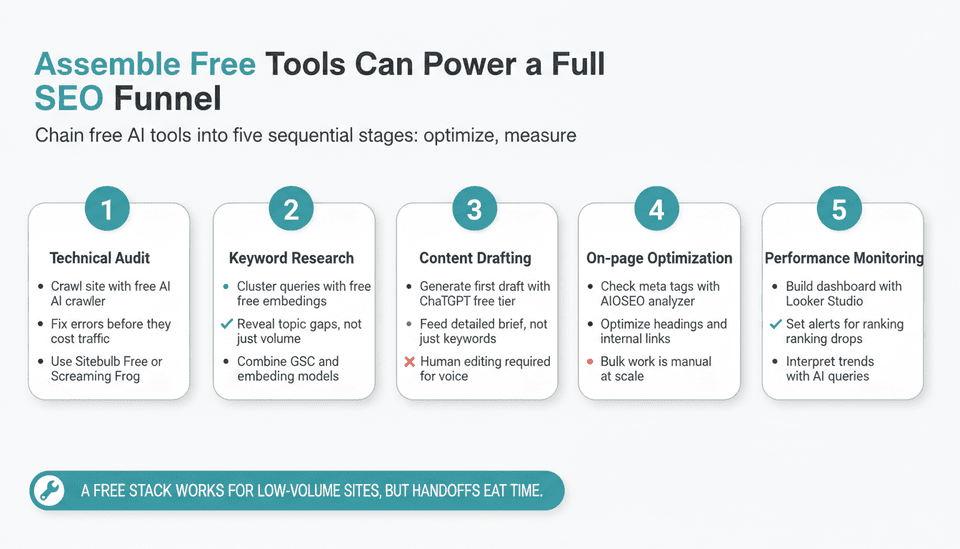
Stage 1: Technical audit with free AI crawlers – find errors before they cost you traffic (inspired by recent ad‑error news).
On November 4, 2026, Practical Ecommerce reported that AI tools can now automatically detect site errors before an ad campaign goes live, preventing wasted spend on traffic that hits a broken mobile menu or a slow‑loading checkout. This is a warning shot for SEO teams: an undiscovered technical glitch can bleed both organic and paid performance. Start your stack with a free AI‑powered crawler. Options include the free tier of Sitebulb (limited URLs but rich AI‑generated recommendations) or an open‑source setup: Screaming Frog's free version for up to 500 URLs, combined with Google's PageSpeed Insights API and a free form of page‑classification logic—for example, a simple script that checks each page's status code and feeds HTML snippets to a free NLP service to identify thin content. The output is a prioritized list of errors: redirect chains, missing meta descriptions, un‑crawlable resources. Treat this as your pre‑campaign checklist.
Stage 2: AI keyword research – moving beyond volume to intent and topic gaps.
The best free AI SEO tools for research are not stand‑alone apps; they are combinations of data sources and lightweight models. Use Google Search Console's free query report to see what already drives clicks, then pass those queries and your site's pages through a free embedding model (e.g., via Cohere's trial endpoint or an open‑source Sentence‑Transformers library running in Google Colab). The embeddings cluster thematically; the clusters reveal coverage gaps—topics where competitors rank but you don't have a page. Resources like the #1 Free SEO & AI Tools directory from SEO Review Tools can supplement this with free keyword generators and audit utilities that fit into an AI SEO optimization workflow. Stop when you have a cluster, not a list. A topic cluster says: "build one pillar page and four supporting pages on these five related queries." Free keyword generators (like Ahrefs' free keyword tool or Keyword Surfer) can append search volume and CPC data. The human analyst still decides intent: commercial investigation vs. informational. AI speeds the grouping by an order of magnitude.
Stage 3: AI content drafting – how to get first drafts that are useful, not just generic.
Most free AI writing assistants produce the same safe, encyclopedia‑style response. To get a usable draft, you must feed the model more than a keyword. Give it a brief that includes: the target query, the entity list from top‑ranking pages, a content angle (e.g., counter‑argument, case study, step‑by‑step), and the first paragraph you'd want to read. The free tier of ChatGPT, Claude, or Google Gemini can generate a long‑form draft, but you will need to do a quality‑judgement pass—checking facts, removing hedging, and injecting product‑specific details that no model knows. Free drafts demand human editing; do not skip this or you will publish generic content that erodes brand credibility. For teams looking at automated drafting, the comparison by The Keyword on November 5, 2026, of 10 AI blog generators highlighted that free tiers exist across the board, but the bottleneck shifts to voice consistency and integration when you scale beyond occasional posts. Independent testing of AI SEO tools—like the roundup from Whatagraph's 2026 evaluation—consistently finds that AI content optimization requires a human editorial pass to be effective.
Stage 4: On‑page optimization – meta tags, headings, internal linking with free tools.
Free tools shine here. The AIOSEO Free SEO Analyzer scores a URL for title tag length, meta description presence, image alt attributes, and basic readability. You can layer on a free NLP API to compare your heading structure against the entities mentioned in the top‑ranking pages—a quick Python script can flag headings that miss a key entity. For internal linking, use a free crawler to export all page titles and URLs, then manually or with a simple script identify where your new article should link to and from. It is painstaking at volume: for a site with 100 pages, this is an hour of work per article. Above roughly four articles per month, the time cost overtakes the dollar savings of a paid tool. CMSWire's 2026 analysis of free SEO tools reaches the same conclusion: free tiers excel at occasional, targeted tasks, not recurring production workflows.
Stage 5: Performance monitoring – free dashboards and AI‑driven insights.
Google Search Console and Google Analytics (both free) give raw data. Connect them to Google Looker Studio for a free dashboard that tracks clicks, impressions, average position, and click‑through rate by page. Add AI‑driven insights by setting up a rule‑based alert: when a page drops more than three positions week‑over‑week, the dashboard highlights it. You can also use a free ChatGPT query to interpret trends: export weekly data and ask, "What pattern do you see in these pages that lost impressions?" The analysis is only as good as the prompt, but it reveals directional signals.
Trade‑offs at every stage: reliability, data limits, and the 'Frankenstack' integration problem.
| Stage | Free Tool Example | What You Get | The Trade‑off |
|---|---|---|---|
| Technical Audit | Sitebulb Free + Google PageSpeed Insights | Crawl up to 500 pages, AI‑generated issue descriptions | Crawl limit misses large sites; manual export/import |
| Keyword Research | Google Search Console + free embeddings | Real query data, topic clusters without cost | Requires scripting skill; no competitive gap analysis without manual work |
| Content Drafting | ChatGPT/Claude free tier | Long‑form draft with decent structure | Generic language, factual errors, no brand voice; editing time is high |
| On‑page Optimization | AIOSEO Free Analyzer + free NLP API | Checks meta tags, headings, entity coverage | One‑URL‑at‑a‑time; no bulk optimization; internal linking requires separate tool |
| Performance Monitoring | Looker Studio + Search Console | Custom dashboard, free alerts | No predictive analytics; insights require human interpretation |
The deeper truth: a free AI SEO toolkit works when you have one pain point to solve occasionally. When you need to run the full funnel weekly for dozens of pages, the manual stitching becomes your primary job—and you stop being a strategist.
The Hidden Costs of Free: What You Sacrifice for Zero Price
Time as currency: hours spent stitching tools together vs. strategic work.
We modeled a workflow for a single pillar page: crawl audit, keyword clustering, draft generation, entity optimization, internal link insertion, and dashboard update. The total hands‑on time was approximately 6 hours. A marketing manager earning the equivalent of $75/hour spends $450 of time per article. Do that 10 times a month, and the labor cost far exceeds a subscription that automates the pipeline. Time is the real subscription you pay with a free stack.
Data fragmentation and the lack of a single source of truth.
Crawl data lives in a XML export from one tool, keyword clusters in a spreadsheet, drafts in a chat interface, and performance numbers in Looker Studio. There is no unified view of SEO health. When a ranking drops, you spend the first hour just reassembling the story. This fragmentation also breaks feedback loops: the dashboard sees a drop, but you cannot automatically trace it to the crawl audit that missed a page speed regression three weeks ago.
Quality and freshness – when free models lag behind paid (and why it matters).
Free AI models often run on older model versions or have a knowledge cutoff that lags by months. For SEO in fast‑moving spaces—like SaaS pricing or regulatory topics—outdated information in a draft can damage trust. Even if the model is current, free tiers throttle speed and context window, so you can't feed enough pages to teach it your brand voice. The result is a draft that looks right but feels wrong, which requires heavy rewriting.
The 'free user' data trap – how your inputs may train someone else's model.
Read the terms. Many free AI writing tools and chatbots retain the right to use your inputs to improve their models. You might be uploading proprietary content briefs, internal data, or customer language into a system that could surface it in another subscriber's output. For early‑stage startups with no sensitive data, this risk is acceptable; for companies handling customer financial or health information, it is a non‑starter. If your SEO strategy involves proprietary frameworks or unpublished product details, free cloud‑based AI tools introduce a data governance gap that no privacy policy solves.
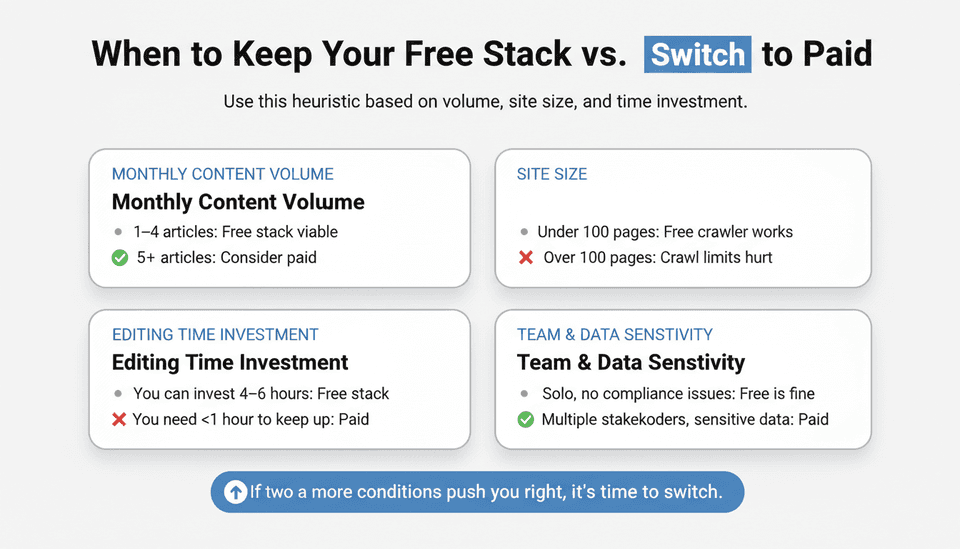
When free works: a decision heuristic based on site size, traffic goals, and team bandwidth.
The heuristic: Use a free AI SEO stack when you publish fewer than 4 articles per month, your site has fewer than 100 pages, and you have at least 5 hours per article for manual assembly and review. Beyond those thresholds, the calendar time and quality erosion push the economics toward a paid platform.
| Condition | Free Stack → Keep Going | Paid Platform → Consider Switching |
|---|---|---|
| Monthly content volume | 1–4 articles | 5+ articles |
| Site size (pages) | Under 100 | Over 100 – crawl limits hurt |
| Editing hours per article | You can invest 4–6 hours | You need <1 hour to keep up |
| Data sensitivity | No compliance issues | GDPR/HIPAA, proprietary data risks |
| Team size | One person does everything | Multiple stakeholders need shared dashboards |
Emerging Frontiers: GEO, AI Visibility, and Why Your Free Toolkit Must Evolve
What GEO (Generative Engine Optimization) is and why it's no longer optional.
Generative Engine Optimization (GEO) is the practice of making your content more likely to be cited, summarized, or recommended by AI‑powered search and assistant tools—like ChatGPT, Gemini, and Perplexity. As Hospitality Net explained on November 5, 2026, GEO is becoming essential even for industries such as independent hotels, where being the answer an AI assistant gives a traveler directly impacts booking revenue. The shift is not future‑tense; it's here. Free tools now need to audit not just Google's ranking signals but also whether your pages are referenced in AI answers. Google's own AI optimization guide now emphasizes clear entities, cited claims, and structured data as foundational for visibility in AI‑powered search features.
Testing AI assistants with free visibility checkers – a hands‑on example.
You can test for free. Pick a query your site should own. Open a free session of ChatGPT, Perplexity, or Gemini and ask: "What is the best [your product category]?" Note whether your brand appears, what source is cited, and what specific text the model pulled. Free browser extensions like the "GEO Visibility Checker" (still in beta as of late 2026) can automate this across a list of queries. The data you collect manually is noisy but directionally useful: if you don't show up in AI answers for your top 20 keywords, you have a visibility problem that traditional rank tracking won't catch.
How the recent rise of AI‑driven site‑error detection changes your pre‑campaign checklist.
The Practical Ecommerce story from November 4, 2026, underscored that AI can now catch site errors before ads go live. For SEO, that means your free technical audit must run not once a quarter but immediately before any major content push or campaign. When you plan a pillar page cluster, start by crawling the entire site with a free AI crawler and resolve every critical error. A new page published on a site with a broken mobile menu gets the same zero conversions as an ad landing on that same broken page. The detection tools are free; the discipline to run them on a pre‑campaign trigger is what costs nothing but saves thousands.
Future‑proofing your stack: which free tools are adapting to AI search, and which aren't.
Free tools that incorporate AI‑answer tracking—like Google's Search Console now showing AI‑assistant referral data in some reports—are investing in the GEO shift. Other free stalwarts that only track blue‑link SERPs are becoming incomplete. As you evaluate your stack, watch for two signs: does the tool provide insight into how your pages perform in AI‑powered search? And does it help you produce content that aligns with Google's AI optimization guidelines, which as of late 2026 emphasize clear entities, cited claims, and structured data? Tools that ignore GEO will leave you optimizing yesterday's search results.
From Free to Paid: When to Graduate to an Integrated SEO Automation Platform
The sign‑posts: content volume, team pain, and opportunity cost.
You're ready to switch when one of three things becomes routine: you spend Monday mornings manually exporting and importing data from five different free tools, your editorial calendar has more than 5 articles per week, or your content team says the phrase "I can't find the draft."
What a unified platform like Joyrise replaces (and what it doesn't) – a transparent look.
An integrated platform like Joyrise automates the entire content‑marketing pipeline that a free stack would stitch together: it scans your site to learn brand voice, plans SEO‑optimized keyword clusters, writes long‑form articles with original images and infographics, handles on‑page SEO (headings, meta, internal links), and publishes directly to Webflow while providing a unified Search Console dashboard. Its model is fine‑tuned for SEO performance and runs a quality‑judgment pass. What it does not replace: strategic thought, audience research that requires human interviews, and the final sign‑off on brand‑sensitive topics. It is a content operations engine, not a strategy brain.
Cost comparison: 10 free tools + your time vs. one subscription.
Assume a steady state of 30 articles per month. With a free stack, the time cost at a $75/hour fully loaded rate for a content+SEO person is roughly 6 hours per article = $450 per article, or $13,500/month in human time. A platform like Joyrise's Basic plan at $199/month (billed annually) delivers those 30 articles generated, optimized, and published with AI images. The time shifts from assembly to review and strategy—perhaps 30 minutes per article, or $1,125/month in human time plus the $199 subscription. The gap is real, but it's only relevant if you actually have someone whose time can be redirected to higher‑leverage work. If you're a solo founder with zero budget and an abundance of time, the free stack may still win.
A 5‑minute self‑assessment to decide if you're ready.
Answer these three questions:
- Does my publishing cadence exceed 4 articles per month?
- Do I spend more than 4 hours per article on assembly, not editing?
- Is my team spending at least 2 hours per week on tool handoffs?
If you answered yes to any two, the free stack is costing more than it saves. Move to a paid platform that integrates the workflow, even if it's not a premium tier; a lightweight paid tool that halves the handoff time can be ROI‑positive within a month.
Common Mistakes, Myths, and Limitations of Free AI SEO Tools
Myth: AI can replace human SEO strategy.
AI mimics patterns; it does not understand business goals, margin structures, or the emotional drivers behind a purchase. It can suggest a topic cluster but cannot decide whether your company should invest in top‑of‑funnel education or bottom‑of‑funnel comparison pages. That decision requires a human who knows the unit economics.
Myth: Free tools are always low‑quality.
Some free tools are stripped‑down versions of enterprise products, offering the same core AI on a smaller scale. The AIOSEO analyzer's recommendations, for instance, mirror the logic of its paid version. Quality is not the issue; scale and integration are.
Mistake: Over‑relying on AI content without human editing or brand voice.
Publishing AI‑generated drafts without a human review that adds original data, brand perspective, and a distinct tone leads to content that blends into the sea of sameness. Search engines may not penalize it directly, but users bounce, and conversion rates suffer. A free AI tool gives you a first draft; if you stop there, you are shipping unfinished work.
Mistake: Ignoring technical SEO because it isn't 'AI'.
Technical SEO is the foundation. You can have brilliant AI‑written content, but if your site has 4‑second load times or canonical‑tag chaos, rankings won't follow. The free AI crawlers exist precisely to solve this; skipping them is like building a house on sand.
Limitation: AI cannot understand your business context or audience nuance—yet.
A free AI tool does not know that your customers hate long paragraphs, that they distrust financial jargon, or that a key competitor just launched a product with an identical name. Only a human can supply that context. The AI SEO strategy you build must put the operator in the loop at every decision point, not hand the wheel to a model.
Your 30‑Day Action Plan with Free AI SEO Tools
Week 1: Audit your site and fix critical errors (with free AI crawler).
Run a full crawl using a free tool. Fix all 5xx errors, broken links, and mobile‑usability issues. Set up a Google Search Console property and verify that all pages are indexed. This creates a clean technical slate.
Week 2: Research and prioritize a topic cluster based on AI gap analysis.
Export your top 50 queries from Search Console and pass them through a free embedding cluster tool (or manually group them). Identify one cluster where you have partial coverage but no pillar page. Prioritize the cluster with the highest combined search volume and business relevance.
Week 3: Generate, optimize, and illustrate a pillar page using free AI tools.
Use a free AI writing tool to produce a long‑form draft based on a detailed brief. Edit it for voice, accuracy, and entity coverage. Run it through a free on‑page analyzer. Create or source a free header image (Canva's free tier, Unsplash) and insert internal links from three existing pages. Publish.
Week 4: Set up monitoring and iterate; evaluate whether your stack is sustainable.
Connect Search Console to Looker Studio and build a one‑page dashboard for your pillar page. After one week, note the time you spent. If assembly and handoffs exceeded 5 hours for a single page, you are outside the heuristic's safe zone. Use that data to decide whether to continue free or explore a paid platform.
Checklist: signals that it's time to move beyond the free toolkit.
- Crawl limit prevents a full‑site audit every month.
- You spend more time on data transfers than on content strategy.
- Your team avoids publishing because the process is too manual.
- You see ranking drops without a clear diagnostic.
- AI‑written drafts no longer represent your brand voice, even after editing.
What are free AI SEO tools?
They are zero‑cost software applications that use artificial intelligence—typically large language models or machine learning classifiers—to automate specific SEO tasks such as keyword grouping, content generation, on‑page analysis, or technical auditing. They almost always come with usage limits and operate in isolation, requiring manual integration to form a full AI SEO optimization workflow.
How do I combine free AI tools into a complete SEO workflow?
Connect a free crawler for technical auditing, a free keyword clustering method (like embeddings on Search Console data), a free AI writer for drafts, a free on‑page analyzer for optimization, and Looker Studio for monitoring. The sequence mirrors: Audit → Research → Create → Optimize → Measure. At each transition, manually export data and feed it into the next tool. This works for low‑volume sites, but the handoff time scales linearly with content volume. A structured SEO workflow with AI requires discipline at every handoff point.
What is the best free AI SEO tool?
There is no single best tool; the value comes from the combination. However, for pure capability‑per‑dollar, the free tier of a modern large‑language model (for drafting and analysis) paired with Google Search Console (for data) is the most versatile starting point. For technical SEO, a free crawler with AI‑suggested fixes (like Sitebulb's free version) is hard to beat. The best free AI tools for SEO are those that fit a specific stage in your workflow without creating redundant work. For a broader view of what's available, the #1 Free SEO & AI Tools directory from SEO Review Tools catalogs current options across every workflow stage.
Are AI SEO tools truly affordable?
The software is free at the point of use, but the cost of time, integration rework, and quality risk can be substantial. A free stack is affordable only when your opportunity cost of time is near zero—typically for very early‑stage solo projects or learning exercises. As soon as a salary is attached to the hours, the economics favor selective paid tools. AI‑powered SEO tools free of charge are best treated as a proof‑of‑concept, not a permanent production system.
What are the limitations of using AI for SEO?
AI cannot understand business context, audience nuance, or brand voice without extensive human guidance. It lacks live awareness of real‑time algorithm changes unless retrained. Free models often have knowledge cutoffs and may produce outdated or factually incorrect content. AI‑powered SEO tools free of charge also carry data privacy risks, as inputs may be used for model training, and they typically cannot execute actions like fixing technical issues or publishing content without manual intervention.
How does AI help improve SEO efforts?
AI accelerates pattern recognition: it clusters thousands of keywords, identifies entity gaps in a draft, flags technical issues from crawl data, and generates first drafts in seconds. This shrinks the time between research and a published page from days to hours, provided a human editor reviews the output. AI content optimization also enables new forms of optimization like generative engine optimization, where AI helps measure how your site appears in AI‑assistant answers.
When should I switch from free tools to a paid SEO platform?
Switch when your monthly content volume exceeds roughly 4 articles, or when the weekly handoff time between free tools exceeds 2 hours, or when data fragmentation causes ranking losses you cannot rapidly diagnose. The sign is not frustration alone; it's measurable calendar hours that could be spent on strategy instead of assembly. A self‑assessment that confirms two of the three factors—volume, handoff time, or team pain—means a paid integrated platform can reduce total cost and risk.
Key Takeaways
- A free AI SEO toolkit is a viable, strategic choice only for sites publishing fewer than 4 articles per month and willing to invest 5+ hours in manual assembly per piece.
- The hidden subscription is your time: data fragmentation, model freshness, and integration friction eat into the margins that free tools create.
- GEO is now a mandatory lens; free visibility checkers can tell you whether your site appears in AI‑assistant answers, a signal traditional rank trackers miss.
- Pre‑campaign technical audits using free AI crawlers prevent wasted traffic—run them every time before a content push, just as ad managers now do before launch.
- The graduation point to a paid platform is reached not when free tools break, but when your team spends more time stitching than strategizing.
For a platform that removes the assembly overhead entirely—planning, writing, illustrating, and publishing daily SEO‑optimized articles to your Webflow blog—you can see what Joyrise produces with your first article before you pay.