 Joyrise
Blog Post Examples: 10 Types You Can Replicate With AI
 By Alexi · · 16 min read

On this page
- 10 Blog Post Examples You Can Actually Build With AI
- Recap: Every Example in One Sentence
- How to Pick the Right Example for Your Strategy
- Can AI-generated blogs rank on Google?
- What are the benefits of using AI for blog writing?
- What are common mistakes when using AI for blogging?
- What are the best practices for editing AI-generated blog content?
- Can AI help with SEO optimization for blog posts?
- Which AI is best for blog writing?
- Key Takeaways
Get 10 blog post examples you can replicate with AI—practical SEO blog examples and best blog post formats for creating effective blog posts. This article is for operators and finance leads who need scalable content marketing examples they can turn into automated blog posts, not just a mood board of blog design ideas. Instead of just admiring blog inspiration, you’ll learn the formats AI blog writing handles reliably, so you can go from a saved screenshot to a live article today. No design school required, no blank page staring.
We’re skipping the generic “here are beautiful blogs” list. Those are useful for visual inspiration (Hostinger’s 55 best blog examples is a solid gallery if you need that). What’s missing is a practical guide to using AI to produce each type. The formats below are chosen based on three criteria: how well AI handles the structure, how likely the format is to rank and drive qualified clicks, and how easily you can feed your brand’s data into the process.
10 Blog Post Examples You Can Actually Build With AI
This list is for marketing teams, SEO managers, and founders running Webflow sites who want to automate daily blog publishing without sounding like a robot. Every format here has been tested by content teams moving from manual writing to an automated pipeline. The examples are distilled from real content types that drive organic traffic at scale.
1. The How‑To Guide: Step‑by‑Step, Search‑Friendly
Why it matters: How-to guides capture bottom-of-funnel traffic from people actively trying to solve a problem. They often pull in long-tail keywords and qualify visitors better than any other format.
How to apply with AI: Provide your AI tool with the exact steps you want covered, or let it generate a logical sequence from a title. The key is to feed it specific parameters: who the guide is for, what tools they have, and what outcome they want. Without that, the AI will produce a generic list that reads like every other result.
A concrete example: a SaaS company selling analytics dashboards might prompt: “Write a how‑to guide titled ‘How to Build a Customer Retention Dashboard in Google Looker Studio’ for ecommerce managers who have basic SQL knowledge. Include screenshot placeholders.” The AI can outline the steps, write the instructions, and even suggest where to insert visuals. You then swap placeholder screenshots for real ones.
Watch out: AI-generated steps can skip critical prerequisites or assume a newer UI. Always have someone on your team validate the guide against the current product or process. A how‑to with one broken step erodes trust faster than no guide at all.
2. The Listicle: Scannable, Shareable, and AI‑Friendly
Why it matters: Listicles are easy to scan, share, and dominate social feeds. From an SEO standpoint, they can rank for “best X” and “X tools” queries, but only if the items are substantive—not just a collection of popular names.
How to apply with AI: AI writes listicles without breaking a sweat because the format is predictable: numbered items, a header, a short paragraph per item, and a concluding sentence. The risk is generating a list of generic fluff. Combat that by injecting your product knowledge into the prompt. For example: “List the top 7 alternatives to [Competitor] for small finance teams, include pricing, a pro/con for each, and a note on when to switch.” Search Engine Land’s 7 proven blog post templates includes a detailed breakdown of one such template that consistently performs.
A real workflow: Use your AI platform’s keyword planner to spot a “top X” query you can win. Feed the tool your curated list of alternatives with one-sentence differentiators. The AI expands each into a proper paragraph, adds an H2 for each item, and wraps it in an intro that matches your brand tone. You review and tighten.
3. The Case Study: Proof That Sells—Without the Fluff
Why it matters: Case studies convert. A well‑structured case study—problem, solution, result—gives prospects concrete proof your approach works. But writing them manually takes hours of interviews and drafting.
How to apply with AI: AI can write a case study from a set of structured notes. You supply: client name (or anonymized), industry, the challenge, what you did, and the measurable outcome. The AI weaves it into a narrative. Never let AI invent numbers. If you feed it a bullet like “grew organic traffic,” it might hallucinate a 300% figure. Instead, give exact data: “Organic traffic went from 12,000 to 41,000 sessions per month in six months.”
Example: A B2B SEO agency could churn out short case studies for each client by feeding a standardized “client snapshot” into the AI. The AI creates a 400‑word post that reads like a mini success story. The team adds a quote from the client’s Slack message as social proof.
4. The Thought Leadership Piece: Opinion With SEO Guardrails
Why it matters: Thought leadership builds brand authority and attracts high‑value links. But raw AI opinion reads hollow because it lacks a real founder’s experience or conviction.
How to apply with AI: Write the core argument yourself—even if it’s just a voice note or a few bullet points. Then give that to the AI as the “author’s brief.” Instruct it to expand your points, counter common objections, and cite examples you’ve approved. This hybrid approach preserves your unique take while letting AI handle the scaffolding. The recent NVIDIA post-training project (Post-Training NVIDIA Nemotron to Increase Accuracy) demonstrated that fine‑tuning a model on domain‑specific data dramatically improves output reliability. The same logic applies here: the more of your own thinking you prime the model with, the less generic the output.
For example: A fintech founder records a three‑minute note on why “free banking” models are unsustainable. The AI turns that into a 1,200‑word post with a logical flow, headings, and relevant industry stats (which you then verify). The result sounds like the founder, not Wikipedia.
5. The News Article: Timely, Automated, and Industry‑Relevant
Why it matters: Industry news can bring spikes of traffic and position your brand as current. But manually staying on top of news is a full-time job.
How to apply with AI: Some AI platforms (like Joyrise’s Pro tier) can monitor selected sources and generate news summaries tied to your niche. You set the keywords—say, “SEC crypto regulation”—and it drafts a news bite. The human step is adding analysis. The AI summarizes; you answer “what this means for our audience.” Otherwise, you’re just rehashing Google News and offering zero differentiation.
Concrete example: Microsoft’s recent report on AI supply chain attacks hijacking coding agents (November 12, 2026) could be summarized by an AI tool tuned for a cybersecurity blog. The draft gives the facts; your CISO adds a paragraph on how your company’s code review practices mitigate such risks. That turns a news summary into a trust signal.
6. The Ultimate Guide: Pillar Content That Ranks for Months
Why it matters: An ultimate guide is the cornerstone of a topic cluster. It earns backlinks, ranks for a broad set of keywords, and serves as internal link destination for dozens of smaller posts.
How to apply with AI: You can’t prompt “write an ultimate guide to SEO” and expect a winner. Instead, break it into modules. Feed the AI one major section at a time—say, technical SEO, on-page, off‑page—and stitch them together. The AI’s job is to organize and articulate; your job is to ensure the structure reflects what Google’s top results are actually covering. Look at the SERP for your target keyword, note the subtopics the top‑3 pages include, and instruct the AI to cover each one. Joyrise’s deep site scan and competitor gap analysis can surface the subtopics you’d otherwise miss. For a finished example, see how a comprehensive AI SEO content optimization guide organizes every angle of the subject.
AI writes the bulk, but you’ll need to add proprietary data, internal links to related posts, and updated stats. A good AI platform will also generate a table of contents and meta tags automatically.
7. The Checklist / Cheat Sheet: Action Over Information
Why it matters: Checklists have sky‑high utility and share rates. They appeal to readers who want to get stuff done, not read another 2,000‑word essay. From an SEO perspective, they can win featured snippets when formatted as a clear numbered list.
How to apply with AI: Give the AI a procedure or workflow and ask it to convert it into a checklist. For instance: “Turn this 10‑step blog post publishing workflow into a downloadable checklist with checkboxes.” AI can generate the code for checkboxes or plain markdown. The value is in the items, not the prose. Make sure each line is a single actionable task with no ambiguity.
Example: “The 8‑point SEO checklist every new blog post must pass before publishing.” AI drafts it from your general SEO guidelines. You then add your specific tool names (e.g., “Check Search Console for indexing”) and internal links.
8. The FAQ Post: Answer the Questions Your Audience Actually Types
Why it matters: FAQs intercept voice search and “people also ask” boxes. They’re also one of the few formats where keyword stuffing is almost forgiven if the questions and answers are genuinely useful.
How to apply with AI: Pull the questions from sources that reflect real user queries: your customer support tickets, sales calls, or Google’s “People Also Ask” section for your primary topic. Then ask the AI to answer each question in 2–3 sentences in your brand’s voice. This is one of the lowest‑effort, highest‑predictability formats for AI. The structure is rigid, the content is short, and the AI rarely goes off‑script.
For example, a Webflow agency might create an FAQ on “Do Webflow sites rank on Google?” with 12 questions scraped from client emails. The AI answers, and you review for technical accuracy.
9. The Comparison Post: 'X vs Y' Drives Qualified Clicks
Why it matters: Comparison posts attract readers deep in the buying process. “Mailchimp vs Klaviyo” or “HubSpot vs Salesforce” means the searcher is choosing a tool and wants a straight answer. These posts convert into signups or affiliate revenue.
How to apply with AI: Give the AI a feature‑by‑feature rubric for both products, with your honest take on strengths and weaknesses. Prompt it to write an impartial analysis with a verdict for different buyer types. AI can frame the comparison, but you must supply the real‑world experience that makes the verdict credible. If you’ve never used one of the tools, the AI’s output will sound like a rewording of product pages—and readers will bounce.
For a finished piece, see how a straightforward AI SEO vs Traditional SEO comparison breaks down the trade‑offs without marketing fluff.
10. The 'Best of' Roundup: Curated External Credibility
Why it matters: A well‑done roundup—e.g., “Best tools for X” or “Top experts’ predictions”—borrows credibility from the entities you mention. It can also attract links from those featured.
How to apply with AI: AI can compile a list from a database or from the web, but curation is the human’s job. If you tell the AI “list the best project management tools,” it’ll return Monday.com, Asana, and Jira every time. So you first create a focused angle: “Best project management tools for client‑facing agencies in 2026.” Then you provide your actual 6 picks with a sentence on why each made the cut. The AI writes the detailed summary and pros/cons for each.
Example: A marketing agency curates “12 best SEO blogs that publish original research” and uses AI to draft the descriptions, pulling in latest article titles from each blog’s RSS feed. The agency then fact‑checks and adds personal commentary on each pick.
Summary table: 10 formats, AI predictability, SEO value, and your role
| # | Format | AI Predictability | SEO Value | Human Effort Required |
|---|---|---|---|---|
| 1 | How‑To Guide | High | High (long‑tail, featured snippet potential) | Verify steps, add visuals |
| 2 | Listicle | High | Medium‑High (if items are unique) | Curate list, avoid generic picks |
| 3 | Case Study | Medium (needs exact input) | Medium (link earning) | Provide accurate data, quotes |
| 4 | Thought Leadership | Low‑Medium | High (authority building) | Author the core argument, fact‑check stats |
| 5 | News Article | Medium‑High (with trusted source) | Medium (freshness boost) | Add expert commentary |
| 6 | Ultimate Guide | Medium (module‑by‑module) | High (pillar content) | Structure, internal links, proprietary data |
| 7 | Checklist | High | Medium (featured snippet) | Compile actionable items |
| 8 | FAQ Post | High | Medium (voice search) | Source real questions |
| 9 | Comparison Post | Medium | High (commercial intent) | Provide real usage experience |
| 10 | Best‑of Roundup | Medium | High (link‑worthy) | Curate original picks, add commentary |
(AI predictability: how reliably AI produces a first draft that doesn’t need major restructuring. Human effort required: the minimum non‑delegable work to make the post publishable and unique.)
Recap: Every Example in One Sentence
- How‑To Guide: Step‑by‑step instructions that capture search intent; AI can draft the sequence, you add real screenshots and accuracy checks.
- Listicle: Scannable lists that get shared; AI populates the format, you supply unique items.
- Case Study: Proof‑driven stories; AI narrates from structured data, you provide the real numbers.
- Thought Leadership: Opinion anchored in experience; AI expands your bulleted argument, you own the perspective.
- News Article: Timely industry updates; AI summarizes events, you add analysis.
- Ultimate Guide: Definitive pillar content; AI handles the writing, you architect the structure and inject unique insights.
- Checklist: Action‑oriented lists; AI converts procedures, you ensure every line is a doable task.
- FAQ Post: Direct answers to real questions; AI writes responses, you supply the questions from customer data.
- Comparison Post: Head‑to‑head evaluations for buyers; AI frames the analysis, you provide firsthand tool knowledge.
- Best‑of Roundup: Curated external picks; AI writes the profiles, you make the choices.
How to Pick the Right Example for Your Strategy
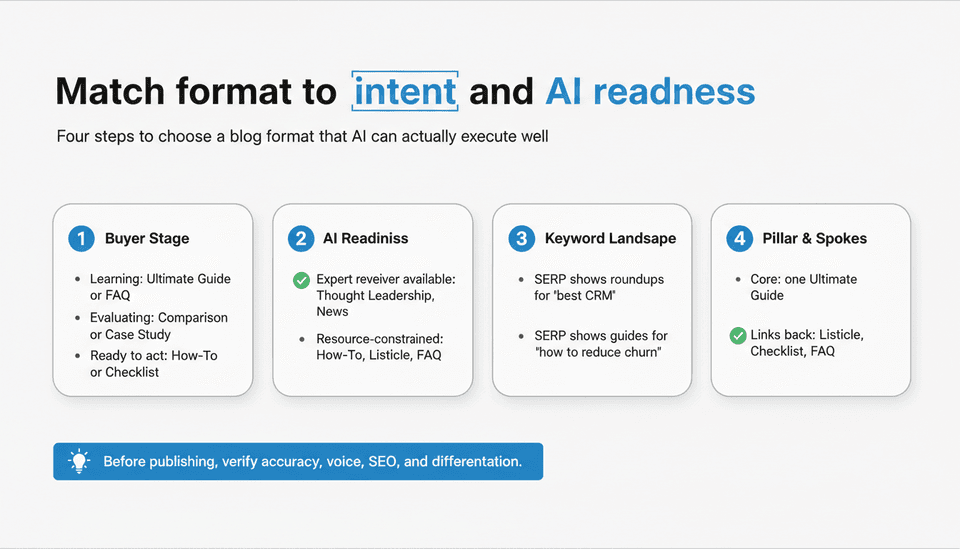
Choosing the right blog post format isn’t about what looks prettiest—it’s about what matches your current audience’s intent and your team’s capacity to guide AI. Here’s a simple decision framework:
- Map the format to the buyer’s stage. If your target reader is just learning about the problem, use an Ultimate Guide or FAQ. If they’re evaluating solutions, choose a Comparison Post or Case Study. If they’re ready to act, a How‑To Guide or Checklist does the job.
- Assess AI readiness. If you have a subject-matter expert who can review, higher-effort formats like Thought Leadership or News are viable. If you’re resource‑constrained, lean on High‑predictability formats like How‑To, Listicle, or FAQ.
- Check the keyword landscape. Some keywords strongly favor a certain format. Google “best CRM” and you’ll see mostly roundups. Search “how to reduce churn” and how‑to guides dominate. Let the SERP tell you which format to build.
- Start with one pillar and its spokes. Pick an Ultimate Guide as your core page, then schedule one Listicle, one Checklist, and one FAQ that link back to it. AI can produce all four in a week if you set up the briefs right.
A practical evaluation framework for any AI‑generated post: Before you hit publish, ask four questions:
- Accuracy: Are all facts, numbers, and process steps verified against a live source?
- Voice: Does it sound like your brand—or at least not like a generic chatbot?
- SEO checklist: Are target keywords in the title, headings, and meta description? Are internal links and a table of contents present?
- Differentiation: Would someone who reads the top three SERP results still find something new here?
If you answer “no” to any, feed the draft back to the AI with specific instructions for revision—or, for the final 10%, hand‑edit.
Can AI-generated blogs rank on Google?
Yes, but with clear conditions. Google’s guidelines don’t penalize AI content per se; they penalize low‑quality, unoriginal content that offers no value. AI‑generated blogs rank when they are reviewed, edited, and enhanced with expertise. An automated first draft that a subject expert then validates and enriches with proprietary data, original examples, and unique analysis can perform as well as a manual post. Joyrise’s platform, for instance, includes a built‑in SEO checker and a second AI quality‑review pass (Pro and Max tiers) to catch thin content before it goes live. But no tool bypasses the need for human sign‑off if you want consistent rankings. For more on this, read Is SEO Being Replaced by AI?.
What are the benefits of using AI for blog writing?
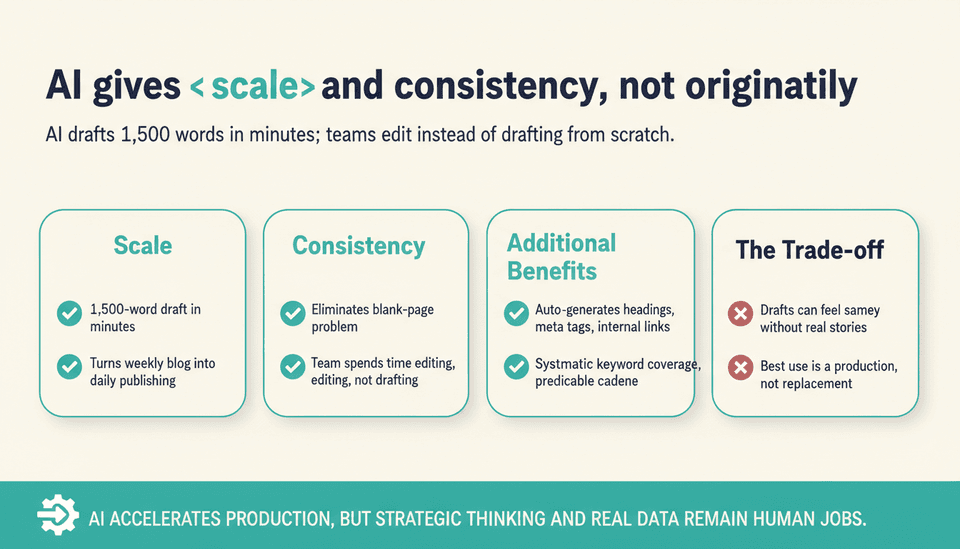
The two biggest benefits are scale and consistency. AI can produce a 1,500‑word draft in minutes, turning a weekly blog into a daily one without hiring an army of writers. It also eliminates the blank‑page problem, so your team spends time editing rather than drafting from scratch. Additional benefits: integrated SEO features (headings, meta tags, internal links) are generated automatically, keyword coverage becomes systematic instead of hit‑or‑miss, and your publishing cadence becomes predictable—a must for building topical authority with search engines.
The trade‑off is originality. AI drafts can feel samey if you never inject real stories or data. That’s why the best use is as a production accelerator, not a replacement for strategic thinking.
What are common mistakes when using AI for blogging?
- Publishing unedited AI content. The most common mistake is treating the AI’s first draft as final. It will contain generalities, maybe outdated facts, and zero brand personality.
- Not feeding the AI your specific data. A generic ChatGPT prompt yields a generic blog. Without a description of your product, customer, and unique point of view, the AI defaults to median‑consensus writing that’s indistinguishable from 50 other sites.
- Ignoring EEAT signals. AI struggles to convey real experience, expertise, authority, and trustworthiness unless you explicitly add those elements. Adding an author bio, citing primary sources, and linking to original research are human tasks.
- Keyword stuffing in the name of “SEO.” Because AI can write on command, some teams instruct it to include a keyword 15 times. That leads to unreadable text and potential ranking drops.
- Using a generic model with no brand safety guard. As Microsoft’s recent research on supply‑chain attacks in AI shows, models can be manipulated post‑training to produce harmful outputs. While not likely in everyday blog writing, the principle holds: know what model you’re using and whether it’s been fine‑tuned or sourced from a trusted provider. A platform built for content—like Joyrise with its custom‑tuned SEO model—reduces that risk.
What are the best practices for editing AI-generated blog content?
Treat AI output as a sophisticated first draft, not a published piece. Your editing checklist should include:
- Fact‑check every claim. AI can hallucinate dates, statistics, and product features. Cross‑reference against your internal knowledge base or a quick Google search.
- Inject your voice. Read the draft aloud. Where it sounds wooden or generic, rewrite with your company’s vernacular—phrases your customers use, analogies your team leans on.
- Add unique examples. AI gives generic hypotheticals. Replace them with a specific client scenario, internal data point, or a recent campaign outcome.
- Strengthen the structure. AI sometimes buries the most important point in the third paragraph. Move the key insight to the top and ensure headings tell a skimmable story.
- Check SEO elements. Verify that the AI hasn’t over‑optimized, that the title tag is under 60 characters, the meta description is under 160, and that each H2/H3 maps to a keyword variant where it makes sense.
- Insert internal links to relevant pages. AI might include placeholder links or none. Add 2–4 deep links to your own high‑value pages.
If your platform has a “quality judge” or second‑pass AI (like Joyrise Pro and Max), use it to catch basic errors before your human review.
Can AI help with SEO optimization for blog posts?
Yes, significantly. AI can generate a title tag, meta description, URL slug, and even a table of contents based on the target keyword. It can suggest internal linking opportunities, format headings, and ensure keyword inclusion without overdoing it. Platforms like Joyrise automate the end‑to‑end process: from keyword research and competitor gap analysis to writing and optimizing the content with all the above elements, then publishing directly to Webflow. That removes the manual churn of copying keywords into a CMS and hoping you remembered every field.
That said, AI can’t replace a strategic SEO audit or a custom content strategy. It operates within the guardrails you set. If you give it a poor keyword or a weak topic cluster, it’ll optimize a post that shouldn’t exist. So always start with a human‑vetted plan, then let AI handle the on‑page execution.
Which AI is best for blog writing?
“Best” hinges on what you’re optimizing for. If you need an occasional post and have an editor, a free tool like ChatGPT or Claude can work. But if you’re scaling to 30+ articles a month and publishing to Webflow, a dedicated blog‑writing platform that combines content generation, SEO, and publishing is the realistic choice.
Joyrise is one example: it’s built on a frontier AI model fine‑tuned specifically for SEO performance, not general conversation. It scans your site to learn your voice and product set, plans keywords from actual site data and competitor gaps, then writes, illustrates, and publishes daily posts. For teams that would otherwise pay an agency $5,000+ per month for a handful of articles, this replaces multiple tools and a chunk of human labor. The Pro plan ($499/month) adds a second AI quality pass and news‑driven article creation, which helps close the gap between raw AI draft and publish‑ready content.
The question isn’t really “which AI writes better prose.” It’s which workflow gets you from idea to live, optimized post with the least overhead. If your current bottleneck is not writing but the assembly line of research, optimization, and publishing, then a purpose‑built platform beats manually stringing together a general‑purpose LLM, an SEO tool, and a CMS login.
For a broader look at the landscape, see What Are the Best AI SEO Companies? Platforms vs. Agencies.
Key Takeaways
- The 10 formats above cover 90% of high‑performing blog content; pick based on your audience’s intent and your capacity to guide AI, not just visual inspiration.
- AI predictability is highest for structured formats like How‑To, List, and FAQ—these require the least human rework and are ideal for daily publishing.
- Always feed your brand data, voice, and target keywords into the AI; generic prompts produce generic posts that won’t rank or convert.
- Treat AI output as a draft; using a formal evaluation framework (accuracy, voice, SEO, differentiation) before hitting publish prevents thin content.
- A dedicated AI content platform that integrates SEO and publishing can reduce the cost per post by an order of magnitude compared to manual writing or agency retainers.
Start turning blog post examples into your own published articles—Joyrise plans, writes, and publishes daily illustrated SEO posts to your Webflow blog, with your first article ready to read before you pay. See how it works.