 Joyrise
Best AI for SEO Writing: 4 Full-Stack Platforms Compared
 By Alexi · · Updated · 16 min read

On this page
- Best AI for SEO Writing: Quick Picks for 2026
- The Shift from Writing Assistant to Full-StackContent Engine
- How We Picked the Contenders:12 Tools Reviewed,4 Made the Cut
- Our Evaluation Criteria: Beyond Just Writing Quality
- The 4 Best AI Platforms for SEO Writing, Tested
- Alternatives We Didn’t Include (and Why)
- When Should You Invest in a Full-Stack Platform vs. a PointSolution?
- Buyer’s Checklist:7 Questions to Ask Before Choosing an AI SEO Writing Tool
- Frequently Asked Questions About AI for SEO Writing
- Key Takeaways
If you’re searching for the best AI for SEO writing in 2026, you’ve probably seen dozens of lists that all stop at the draft. Most tools can help you write a blog post, but they hand it back to you for editing, images, SEO tagging, and publishing. That’s fine if you have a team to do the rest. But for many businesses—especially those on Webflow—what they actually need is a platform that plans, writes, illustrates, optimizes, and publishes the article every day without manual steps.
That’s the shift we’re tracking here. Rather than comparing writing assistants in a vacuum, we looked at platforms that can run an entire content operation end to end. Four stood out. Joyrise is the only one that automates publishing to Webflow, so it’s the natural choice for hands-off daily traffic. Surfer SEO, Frase, and Scalenut are excellent at what they do—optimization, research, and budget-friendly planning—but they still require you to handle the final mile yourself.
This breakdown shows you when a full-stack engine beats a point tool, what the trade-offs are, and how to choose based on your own workflow.
Best AI for SEO Writing: Quick Picks for 2026
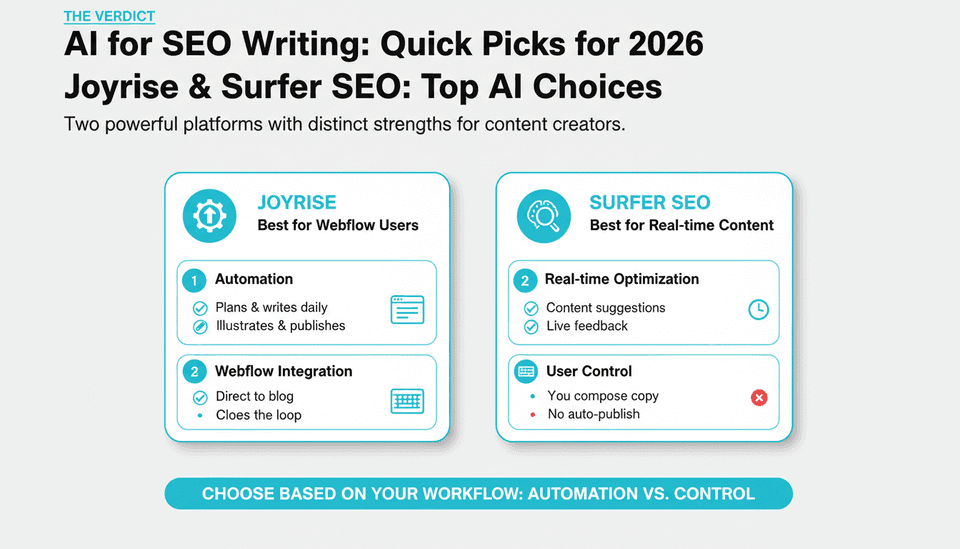
- Joyrise – Best for Webflow users who want daily, hands-off publishing. Plans, writes, illustrates, and publishes articles directly to your Webflow blog. The only platform here that closes the loop from keyword to live post.
- Surfer SEO – Best for real-time content scoring and optimization. Gives you a live content score as you write, using SERP data. Powerful for polishing drafts, but no writing or publishing automation.
- Frase – Best for AI-powered research and outline creation. Builds detailed content briefs by analyzing top-ranking pages. Ideal for teams that want to speed up research, not replace the writing process.
- Scalenut – Best for all-in-one planning and drafting on a budget. Offers topic clustering, AI writing, and content optimization at a lower price point. Still requires manual publishing.
For a quick side-by-side, jump to our comparison table later in the article.
The Shift from Writing Assistant to Full-StackContent Engine
For years, thebestAI writing software for SEOwas a tool that helped you draft an article faster. You'd still need an SEO specialist to choose the topic, a designer to make the header image, a developer to handle internal links, and a content manager to hit publish. That stack works, but it's expensive and slow.
Two things changed in 2026.
First, businesses are increasingly bundling SEO, web development, and content into one engagement instead of hiring separate providers. Digital marketing firm DS Network LLC reported on November 3 that more clients now ask for all three from a single team, reflecting a broader market trend (Yahoo Finance, Nov 3, 2026). When you want to buy the outcome—organic traffic—you're less interested in cobbling together point tools.
Second, the market for all-in-one AI productivity platforms is heating up. A head-to-head comparison of such platforms on November6 (North Penn Now) highlighted how tools that combine writing, SEO, and automation are replacing fragmented workflows. That same logic applies to SEO content: there's growing demand for a full-stack AI content solution that can handle the entire cycle.
The majority of "best AI for SEO writing" roundups ignore this. They talk about writing quality scores and ignore the automated blog posting part. But for a founder or marketing lead, the real bottleneck isn't drafting anymore—it's the 30 minutes of manual work per article to research, illustrate, optimize, and publish. If you're aiming for daily publishing, that bottleneck matters more than whether one AI writes slightly more lively sentences.
Yet, as we'll see, mostAI SEO writing toolsstill stop at the draft. Only one in our list closes the loop by automatically publishing directly to a CMS.
How We Picked the Contenders:12 Tools Reviewed,4 Made the Cut
We started with a broad candidate universe: every tool that markets itself as an AI SEO writing assistant or automated content creation platform. The initial list included12: Jasper, Copy.ai, Writesonic, Surfer SEO, Frase, Scalenut, SEO Writing AI, Rytr, Semrush ContentShake, Wordtune, and Joyrise. We also considered WordPress-specific AI plugins mentioned in a recent Hostinger comparison (3 days ago). We then filtered using strict inclusion criteria:
- The tool must handle keyword planning and content strategy, not just write text.
- It must offer on-page SEO optimization (meta tags, headers, internal linking suggestions, or a content score).
- It must publish content in some form—draft saving, CMS integration, or direct publishing.
- It must be marketed as a solution for businesses, not just individual creators.
- It must have publicly documented features and pricing as of November2026.
Excluded: Any tool that cannot publish or doesn't include SEO planning was cut. That eliminated Jasper, Copy.ai, Writesonic, Rytr, Wordtune, and many others—they are excellent AI writers, but they are not content operation platforms. SEO Writing AI, a popular 1-click WordPress publishing tool, was excluded because our focus is on platforms that serve Webflow users, and its WordPress-only publishing doesn't address the full-stack need for design-agnostic CMS publishing. Semrush ContentShake was borderline but lacks automated publishing; it's more a writing aid within the Semrush ecosystem. All WordPress plugins, per Hostinger, still require manual intervention for publishing and SEO fine-tuning, so they fall short of the automation goal.
Four platforms met the bar: Joyrise, Surfer SEO, Frase, and Scalenut. They're evaluated below.
Our Evaluation Criteria: Beyond Just Writing Quality
We didn't run a blind taste test of AI prose. Instead, we assessed each platform against the full workflow a business needs to actually publish a rank-worthy article every day.
- Keyword and topic planning: Can it identify gaps, suggest topics, and build content clusters, or does it rely on you to bring your own list?
- Research and outline creation: Does it analyze top-ranking pages and build a data-backed brief?
- AI writing quality: Does the output require heavy editing to feel human? Here we drew on third-party evaluations like Freddiechatt's hands-on comparison and the recent FindArticles test of7 AI humanizer tools (1 day ago), which showed that certain rewrites can make AI text read as human.
- On-page SEO optimization: Does it handle meta titles, descriptions, headings, internal links, and a content score?
- Image and illustration generation: Does it include original header images or infographics, or do you need to source them elsewhere?
- Publishing automation: Can the platform push a post directly to your CMS with zero manual steps? This is the key differentiator for AI content publishing.
- Performance tracking integration: Does it connect to Google Search Console or provide a dashboard to measure clicks and impressions?
- Quality control without human review: Which platforms have a built-in check—like a second AI rewriting draft for quality—to reduce the risk of shallow or factually off content?
The One.com guide published November3 reminds us that even the best AI output still needs fact-checking and brand voice adjustments (One.com, Nov3, 2026). So we looked for platforms that offer a quality safety net, not just hope.
The 4 Best AI Platforms for SEO Writing, Tested
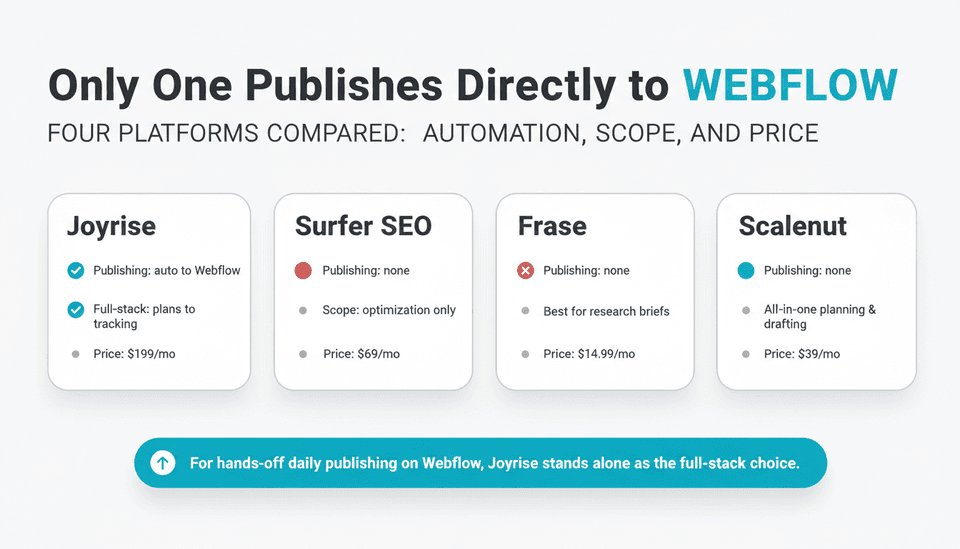
Below you'll find a comparable shortlist of the four, each with a clear best-for label and evidence for that claim.
| Platform | Best For | Publishing Automation | Full-StackCapability | Starting Price (Monthly) |
|---|---|---|---|---|
| Joyrise | Webflow users needing daily hands-off publishing | Yes, direct to Webflow | Plans, writes, illustrates, publishes, tracks | $199 (30 articles) |
| Surfer SEO | Real-time content scoring & optimization | No | Content optimization only, no planning/publishing | $69 |
| Frase | AI-powered research & brief creation | No | Research and briefs; writing left to you or integrations | $14.99 |
| Scalenut | All-in-one planning & drafting on a budget | No | Topic clusters, content briefs, AI writing | $39 |
Pricing source: Freddiechatt (2026). Joyrise pricing from official plans.
Joyrise: Best for WebflowUsers Who Want Hands-Off Publishing Every Day
Joyrise is the only platform in this list that fits the definition of an automated content creation platform. It doesn't ask you to write, optimize, or publish. After a one-time setup—site scan for brand voice, audience, and product offering—it plans topics, writes long-form articles with original header images and infographics, builds in SEO features like internal links and meta descriptions, and publishes directly to your Webflow blog.
Key capabilities that matter for hands-off operations:
- Publishing automation: You connect your Webflow site, set your posting cadence (up to10 articles/day on the Max plan), and it auto-publishes. No manual review required if you choose, though the platform does offer a draft review option.
- Quality judgment pass: Pro and Max plans run a second AI rewrite to catch weak drafts before they go live. This addresses the risk that no human is editing—an approach more credible after the FindArticles test showed that an AI humanizer pass can meaningfully improve perceived writing quality.
- News-driven article creation: Pro and Max tiers can generate industry news updates, giving your blog timely content without manual monitoring.
- Performance feedback loop: An integrated Search Console dashboard shows clicks and impressions, closing the loop between writing and results.
Price and positioning: At $199/month (Basic) for30 articles, Joyrise costs less than most part-time content interns, but it's not cheap compared to pure writing tools. The real ROI argument is replacing an SEO agency: the platform claims to operate at 1/10th the cost of traditional SEO agencies, which aligns with market rates where a content-focused agency retainer often runs $2,000–$5,000/month. ForWebflowSEO contentat scale, it's the only option that eliminates manual publishing labor entirely.
Best for: Marketing teams at Webflow businesses, founders who want daily organic content without hiring, and anyone who would otherwise pay an agency to run a content program.
Trade-off: It's Webflow-only (as of now). If you're on WordPress or another CMS, pick another tool.
Surfer SEO: Best for Real-Time Content Scoring and Optimization
Surfer SEO is the go-to SEO writing assistant for content editors who already have a draft and want to see exactly how to align it with top-ranking pages. Its Content Editor gives you a live score, a target word count, recommended keyword usage, and feedback on headings and images—all based on SERP analysis.
Where Surfer shines: If you're editing a draft from any AI writer (or a human), Surfer will show you what the winning pages include and where your draft falls short. It doesn't plan topics or write from scratch, but it's the ultimate optimization tool for SEO content automation in the final polishing stage.
Publishing: None. Surfer expects you to copy-paste the optimized text into your CMS manually. That keeps it firmly in the point-solution category.
Best for: SEO specialists who want to optimize content for specific queries before publication, teams that already have a writer or an AI drafting tool, and anyone who needs a second opinion on their on-page SEO.
Pricing starts at $69/month, which is reasonable for the optimization depth, but keep in mind you'll need to add a writer (or another AI) and a publisher to complete the loop.
Frase: Best for AI-Powered Research and Outline Creation
Frase is built around a simple idea: instead of spending hours reading the top20 results for a keyword, let AI analyze them and build a comprehensive content brief. Frase examines the structure, common subtopics, questions people ask, and statistical mentions—then generates an outline and even a first draft.
What makes it valuable: The research brief is detailed and can significantly cut down prep time. It's the tool we'd recommend to a team that still wants a human or AI writer to produce the article but needs the research to be fast and data-backed.
Publishing: Frase does not publish to any CMS automatically. You can export content or integrate with WordPress via a Zapier bridge, but it's nowhere near a full-stack AI content publishing solution.
Best for: Content managers and SEOs who handle high-volume research, agencies that prepare outlines for writers, and teams that want toblendAI for content marketingwith human oversight.
Pricing starts at a very low $14.99/month, making it the most cost-effective way to get SERP-informed research. However, you'll still need a separate writing and publishing process.
Scalenut: Best for All-in-One Planning and Drafting on a Budget
Scalenut is the closest you'll get to a full content marketing platform without publishing automation. It covers keyword planning through topic clusters, builds content briefs, provides an AI writer that can draft long-form articles, and scores your content for SEO. Its“ Cruise Mode” can generate a full blog post in one go.
Where Scalenut wins: If you want a single dashboard for topic research, briefs, writing, and on-page optimization—and you're willing to handle publishing manually or through a simple export—Scalenut does it all at a fair price.
Publishing: No direct CMS integration for automatic posting. You copy and paste or use a manual export workflow. So while it's an all-in-one for planning and drafting, it doesn't cross the publication finish line.
Best for: Soloprenneurs and small teams who need to replace a subscription to multiple tools (keyword research, brief builder, AI writer, optimizer) with one affordable platform.
Pricing begins at $39/month, a strong budget option for the planning-to-draft pipeline.
Alternatives We Didn’t Include (and Why)
SeveralpopularAI SEO writing toolsdidn't make the final list, each for a specific reason:
- Jasper – A powerful AI writer with brand voice features, but it doesn't plan keywords or publish to a CMS. It's a writing co-pilot, not a content machine.
- Copy.ai and Writesonic – Quick-draft generators with some SEO features, but they lack publishing and deep research integration.
- SEO Writing AI – Offers1-click publishing to WordPress, which is attractive, but our focus is on Webflow users, and it doesn't provide the full planning-to-track loop we required.
- WordPress AI plugins (e.g., AIOSEO, RankMath AI) – As Hostinger's comparison revealed (3 days ago), even the top plugins require manual intervention for publishing and optimization, so they aren't truly hands-off.
- Semrush ContentShake – A solid writing aid inside the Semrush suite, but no automated publishing; it's more for Semrush users who want a convenient drafting add-on.
In short, if a tool can't plan, write, optimize, and publish in a streamlined way, it didn't make the cut.
When Should You Invest in a Full-Stack Platform vs. a PointSolution?
Invest in a full-stack platform when:
- You're on Webflow and want to publish daily without adding headcount.
- You're replacing an agency that charged thousands per month, and you're looking for a fractional cost with automation.
- You need the whole flywheel—keywords, writing, images, on-page SEO, and publishing—to run without you.
- Quality control is built in (e.g., a second AI rewrite pass) so you can trust articles that go live without a human editor.
Stick with a point solution when:
- You already have a writer or an AI drafting tool and just need optimization (get Surfer SEO or Frase).
- You're on WordPress and fine with manual or semi-automated publishing via plugins (though you'll still need to handle many steps).
- Your budget is tight and you're willing to do the publishing work yourself (Scalenut gives you the planning and writing).
- You need maximum control over every word before it goes live; then a tool like Surfer or Frase paired with a human editor is safer.
If you're not sure, start by calculating the cost of your current content workflow—including the time spent on admin—vs. the price of a platform that automates those steps. That number often makes the decision obvious.
Buyer’s Checklist:7 Questions to Ask Before Choosing an AI SEO Writing Tool
Use these questions to vet any platform you're considering. They're designed to surface whether a tool can actually replace your current content production cost.
- Does it publish directly to my CMS without manual steps? If not, factor in the time you'll spend every week copying and pasting. That labor cost can undo the savings of a cheaper tool.
- How does the platform handle quality control without human review? Look for a built-in quality judgment pass, fact-checking against current sources, and an AI humanizer step. If none exist, you'll need to budget for editing time.
- Does it plan keywords based on my site, or do I have to supply them? A true SEO content automation platform should analyze your site and competitor gaps to suggest what to write about.
- Are original images generated automatically? Header images and infographics are essential for engagement and social sharing. If the tool doesn't create them, you'll need a designer or another AI tool in the mix.
- What does the content look like after publishing? Review sample articles from the platform, not just demos. Can you tell it's AI? Does it align with your brand?
- Can it handle news-driven or timely content? If your industry moves fast, you may want a tool that can generate articles based on recent events (as Joyrise's Pro plan does).
- How does pricing scale with volume? Evaluate per-article cost at your target publishing frequency. A $39/month tool might be cheaper for10 articles, but if you need30, the economics can flip.
For a deeper dive on evaluating tools independently, seeCanIDo SEO on My Own? A DIY Decision Gide.
Frequently Asked Questions About AI for SEO Writing
What is the best AI for SEO writing?
It depends on what“ best” means in your workflow. If you need an end-to-end solution that publishes automatically to Webflow, Joyrise is the strongest option. If you want real-time optimization for a draft you've already written, Surfer SEO is better. Frase excels at research, and Scalenut offers a budget-friendly planning-plus-writing package. For a detailed comparison, seeWhichAI Tool Is Best for SEO?2026 FAQ & Answers.
Can AI tools replace human SEO writers?
Not entirely—yet. AI can handle bulk drafting, research, and routine on-page SEO, but human oversight remains necessary for fact-checking, strategic editorial direction, and adding genuine insight. The One.com guide (Nov3,2026) emphasizes that the best output comes from a human-AI partnership. Full-stack platforms with a quality judgment pass reduce the editing burden, but they don't eliminate the need for occasional spot-checks, especially onYMYLtopics.
How do AI writing tools help with SEO?
They accelerate content production, allow you to target more keywords consistently, and enforce on-page SEO best practices at scale. When integrated with keyword research and SERP analysis, they help produce content that reflects what already ranks, reducing the guesswork. Automated content creation platforms also maintain internal linking and metadata, which would otherwise require manual effort per article.
What features should I look for in an AI SEO writing platform?
Beyond basic writing ability, prioritize: (1) keyword and topic planning from your site data, (2) on-page SEO automation (meta, headings, internal links), (3) original image generation, (4) direct CMS publishing, (5) built-in quality control, and (6) performance tracking integration. The more of these a platform handles without your time, the closer you get to a true AI content publishing system.
Are there AI tools that publish directly to my website?
Yes, but they are rare. As of2026, Joyrise is the only platform we evaluated that publishes directly to Webflow without manual steps. Some WordPress-focused tools like SEO Writing AI offer1-click publishing, but they don't include the full planning and optimization suite. Most other AI SEO writing tools require you to copy content into your CMS and set up the post yourself.
How much does an AI content marketing platform cost?
Pricing varies widely. Point solutions for writing or optimization start at $15–$70/month. Platforms that offer planning, writing, optimization, and publishing typically begin at $199/month. At the high end, full-stack automation can reach $999/month for high-volume needs, which is still a fraction of what an agency or dedicated content team would cost.
Is AI content safe for Google rankings?
Yes, provided it's helpful, original, and created for users, not just to manipulate rankings. Google's guidelines don't penalize AI content per se; they penalize low-quality, spammy content. A platform that includes a quality judgment pass and on-page SEO optimization helps ensure output meets a reasonable quality bar, but you should still review articles for factual accuracy and brand tone, especially before they go live.
Do I need to edit AI-generated SEO articles?
Usually, yes—at least to some degree. Even the best AI can produce factual errors or generic phrasing. The platforms that include a second AI rewrite pass (like Joyrise's Pro and Max tiers) reduce the need for heavy editing, but they don't eliminate the need for occasional human spot-checks. If you're publishing without any review, opt for a platform with robust quality safeguards and watch your Search Console data closely in the first few weeks.
Key Takeaways
- The best AI for SEO writing is the one that matches your publishing volume and CMS: for Webflow hands-off publishing, Joyrise is the only full-stack option; for optimization, Surfer SEO; for research, Frase; for budget planning, Scalenut.
- Publishing automation is the missing chapter in most tool comparisons, yet it's the time-sink that kills ROI when you try to scale content manually.
- A full-stack platform can cut the cost of a traditional content agency by up to90%, but only if you trust the built-in quality checks and monitor early output.
- AI content still needs a human editor's eye for facts and nuance—never turn on auto-publish without a plan for occasional review, especially on critical topics.
- Before choosing, calculate the per-article cost of your current process including labor, then compare it with platforms that automate from keyword to live post.
Ready to see a platform that writes and publishes daily SEO articles to your Webflow blog without lifting a finger? Start your free trial at Joyrise and read your first article before you pay.