 Joyrise
Affordable Search Engine Optimization Service: 2026 Guide
 By Alexi · · 14 min read

On this page
- Executive Summary: The New Economics of Affordable SEO in 2026
- What an Affordable Search Engine Optimization Service Actually Delivers
- How Search Engines and AI Answer Engines Evaluate Your Content
- Types of Affordable SEO Services: Comparing Your Options
- A Practical Framework for Choosing an Affordable SEO Provider
- Common Myths and Mistakes in Affordable SEO
- Step-by-Step: Launching an Affordable SEO Campaign in 30 Days
- Future-Proofing Your Affordable SEO Strategy
- Frequently Asked Questions About Affordable Search Engine Optimization Services
- Next Steps: Getting Started Without Overpaying
- Key Takeaways
In 2026, an affordable search engine optimization service isn’t about paying the lowest possible fee. It’s about using smarter tooling—especially AI automation—to get the visibility you’d expect from a pricey agency, without sacrificing the quality that search engines (and now, AI answer engines like ChatGPT and Gemini) demand. This guide maps exactly how to get there, covering traditional search rankings and the fast-emerging discipline of Generative Engine Optimization (GEO), a layer almost none of today’s ranking content addresses.
Executive Summary: The New Economics of Affordable SEO in 2026
Affordable SEO now lives at the intersection of three forces: commoditized AI content generation, automated publishing workflows, and the need to appear not just on Google but inside AI‑generated answers. A few years ago, “affordable” often meant a freelancer posting thin blog copy for $500 a month. Today, the same budget can fund a platform that publishes real, illustrated articles every day while monitoring how AI assistants surface your brand. The trade‑off? You give up dedicated account management. The upside? You get daily content at 1/10th the cost of a traditional retainer, and—if you choose right—a white‑hat approach that doesn’t put your domain at risk.
What an Affordable Search Engine Optimization Service Actually Delivers
Definition and Core Components of SEO
SEO is the work of making a website trustworthy, clear, and relevant enough that search engines rank it above competitors for the queries that matter to your business. The core components haven’t changed: on‑page signals (titles, headings, internal links), technical health (crawlability, speed, structured data), off‑page reputation (backlinks, citations), and content that answers searcher intent. Any affordable service worth paying for will address all four, but it will prioritize ruthlessly—fixing what’s broken first, then scaling content production.
Why “Affordable” Doesn’t Mean Cheap: The ROI Equation
Price only matters in relation to return. A $2,000‑per‑month agency that brings in $15,000 in new revenue is a better deal than a $299‑per‑month package that delivers nothing but boilerplate blog posts. The metric that separates affordable from cheap is cost per new customer acquired through organic search. Smart SEO pricing isn’t about the lowest sticker price—it’s about the highest return on that investment. Affordable services drive that number down by automating repetitive work, so you pay for strategic output instead of hours logged.
The Role of AI and Automation in Driving Costs Down
Modern AI SEO tools have collapsed the cost of keyword research, content drafting, and on‑page optimization. Platforms that use AI to scan your site, plan topic clusters, and generate long‑form articles with custom images can replace a junior copywriter, a part‑time SEO, and a designer—all while publishing daily. This is why services built on AI pipelines, like Joyrise, can offer 30 to 180 articles a month at subscription prices that would barely cover one agency‑produced post. Automation also reduces the turnaround time for fixing technical issues; an AI audit can surface canonical errors or broken internal links in seconds, tasks that previously demanded billable hours.
How Search Engines and AI Answer Engines Evaluate Your Content
Traditional Search Engine Ranking: Crawl, Index, Rank
Google and Bing still follow the same fundamental flow: a bot crawls your pages, the content is indexed, and an algorithm scores relevance and authority against user queries. The end goal of a high search engine ranking demands clean technical fundamentals, keyword‑aligned content, and a steady stream of authoritative signals. None of that requires a $10,000 monthly retainer—it requires discipline and the right tools.
GEO and AI Search: How ChatGPT, Gemini, and Grok Source Answers
Generative Engine Optimization (GEO) is the practice of making your brand’s information so clear, consistent, and well‑structured that AI models choose to cite it when composing answers. These models—Google Gemini, ChatGPT, Grok, and DeepSeek—don’t “rank” pages the way a traditional search engine does. They pull from a broad corpus and use signals of trust, recency, and factual consistency to decide what to include. On November 12, 2026, AI Search Engineers explained that for moving companies and staffing agencies, inconsistent or outdated business data across the web directly leads to AI tools describing services inaccurately—or omitting them altogether (Morningstar, Nov 12, 2026). The implication for affordable SEO is clear: consistent NAP data, well‑written service descriptions, and structured FAQ content are no longer optional; they’re the baseline for being cited by AI. Effective GEO optimization starts with these fundamentals.
The Convergence of SEO and GEO for Maximum Visibility
On November 16, 2026, HKGSEO launched a dual‑engine optimization monthly plan that targets traditional rankings and AI recommendations in a single retainer, reflecting where the market is heading (wahanariau.com, Nov 16, 2026). Onyx Growth Labs similarly now helps brands appear in both Google and AI search results (Issuewire.com, Nov 17, 2026). For an affordable search engine optimization service, this convergence means the scope of work must expand—but the cost doesn’t have to. AI‑powered platforms can generate the entity‑rich, FAQ‑style content that both search bots and AI models prefer, and they can automatically check that your site’s structured data matches the service details you want cited.
Types of Affordable SEO Services: Comparing Your Options
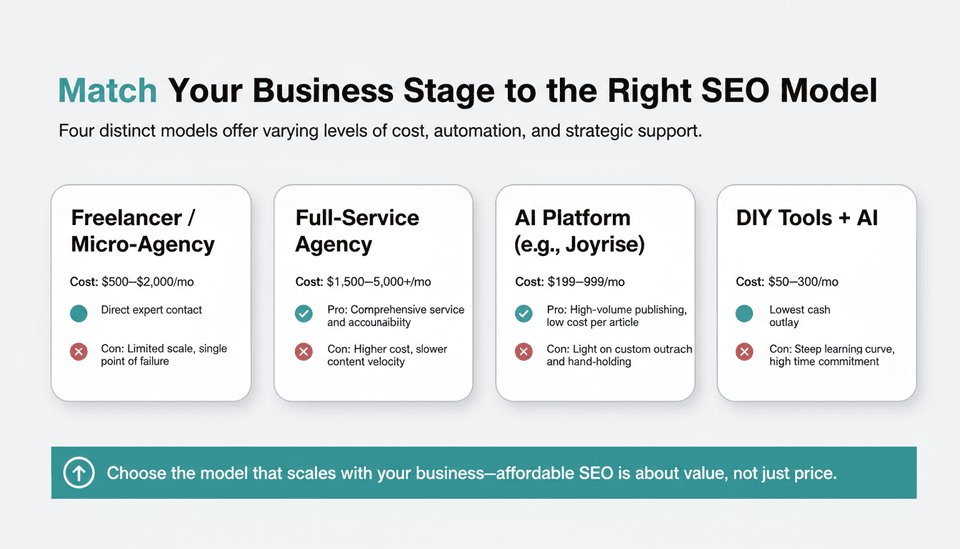
The range of SEO pricing you’ll encounter spans from $299 for basic local packages to $2,500 for comprehensive strategies, as highlighted by industry roundups.
Freelancers and Micro-Agencies
Independent operators typically charge $500–$2,000 per month. They offer direct communication and bespoke strategies, but their capacity is finite. Quality varies enormously, and they rarely have in‑house AI pipelines for content at scale. You’re betting on one person’s judgment.
Full-Service Monthly Retainers
Traditional agencies bundle strategy, content, technical SEO, and link building. Monthly fees often start at $1,500 and climb past $5,000. Many affordable agencies advertise starter packages around $299, but these are usually light on actual content production and heavy on reporting. The value is in experienced hands managing everything—but the price will reflect that.
AI-Powered Content Platforms (e.g., Joyrise)
A newer model: subscription platforms that use AI to plan, write, and publish SEO‑optimized articles directly to your site. Joyrise, for instance, scans your brand voice, builds a keyword plan from competitor gaps, and auto‑publishes daily illustrated posts to Webflow—including meta tags, table of contents, and internal links—starting at $199 per month. This model excels at consistent, high‑volume content production and includes baked‑in SEO features that previously required manual effort. The trade‑off is that you won’t get custom outreach campaigns or hands‑on consulting. But for businesses that need to scale organic traffic without scaling headcount, it’s a category worth looking at.
DIY with Tools and Guidance
You can buy access to tools like Ahrefs, Semrush, or SE Ranking for $50–$150 per month, learn the workflows, and execute everything yourself. The cost is time and a steep learning curve. Pairing tools with an AI writing assistant and a solid SEO workflow process can keep total spend under $300 a month while building a strong foundation—if you have the bandwidth.
Which Model Fits Your Business Stage and Budget?
| Model | Typical Monthly Cost | Best For | AI/GEO Capabilities | Pros | Cons |
|---|---|---|---|---|---|
| Freelancer / Micro‑Agency | $500 – $2,000 | Custom strategy, niche expertise | Varies; rarely automated | Direct expert contact | Limited scale, single point of failure |
| Full‑Service Agency | $1,500 – $5,000+ | Businesses that can invest for full‑spectrum growth | Usually includes some AI tools, GEO as add‑on | Comprehensive service, accountability | Higher cost, slower content velocity |
| AI Platform (e.g., Joyrise) | $199 – $999 | Marketing teams, founders, and SEO managers who need scaled content | Built‑in AI content generation, some GEO through structured data and FAQs | High‑volume publishing, low cost per article | Light on custom outreach, less strategic hand‑holding |
| DIY Tools + AI | $50 – $300 (tools + AI) | Founders with time and willingness to learn | GEO possible if you implement technical optimizations | Lowest cash outlay | Steep learning curve, high time commitment |
A Practical Framework for Choosing an Affordable SEO Provider
Red Flags: What to Avoid in Cheap SEO
Not every low‑cost offer is a bad one, but certain signals almost guarantee wasted money and potential harm to your site. Steer clear of any provider who:
- Guarantees a specific ranking (no one controls Google’s algorithm).
- Offers “thousands of backlinks” from private blog networks.
- Uses generic, unedited AI content with no quality review.
- Fails to explain their process or produce a sample report before you pay.
- Has no evidence of their own organic visibility—if they can’t rank themselves, they can’t rank you.
Evaluating Value: Questions to Ask Before You Pay
Use this five‑point checklist before committing to any affordable search engine optimization service:
- “Show me an example of a site you’ve worked on, and the organic traffic curve over the last 12 months.”
- “Walk me through your content QA process—does a human review every piece before it goes live?”
- “How do you handle technical SEO? Will I get a prioritized punch list?”
- “What’s your approach to GEO—do you optimize for AI answer engines or only for Google?”
- “If I cancel after three months, what assets do I own?”
These questions will quickly separate operators who deliver value from those repackaging free tools with a steep markup.
Calculating Projected ROI and Break-Even Timelines
A rough but useful framework: estimate your average customer lifetime value (LTV), assume a conversion rate from organic traffic (2–3% is common for many B2B and service sites), and project traffic growth based on modest keyword volume improvements. For example, if your LTV is $800, and an affordable SEO plan that costs $500 per month lifts your organic traffic by 400 visitors a month with a 2% conversion rate, that’s eight new customers—$6,400 in revenue against $500 in cost. Break‑even happens in the first month. Even if traffic growth takes four months to materialize, the math often works. The key is tracking those metrics from day one.
Common Myths and Mistakes in Affordable SEO
Myth: “You Can Rank for Free with Just Keywords”
Content is not ranking fuel in isolation. Without technical soundness, a reasonable internal link structure, and some external signals, even the best keyword‑stuffed page won’t rank for competitive terms. Affordable services that only “write content” without addressing the surrounding ecosystem are incomplete.
Mistake: Ignoring Technical Foundation
Many small business SEO efforts launch with content and backlinks while leaving core web vitals in the red, sitemaps broken, or mobile rendering broken. Technical debt does not heal on its own. The cheapest way to avoid disaster is to run a tool like Google Search Console (free) and fix what it flags before pouring money into content. For a deeper guide, Can ChatGPT Do an SEO Audit? explains what you can and can’t automate on the technical side.
Myth: “AI Content Can’t Rank” (Adjudicating the AI Content Debate)
The debate persists because a lot of unedited, zero‑value AI output does fail to rank—and can trigger manual actions if it’s deceptive. However, Google’s guidance focuses on helpfulness and quality, not the tool that produced the text. When an AI‑generated draft is reviewed by a subject‑matter expert, fact‑checked, and structured to serve user intent, it can rank competitively. Some automated platforms, like Joyrise, use a second AI quality judge that rewrites drafts before publishing, essentially auditing content at scale. The verdict: AI content is dangerous when it’s the final product with no oversight; it’s a legitimate, white hat SEO asset when paired with editorial judgment and solid SEO architecture. The myth that all affordable SEO using AI is spam overlooks how the best tools now embed quality controls directly into the pipeline, resulting in legitimate white hat SEO.
Adjudicating the “Cheap = Spam” Stereotype
The idea that any low‑cost SEO service must rely on black‑hat tactics is outdated. Affordable services powered by AI automation can deliver exactly the same on‑page best practices—clean markup, unique research, proper citations—that an expensive agency would, because the cost driver is now software, not labor. When chosen correctly (using the vetting framework above), an affordable, automated service can be fully white hat SEO. The risk isn’t the price point; it’s the lack of a quality gate. Select providers that show you exactly how that gate works.
Step-by-Step: Launching an Affordable SEO Campaign in 30 Days
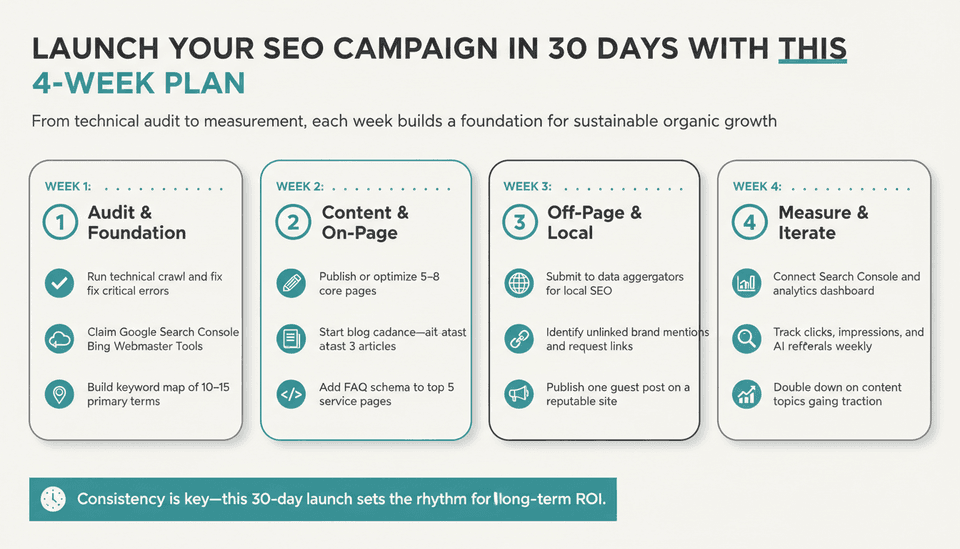
Week 1: Audit and Foundation
Run a full technical crawl (Screaming Frog or Sitebulb), fix critical errors, and claim or verify Google Search Console and Bing Webmaster Tools. Build a keyword map of 10–15 primary terms and their long‑tail variants using free tiers of the top 3 SEO tools in 2026. Ensure your business name, address, and phone (NAP) are identical everywhere online—this is the cheapest GEO win you can get.
Week 2: Content and On-Page Optimization
Based on your keyword map, publish or optimize 5–8 core service or category pages, then start a blog cadence—aim for at least three articles this week. If you’re using an AI platform, configure its keyword planner and brand voice settings. Every piece needs a unique title, an H1, descriptive alt text, and internal links to relevant service pages. This is also the week to add FAQ schema to your top 5 service pages, directly addressing questions that AI answer engines pull.
Week 3: Off-Page and Local Signals
For local SEO, submit your business to the big three data aggregators (Neustar Localeze, Factual, and Data Axle) or use a service like BrightLocal. Claim industry‑specific directories. For non‑local businesses, identify 10–20 unlinked brand mentions and request links, or publish one guest post on a reputable site using a genuinely useful piece of content—not a keyword‑stuffed syndicate article.
Week 4: Measurement and Iteration
Connect Google Search Console and your AI platform’s analytics dashboard (Joyrise users get an integrated Search Console view) to track clicks, impressions, and AI assistant referrals. Compare week‑over‑week changes in indexed pages, average position, and click‑through rate. Adjust your plan: double down on content topics that gain traction, and re‑optimize pages that are stuck at positions 8–12.
Future-Proofing Your Affordable SEO Strategy
Adapting to Algorithm Changes on a Budget
When Google rolls out a core update, affordable SEO suffers not from a lack of talent but from a lack of rapid response. The remedy is to set up automated monitoring for ranking swings using tools like SE Ranking (reasonable cost) and to keep a content inventory that documents what each page serves. This way, when a knowledge graph‑type query suddenly pulls in AI‑generated overviews instead of classic results, you can pivot to AI SEO content optimization that serves both user intent and citation criteria.
When to Scale Up: From Affordable to Aggressive
If organic traffic growth hits a consistent 20–30% month over month, and your cost‑per‑acquisition is well below customer LTV, it’s time to reinvest. That might mean upgrading an AI content platform plan (say, from 30 to 180 articles per month), adding a dedicated freelance link builder, or finally hiring an SEO strategist one day a week. The affordable phase is a launchpad, not a forever state. The decision to scale hinges on one number: when your organic customer acquisition cost stays below 20% of LTV, increase spend until it reaches a comfortable margin.
Frequently Asked Questions About Affordable Search Engine Optimization Services
What is an affordable search engine optimization service?
It’s a service that improves your visibility in search engines and AI answer engines for a cost that’s proportional to the business results it generates, typically using automation and focused scope to keep fees far below full‑service agency rates—often in the $199–$2,000 per month range.
How does SEO work?
SEO works by aligning your website’s technical structure, content, and external reputation with the signals search engines and AI models use to determine relevance and authority. An affordable service amplifies the highest‑impact levers—technical health, keyword‑targeted content, and structured data—without wasting budget on vanity metrics.
Why is SEO still important?
Even in an AI‑search world, organic discovery remains the biggest source of intent‑driven traffic for most businesses. AI answer engines rely on the same underlying content ecosystem; without strong SEO foundations, you’re invisible both on Google and inside ChatGPT.
Which SEO solution is right for my business?
If you need a few strategic articles a month and personal guidance, a freelancer might suffice. If you need to publish daily and track AI citations, an AI‑powered content platform like Joyrise fits. If you have a complex, multi‑location enterprise site, a specialized agency is worth the premium.
How do I know which type of SEO I need?
Map your business goals to the depth of work required. A local bakery needs local SEO, basic technical fixes, and maybe one good blog post a week. A B2B SaaS company targeting competitive terms across multiple buyer personas likely needs a full‑funnel content plan, some link building, and robust analytics. Start small, measure, then decide.
What is the difference between affordable and cheap SEO?
Affordable SEO reduces cost through efficiency—automation, focused scope, smart tooling—and still produces measurable results using white hat SEO methods. Cheap SEO reduces cost by removing quality control, using duplicate content, or buying spam links, leading to algorithmic penalties and no long‑term value.
Can affordable services include AI optimization?
Yes. GEO is increasingly standard in well‑built affordable offerings. Through structured data, consistent business information, and FAQ‑rich content, even a low‑cost platform can increase the chances that AI models cite your business accurately.
How do I measure ROI of affordable SEO?
Track organic traffic, goal completions (leads, sales), and attributed revenue in Google Analytics or your CRM. Compare the cost of the service against the value of conversions driven by organic search. Simple ROI: (Revenue from organic – SEO cost) / SEO cost. True ROI accounts for the lifetime value of acquired customers.
What is GEO and why does it matter?
Generative Engine Optimization is the practice of making your content and data trustworthy and citable by AI models like Gemini and ChatGPT. It matters because these AI interfaces are becoming a primary search entry point—if your business is cited in an AI‑generated answer, you win the click without requiring a traditional blue link.
Can AI content rank?
Yes, when it’s original, reviewed for accuracy, and built to satisfy user intent. Raw, unedited AI output often fails because it lacks depth and freshness. Google has repeatedly stated it evaluates content quality, not the method of creation. The safe path is to treat AI as a drafting engine and apply a human (or second‑AI) review layer.
Next Steps: Getting Started Without Overpaying
Begin with a free technical audit and a one‑page keyword plan. If you can invest in content scale, sign up for a trial of an AI content platform that publishes directly to your site—most offer a no‑commitment period, so you’ll see real performance data before a dollar leaves your account. Choose the provider only after you’ve run through the vetting questions above, and always retain ownership of your content and domains.
Key Takeaways
- Affordable SEO in 2026 means leveraging AI automation to produce high‑quality, white‑hat work at a fraction of traditional agency cost, without ignoring the rise of AI answer engines.
- The line between cheap and affordable is a quality gate: verify exactly how any service or tool reviews and refines output before publishing.
- GEO is no longer optional; even affordable services must optimize structured data and business information for AI citations, or you’ll miss traffic from ChatGPT, Gemini, and similar platforms.
- Your 30‑day launch should pair technical fixes with a sustainable content velocity—start with a real content plan, not a one‑time keyword dump.
- Measure every dollar with a simple ROI model: affordable SEO becomes a growth engine as soon as customer acquisition cost from organic search stays well below lifetime value.
Get started with affordable, white hat SEO by signing up for Joyrise’s AI-powered platform and publishing your first optimized article today.