 Joyrise
7 Accountant SEO Tactics for the AI Age (Ethical & Effective)
 By Alexi · · 15 min read

On this page
- Introduction: Who This List Is For and How We Chose These Tactics
- 1. Launch an AI-Powered Content Engine That Reflects Your Expertise
- 2. Automate Local SEO to Capture ‘Accountant Near Me’ Searches
- 3. Build Topic Authority with Automated Internal Linking
- 4. Use News-Driven Content to Demonstrate Timely Awareness (and Ethics)
- 5. Maintain Freshness by Refreshing Content at Scale
- 6. Track Performance with AI-Driven Dashboards
- 7. Balance AI Automation with Human Strategic Oversight
- Recap: The 7 Tactics at a Glance
- Summary Table: The 7 Tactics, Core Actions, and Key Benefits
- How to Pick the Right Starting Tactics for Your Firm
- Frequently Asked Questions About Accountant SEO
- Key Takeaways
- Sources
Introduction: Who This List Is For and How We Chose These Tactics
In November 2026, South Korea’s tax world erupted when the top scorer on the national tax accountant exam was caught using AI glasses and a hidden camera to cheat (God’s World News, November 17, 2026), a defining moment for accountant seo. The scandal has since spread fear to college entrance exams, where officials now inspect glasses and shirt buttons (U.S. News & World Report, November 16, 2026). For accounting firms, this isn’t just a headline—it’s a signal. AI is now under the compliance microscope, and rightly so. But used transparently and with professional oversight, AI is also the most practical way to build the consistent, authoritative content that Google rewards in an accountant seo strategy. This guide is for firm owners, partners, and finance leads who need to grow organic traffic without sacrificing the integrity clients demand. We selected these seven tactics because they close the gaps no current ranking page addresses: how to automate content ethically, leverage breaking news for SEO authority, and keep a human accountant in the loop as the final gatekeeper. Each tactic is grounded in real platform capabilities—including Joyrise, an automated content marketing platform—and the latest industry news. There’s no theory here, only what works today.
1. Launch an AI-Powered Content Engine That Reflects Your Expertise
Why It Matters
Consistent, high-quality publishing is the baseline of modern SEO for accounting firms. Google’s algorithms reward sites that demonstrate topical authority over time, and nothing builds that authority faster than a steady stream of articles that answer the exact questions your clients type into search. Yet most accounting practices still rely on sporadic blog posts, if any, because manual writing is slow and expensive. AI changes the equation: you can now automate deep site scans that learn your firm’s brand voice, then generate researched, long-form articles with original header images, headings, meta descriptions, tables of contents, and internal links—all without an agency or a writer. This kind of automated content for accountants removes the bottleneck while keeping your domain’s authority growing week after week.
How to Apply It
Choose a platform that automates the entire pipeline, not just text generation. Joyrise, for example, runs a site crawl to understand your services, tone, and audience, then plans a keyword-based editorial calendar. It writes SEO-optimized articles, creates branded illustrations, and publishes directly to Webflow (or saves drafts for your review). For a firm specializing in small business tax, the engine might produce a piece on QBI deductions one day and a guide to entity selection the next—each targeting long-tail keywords competitors overlook. You can start with 30 articles a month on the Basic plan and scale up as you see results. The key is that the output reflects your expertise, not generic tax advice, because the AI learns from your actual site content and service pages. If you’re building the pipeline from scratch, a practical first step is to designate one partner to review the initial batch of AI drafts and refine the custom voice settings.
Internal link: For a deeper dive into setting this up, see how to use AI in SEO to build an automated content pipeline.
2. Automate Local SEO to Capture ‘Accountant Near Me’ Searches
Why It Matters
“Accountant near me” and “CPA in [city]” are among the highest-converting queries in the profession. Someone searching this way already needs a tax preparer or advisor and is ready to act. While foundational local SEO for accountants—Google Business Profile optimization, consistent NAP citations, and review generation—remains critical, most firms still create location pages manually, often with thin, duplicate content. That leaves significant ranking potential on the table, especially for multi-office practices.
How to Apply It
Leverage AI to generate unique, service-rich local landing pages at scale. Feed the tool your office data (address, phone, hours) and target city modifiers. The AI can produce location-specific content, such as “Denver Small Business Tax Services” or “Chicago Estate Planning for Families,” complete with embedded maps, relevant local tax considerations, and contextual internal links. The best systems update these pages when your Google Business Profile details change—no manual edits required. For a five-office firm, this approach can turn one template into five distinct pages that each rank for their own city terms, without duplicating content. Make sure each page passes a human review for location accuracy, especially around state-specific tax rules.
3. Build Topic Authority with Automated Internal Linking
Why It Matters
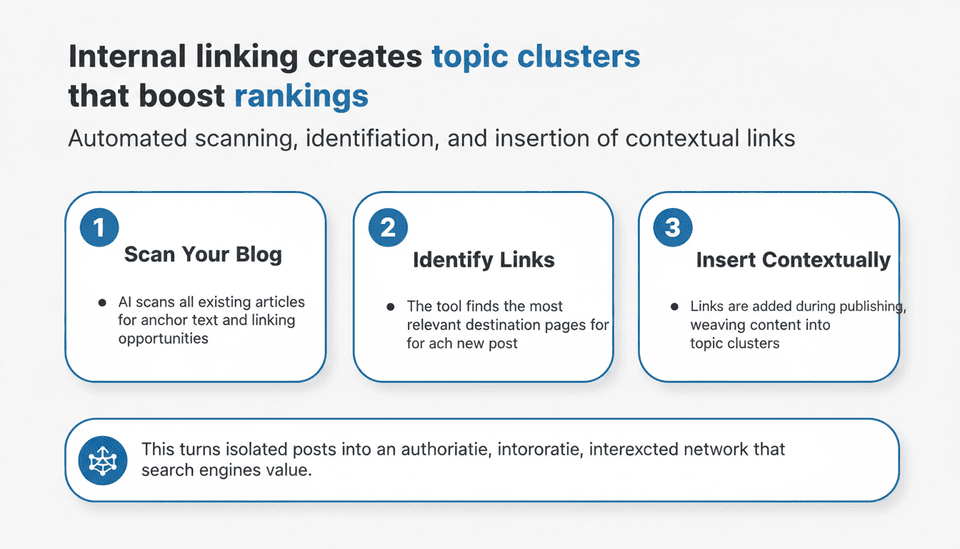
Internal linking SEO is often the most neglected lever in accountant website optimization. When you publish a new article, manually finding and adding links to related posts is tedious, so it rarely happens—yet internal links are how Google understands your site’s topic structure and distributes ranking power. Without deliberate linking, even excellent content can sit orphaned and underperform.
How to Apply It
Adopt a tool that inserts contextual internal links automatically as each piece is published. Joyrise’s platform, for example, scans your entire blog to identify the most relevant anchor text and destination pages, then weaves those links into the new article during the publishing process. If you publish a post about 2026 tax brackets, it will link back to your cornerstone guide on small business tax planning and forward from that guide to the new piece. This technique builds dense topic clusters that signal topical expertise to Google—exactly what earns higher rankings for competitive accounting SEO strategies. Over time, you’ll see that pages connected by six to eight internal links often outperform isolated pages by a significant margin, even without additional backlinks.
Internal link: AI SEO content optimization walks through how automated internal linking and other on-page adjustments work together.
4. Use News-Driven Content to Demonstrate Timely Awareness (and Ethics)
Why It Matters
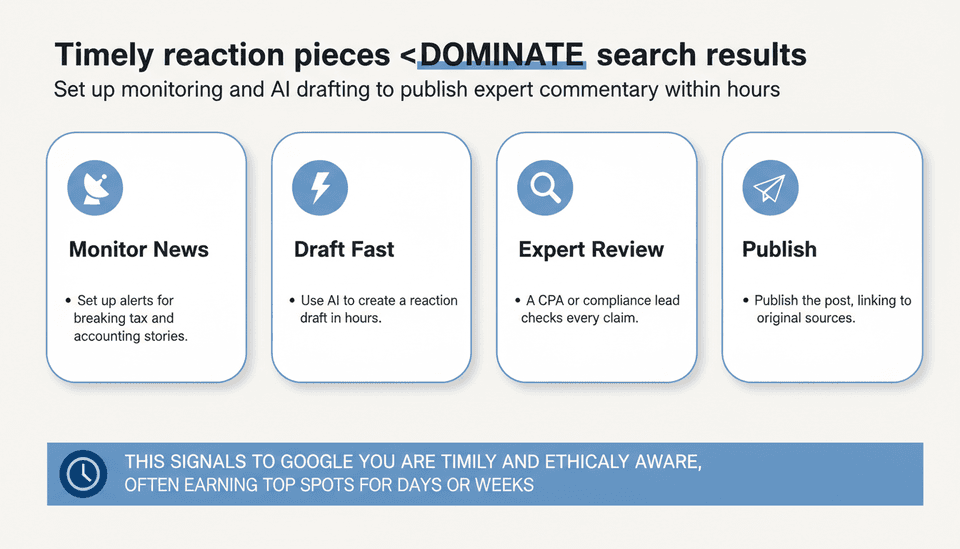
No ranking page teaches accountants how to capitalize on industry news for news-driven SEO. Yet Google’s freshness algorithms reward pages that react quickly to real-world events, and for accounting firms, news coverage is a powerful way to demonstrate both expertise and ethical awareness. The South Korea AI cheating scandal is a perfect catalyst: a tax accountant exam was compromised using AI glasses and a hidden camera, and now college entrance exams face similar scrutiny. This is a story about trust in credentialing—something central to every CPA’s brand.
How to Apply It
Set up a monitoring system (Google Alerts, industry RSS feeds) to catch breaking stories relevant to accounting, tax law, or financial technology. When a story breaks, use an AI writing assistant to draft a reaction piece within hours, not days. For example, you could publish: “What the South Korean AI Cheating Case Means for Your Tax Firm’s Internal Controls.” The post would summarize the news (citing the November 16, 2026 AP report via U.S. News & World Report), then pivot to practical takeaways—how your firm vets remote hires, uses AI ethically in your own workflows, and reinforces client data security. Before publishing, have a CPA or compliance lead review every claim. This ethical SEO for accountants angle not only ranks for trending queries but also signals to prospective clients that you’re on top of the profession’s sharpest debates. Because few firms do this, you’ll often own the top spots for “AI cheating accountant” and related long-tails for days or weeks.
Internal link: See blog post examples you can replicate with AI for templates that fit a news-driven format.
5. Maintain Freshness by Refreshing Content at Scale
Why It Matters
Tax laws, deduction limits, and regulatory thresholds change annually. A post titled “2023 Tax Deduction Guide” not only looks outdated—it also risks harming your site’s credibility and rankings if it’s still indexed for high-volume queries. Google’s algorithms increasingly favor content that is explicitly up-to-date, and a stale blog signals neglect. Yet refreshing old posts manually is a major resource drain for small firms.
How to Apply It
Use an AI-powered content tool to audit your existing library for outdated references, then automatically rewrite those posts with current figures, updated legislation, and fresh internal links. The process can be scheduled: for example, every January, the system revisits all tax-year-specific articles from the prior year, updates figures (e.g., standard deduction amounts, 401(k) contribution limits), and republishes. This keeps pages that already have some authority from decaying in rank. For a practical example, an article originally targeting “small business tax credits 2024” can be refreshed to “small business tax credits 2026” without having to write a new piece from scratch, preserving all earned backlinks and domain trust. The key is ensuring a human reviewer verifies the updated numbers before the post goes live—no AI can yet shoulder sole responsibility for tax accuracy.
6. Track Performance with AI-Driven Dashboards
Why It Matters
Standard Google Search Console reports show clicks and impressions from traditional web search. But with AI summaries now appearing in search results, a portion of your traffic comes from AI assistants citing your content—and that traffic is invisible in ordinary dashboards. If you don’t measure it, you can’t optimize for it. Some platforms now pull in “AI assistant referrals” as a distinct metric, letting you see which of your pages Google’s SGE or other AI systems are using in their answers.
How to Apply It
Connect your Search Console account to a dashboard that surfaces AI-referred traffic alongside your classic organic data. When you see a spike in AI referrals to a particular tax guide, double down on that topic: refresh the content, add expert commentary, and build more internal links into it. This turns a previously hidden signal into a direct content investment signal. Even without a specialized dashboard, you can use regular rank tracking and watch for sudden impressions from informational queries where AI summaries appear—if your page shows up in the “Sources” section of an AI snippet, you’ll often see an impression bump. The principle is simple: if AI cites your accounting content, Google is telling you it’s authoritative. Nurture those pages aggressively.
7. Balance AI Automation with Human Strategic Oversight
Why It Matters
The loudest conflict in the accountant SEO conversation is whether to hire an agency or do it yourself. Some ranking pages assert accountants must hire an agency for effective SEO, while others provide DIY step-by-step instructions. Neither side accounts for AI automation. The right answer in 2026 is not either-or. AI platforms can now handle the volume and consistency that used to require an agency, at a fraction of the cost, but a human accountant must remain the final gatekeeper for accuracy, ethics, and tone. The AI cheating scandal only reinforces this: using AI without oversight erodes the trust that is the foundation of your practice.
How to Apply It
Adopt an AI content platform that lets you review drafts before publication—Joyrise, for instance, can save articles as drafts for approval. Then, implement a simple Ethical AI Content Checklist for Accountants that every piece must clear before it goes live:
- Every tax number, deduction, or legal claim verified by a licensed CPA.
- No fabricated client results, anonymous testimonials, or unverifiable performance claims.
- If AI assistance was used for the draft, the final version has been validated by a human expert (explicit disclosure in the content is optional but builds trust).
- News-driven posts include proper source attribution (date, publication, and a link back to the original report).
- All statements about your firm’s services or credentials match your actual qualifications and regulatory standing.
This checklist is not just for ethics; it’s also protective against the reputational risk that the South Korean scandal made undeniable. When you combine AI’s scale with this human sanity check, you get the best Google ranking for CPAs without ever being the firm that published an embarrassing AI error. The trade-off is speed: you might publish a few hours later than fully automated systems, but the credibility you keep is worth far more than a rushed post.
Recap: The 7 Tactics at a Glance
- AI-Powered Content Engine: Automate daily publishing of expertise-rich articles to build domain authority.
- Automate Local SEO: Generate location-specific pages to win high-intent nearby searches.
- Automated Internal Linking: Let AI connect your content into tight topic clusters without manual work.
- News-Driven Content: Publish fast, relevant reaction pieces to demonstrate timely awareness and ethics.
- Content Freshness at Scale: Refresh old posts with current numbers to keep rankings and credibility.
- AI-Driven Dashboards: Track AI-referred traffic and double down on what AI cites.
- Human Oversight Balance: Run every AI output through a CPA-powered ethics checklist before publishing.
Summary Table: The 7 Tactics, Core Actions, and Key Benefits
| Tactic | Core Action | Key Benefit |
|---|---|---|
| 1. AI Content Engine | Set up an automated pipeline that writes and publishes daily | Establishes consistent topical authority for accountant SEO |
| 2. Automate Local SEO | Use AI to create unique location pages at scale | Captures “near me” queries across multiple offices |
| 3. Automated Internal Linking | Implement a tool that inserts contextual links in every post | Strengthens topic clusters and improves crawl depth |
| 4. News-Driven Content | Draft and publish reaction pieces within 24 hours of breaking news | Ranks for trending queries and shows ethical awareness |
| 5. Content Freshness | Schedule AI rewrites of outdated posts with updated year and laws | Preserves existing rankings and user trust |
| 6. AI-Driven Dashboards | Monitor AI assistant referrals alongside organic clicks | Reveals which content Google’s AI uses, guiding investment |
| 7. Human Oversight | Enforce a CPA-review checklist for every piece | Prevents errors and upholds professional ethics |
How to Pick the Right Starting Tactics for Your Firm
Start with the tactic that addresses your biggest bottleneck. If your blog is empty or updated only twice a year, deploy Tactic 1 immediately—a steady content engine is the foundation of everything else. If you already have content but it’s poorly linked, Tactic 3 (internal linking) will yield a faster ranking lift than writing entirely new posts. Multi-office firms get near-instant value from Tactic 2 (local SEO automation), while solo practitioners who dominate a single city can postpone it. Tactic 4 (news-driven content) is ideal for firms with a partner who enjoys commenting on industry events—it lets that personality shine while feeding SEO. And if your site has been live for years, Tactic 5 (freshness) can recover rankings without a new content creation push. Finally, apply Tactic 7’s oversight checklist to everything you publish, regardless of which other tactics you use. No AI tactic works without an accountant’s final say.
Frequently Asked Questions About Accountant SEO
What is SEO for accountants?
SEO for accountants is the practice of optimizing an accounting firm’s website and online presence so it appears prominently in Google when potential clients search for tax services, bookkeeping, small business advising, or related queries. It combines technical site improvements, local visibility, and authoritative content that answers searchers’ real questions.
Why does SEO matter for accounting firms?
Most people looking for an accountant start with an online search—often a commercial query like “CPA near me” or “best tax preparer for freelancers.” If your firm isn’t on page one, you’re invisible to that prospective client. SEO captures demand at the moment it exists, making it a more cost-effective long-term client acquisition channel than traditional advertising or networking alone. As the Webtonic 2026 playbook notes, many accounting firms still rely heavily on referrals, leaving a wide open field for those who invest in search visibility.
How can I improve my local SEO as an accountant?
Start with a fully optimized Google Business Profile (correct categories, services, photos, and a steady flow of reviews). Ensure your name, address, and phone number are identical across all online directories. Then, move beyond those basics by generating location-specific pages on your website—each targeting a service area you actually serve. AI tools can now help you create and maintain these pages without duplicating content, which is the biggest risk in manual local SEO.
Do I need more content on my accounting firm's website?
Yes, almost certainly. Content is how you rank for long-tail questions like “how to deduct a home office in 2026” or “S corp vs. LLC tax implications.” Each article is a new doorway for a searcher to find you. But the volume has to be sustainable. That’s where AI for accounting marketing becomes practical: an automated content platform can produce the daily or weekly articles that a marketing manager never could, while you focus on review and accuracy.
How can link building benefit my accounting firm?
Backlinks from reputable sites—local chambers of commerce, industry publications, or partner businesses—act as votes of confidence to Google. They raise your domain authority, making all your pages rank better. But link building is slow and often requires outreach. Content that earns links naturally by being useful (guides, stats, original takes) is the most ethical and durable path. Automated internal linking, as covered in Tactic 3, also helps distribute that authority once you’ve earned it.
Can I do SEO myself or should I hire an agency?
This is the core conflict. Agency-led SEO provides expertise but is expensive and often not transparent. DIY SEO demands time you don’t have. Our adjudicated position: AI automation now makes it feasible to handle the content engine and many technical elements in-house, shattering the old pay-an-agency-or-do-nothing binary. Use an AI platform for the heavy lifting—planning, writing, internal linking, publishing—while allocating a few hours a month of a partner’s or manager’s time for strategic review and the ethics checklist. For highly specialized international tax practices, an agency may still add unique value, but for most local and regional firms, AI plus in-house oversight is the best blend of cost and control.
What role does AI play in accounting SEO?
AI now powers every step from keyword research and content creation to internal linking and performance monitoring. It can learn your firm’s specific voice, generate 30–180 SEO-optimized articles a month, and even draft pieces tuned to breaking news. The role is to replace rote manual work, not human judgment. As the South Korea cheating scandal shows, AI without oversight is a liability; harnessed with a CPA’s final review, it’s the only scalable way to sustain an ethical SEO for accountants program.
How do I start with SEO for my accounting practice?
Start with a technical site audit (speed, mobile-friendliness, schema markup) and a properly filled Google Business Profile. Then, commit to a consistent publishing rhythm. The quickest way to do that without hiring is to set up an AI content platform like Joyrise that handles the planning, writing, and publishing while you approve drafts. Free up a few hours in the partner group for weekly oversight. From there, layer on local pages and internal linking as you see early traction.
Is using AI for marketing ethical after the recent cheating scandals?
Absolutely, provided you adopt the transparency and verification practices outlined in Tactic 7. The South Korean case (November 2026) involved deliberate deception to cheat an exam. Marketing, by contrast, is about informing and attracting clients with genuine information. The ethical line is clear: never publish AI-drafted content without a qualified accountant’s review, attribute news sources, and avoid any suggestion of fabricated credentials or results. Used this way, AI is no different from a paralegal researching a memo—it accelerates work but does not replace professional responsibility.
How do I track if my AI-generated content is performing?
Go beyond generic traffic numbers. Use a dashboard that separates AI-referred traffic from standard organic search, as some advanced platforms now offer. Monitor which posts earn AI citations, and which queries drive those clicks. Tracking ranked keywords over time, along with impressions from Search Console, gives you a clear picture. If a tax guide starts generating AI assistant traffic, you know the content is being seen as authoritative—then double down on refreshing and linking to it.
Key Takeaways
- AI automation, when coupled with a CPA’s final review, lets accounting firms publish consistent, SEO-optimized content without an agency’s cost or a DIY time drain.
- Automating local landing pages, internal links, and content refreshes directly addresses the biggest gaps in typical accountant websites.
- Leveraging breaking news like the South Korean AI cheating scandal produces timely, ethical content that other firms ignore—earning rankings and trust.
- Tracking AI-referred traffic is the new frontier; pages that Google’s AI cites should get the most investment.
- An AI platform is not a replacement for professional oversight; it’s a tool that makes human oversight the only bottleneck, not the writing itself.
Start pairing ethical AI with your firm’s deep expertise to build an SEO presence that reflects the trust your clients expect—see how Joyrise turns that into a daily publishing reality.